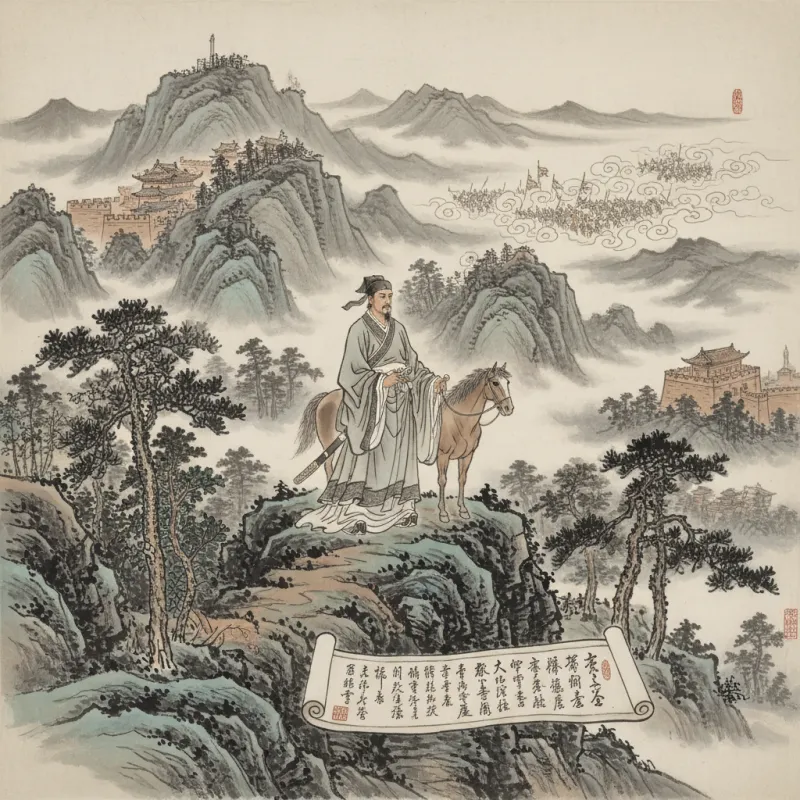
Xin Qiji: The Warrior Poet of the Southern Song
⏱️ 23 min read📅 Updated April 06, 2026⏱️ 22 min read📅 Updated April 06, 2026Xin Qiji: The Warrior Poet of the Southern Song
Introduction: A Poet Forged in Battle
Among the pantheon of Chinese literary giants, few figures embody such dramatic contradictions as Xin Qiji (辛弃疾, Xīn Qìjí, 1140-1207). While most Song Dynasty poets cultivated their craft in the refined atmosphere of imperial courts or tranquil mountain retreats, Xin forged his poetic voice on battlefields and in the bitter frustration of political exile. He stands as the supreme master of the ci (词, cí) form—lyric poetry set to music—transforming what had been primarily a vehicle for romantic sentiment into a powerful medium for expressing patriotic fervor, military ambition, and profound disillusionment.
Born during one of China's most turbulent periods, when the Jurchen Jin Dynasty had conquered northern China and driven the Song court south, Xin Qiji spent his youth under foreign occupation. This experience would define both his life and his poetry, infusing his work with an intensity and martial spirit unprecedented in Chinese lyric verse.
The Making of a Warrior
Xin Qiji's early life reads like an adventure novel. Born in Jinan (济南, Jǐnán) in present-day Shandong Province, he grew up in Jin-occupied territory, never forgetting that he was a subject of the Song Dynasty living under foreign rule. At the age of twenty-one, when a local resistance leader named Geng Jing (耿京, Gěng Jīng) raised an army against the Jin, Xin joined with enthusiasm, quickly rising to become one of Geng's trusted advisors.
The defining moment of Xin's military career came in 1162. When a traitor named Zhang Anguo (张安国, Zhāng Ānguó) murdered Geng Jing and defected to the Jin with the rebel army's seal, Xin took decisive action. Leading a mere fifty cavalry, he rode deep into enemy territory, infiltrated a Jin military camp of fifty thousand soldiers, captured the traitor, and brought him back to the Southern Song capital for execution. This audacious feat earned him immediate fame and an official position in the Song government.
Yet this would be the apex of Xin's military career. The Southern Song court, dominated by officials who favored appeasement over confrontation with the Jin, had little use for a firebrand warrior who constantly advocated for northern campaigns to recover lost territory. For the next forty years, Xin would serve in various provincial administrative posts, his military talents largely wasted, his proposals for reconquest repeatedly ignored.
Revolutionary Innovations in Ci Poetry
Before Xin Qiji, the ci form was largely associated with the wanyue pai (婉约派, wǎnyuē pài)—the "Graceful and Restrained School"—exemplified by poets like Li Qingzhao (李清照, Lǐ Qīngzhào). These poems typically explored themes of romantic love, feminine beauty, and melancholic separation, employing delicate imagery and refined language.
Xin Qiji shattered these conventions. He became the leading figure of the haofang pai (豪放派, háofàng pài)—the "Heroic and Unrestrained School"—alongside Su Shi (苏轼, Sū Shì). Where traditional ci whispered, Xin's poetry roared. He imported the grand themes, historical allusions, and masculine vigor of shi (诗, shī) poetry—the classical verse form—into the ci structure, creating works of unprecedented power and scope.
Consider his famous piece "Broken Array: Composed for Chen Tongfu" (《破阵子·为陈同甫赋壮词以寄之》, Pòzhènzǐ: Wèi Chén Tóngfǔ Fù Zhuàngcí Yǐ Jì Zhī):
醉里挑灯看剑,梦回吹角连营。 Zuì lǐ tiāo dēng kàn jiàn, mèng huí chuī jiǎo lián yíng. Drunk, I trim the lamp to examine my sword; dreaming, I return to camps linked by bugle calls.
八百里分麾下炙,五十弦翻塞外声。 Bābǎi lǐ fēn huī xià zhì, wǔshí xián fān sàiwài shēng. Eight hundred li of roasted meat distributed to troops under my command; fifty-stringed instruments playing frontier tunes.
沙场秋点兵。 Shāchǎng qiū diǎn bīng. On the autumn battlefield, reviewing the troops.
The imagery here—examining weapons while drunk, military camps, roasted meat for soldiers, battlefield inspections—was revolutionary for ci poetry. Yet the poem's devastating conclusion reveals the gulf between dream and reality:
可怜白发生! Kělián báifà shēng! Pitiful that white hairs have grown!
This final line transforms the entire poem. All the martial glory exists only in dreams and drunken fantasies. The poet has grown old without ever leading the northern campaign he yearned for.
Themes of Frustrated Ambition
The tension between heroic aspiration and bitter reality permeates Xin Qiji's work. His poetry returns obsessively to historical heroes and military campaigns, drawing parallels between past glories and present failures. He frequently invokes figures like Huo Qubing (霍去病, Huò Qùbìng), the Han Dynasty general who defeated the Xiongnu, or Liu Yu (刘裕, Liú Yù), who recovered lost territory and founded the Liu Song Dynasty.
In "Eternal Happiness: Reminiscing at Beigu Pavilion in Jingkou" (《永遇乐·京口北固亭怀古》, Yǒngyùlè: Jīngkǒu Běigù Tíng Huáigǔ), written when he was sixty-five, Xin reflects on the site where Liu Yu once trained his troops:
千古江山,英雄无觅孙仲谋处。 Qiāngǔ jiāngshān, yīngxióng wú mì Sūn Zhòngmóu chù. Through the ages, these rivers and mountains—where can we find a hero like Sun Quan?
舞榭歌台,风流总被雨打风吹去。 Wǔxiè gētái, fēngliú zǒng bèi yǔ dǎ fēng chuī qù. Dance pavilions and singing terraces—all that elegance has been blown away by wind and rain.
The poem moves through various historical references, each highlighting the contrast between past military success and present inaction. The work concludes with a warning against rash military action, referencing Emperor Wu of the Northern Wei's disastrous southern campaign. Yet even this caution is tinged with irony—Xin spent his life advocating for military action that never came, and now warns against the very rashness he embodied.
Mastery of Imagery and Allusion
Xin Qiji's poetry demonstrates extraordinary technical virtuosity. He employed the full range of ci tune patterns, from short lyric forms to extended compositions, and filled them with dense networks of historical and literary allusions. His imagery draws from military life, nature, history, and everyday experience with equal facility.
In "Qingpingle: Village Dwelling" (《清平乐·村居》, Qīngpínglè: Cūnjū), he demonstrates his ability to capture intimate domestic scenes with the same skill he brought to battlefield visions:
茅檐低小,溪上青青草。 Máoyán dī xiǎo, xī shàng qīngqīng cǎo. The thatched eaves are low and small; by the stream, the grass grows green.
醉里吴音相媚好,白发谁家翁媪? Zuì lǐ Wú yīn xiāng mèi hǎo, báifà shuí jiā wēng ǎo? Drunk, speaking Wu dialect, they charm each other—whose white-haired old couple is this?
This gentle scene of rural contentment stands in stark contrast to his martial poems, revealing the breadth of his poetic range. Yet even here, the mention of white hair subtly echoes his larger themes of aging and unfulfilled dreams.
The Pain of Political Marginalization
Xin Qiji's career was marked by repeated dismissals, demotions, and long periods of forced retirement. His outspoken advocacy for military action and his criticism of court policies made him enemies among the powerful. He spent nearly twenty years in various forms of political exile, living on his estate and watching his proposals gather dust.
This experience of huaicai buru (怀才不遇, huáicái bùyù)—possessing talent but lacking opportunity to use it—became a central theme in his work. In "Congratulating the Bridegroom" (《贺新郎》, Hèxīnláng), he writes:
老大那堪说! Lǎodà nà kān shuō! Growing old—how can I bear to speak of it!
似而今、元龙臭味,孟公瓜葛。 Sì ér jīn, Yuán Lóng chòuwèi, Mèng Gōng guāgé. Like Chen Deng and Xu Mian of old, sharing the same temperament and connections.
The historical references here point to talented men whose abilities were wasted by their times, creating a community of frustrated heroes across the centuries.
Nature and Philosophical Reflection
Despite his martial reputation, Xin Qiji also produced numerous poems celebrating natural beauty and exploring philosophical themes. During his years of retirement, he developed a deep appreciation for rural life and the consolations of nature.
In "Xijiang Moon: Night Walk on Huangsha Road" (《西江月·夜行黄沙道中》, Xījiāngyuè: Yèxíng Huángshā Dào Zhōng), he captures a summer night's journey:
明月别枝惊鹊,清风半夜鸣蝉。 Míngyuè bié zhī jīng què, qīngfēng bànyè míng chán. The bright moon startles magpies from their branches; the clear breeze at midnight stirs cicadas' song.
稻花香里说丰年,听取蛙声一片。 Dàohuā xiāng lǐ shuō fēngnián, tīng qǔ wā shēng yí piàn. In the fragrance of rice flowers, they speak of a good harvest; listen to the chorus of frogs.
These lines demonstrate Xin's ability to evoke sensory experience—sight, sound, and smell—creating an immersive natural scene. Yet even in such peaceful moments, the mention of harvest and abundance may carry political undertones, suggesting the prosperity that proper governance could bring.
Legacy and Influence
Xin Qiji left behind over six hundred ci poems, more than any other Song Dynasty poet. His influence on Chinese literature proved immense and enduring. He demonstrated that the ci form could handle any subject matter and emotional register, from intimate personal reflection to grand historical meditation.
Later poets and critics consistently ranked him alongside Su Shi as the twin peaks of the Heroic and Unrestrained School. The phrase "Su Xin" (苏辛, Sū Xīn) became shorthand for this bold, expansive approach to ci poetry. His work inspired countless later poets, particularly during periods of national crisis when his patriotic fervor resonated with contemporary concerns.
The Qing Dynasty critic Liu Xizai (刘熙载, Liú Xīzǎi) wrote: "Xin Qiji's ci is like a galloping horse, like a soaring dragon—nothing can restrain it." This captures the essential quality of Xin's poetry: its irrepressible energy and refusal to be confined by convention.
Conclusion: The Eternal Warrior
Xin Qiji never achieved his dream of leading armies north to recover lost territory. He died at sixty-eight, having spent most of his adult life in political frustration. Yet through his poetry, he achieved a different kind of immortality. His verses continue to inspire readers with their passionate intensity, technical brilliance, and profound humanity.
What makes Xin Qiji's poetry enduringly powerful is not merely its martial vigor but its emotional complexity. Behind the battlefield imagery and historical allusions lies a deeply human story of ambition thwarted, talent wasted, and dreams deferred. His work captures the tragedy of the capable person living in incapable times, the warrior forced to fight only with words.
In this sense, Xin Qiji represents something universal: the struggle between aspiration and reality, between what we wish to accomplish and what circumstances permit. His poetry transforms personal frustration into art of lasting significance, proving that sometimes the pen truly is mightier than the sword—not because it wins battles, but because it wins immortality.
The warrior who captured a traitor from an army of fifty thousand could not capture the northern territories for his dynasty. But the poet who channeled his frustration into verse captured something more enduring: the hearts and minds of readers across eight centuries, making Xin Qiji not just a warrior poet, but a poet whose words continue to fight long after the battles of his age have faded into history.
About the Author
Poetry Scholar — A translator and literary scholar focused on Tang and Song dynasty poetry, exploring how classical Chinese verse speaks to modern readers.
Related Articles
Li Qingzhao: China Greatest Female Poet
China Greatest Female Poet...
Lu You: The Patriotic Poet Who Never Forgot His Country
The Patriotic Poet Who Never Forgot His Country...
Ouyang Xiu: The Literary Reformer of the Song Dynasty
The Literary Reformer of the Song Dynasty...
Su Shi (Su Dongpo): The Renaissance Man of Song Dynasty
The Renaissance Man of Song Dynasty...