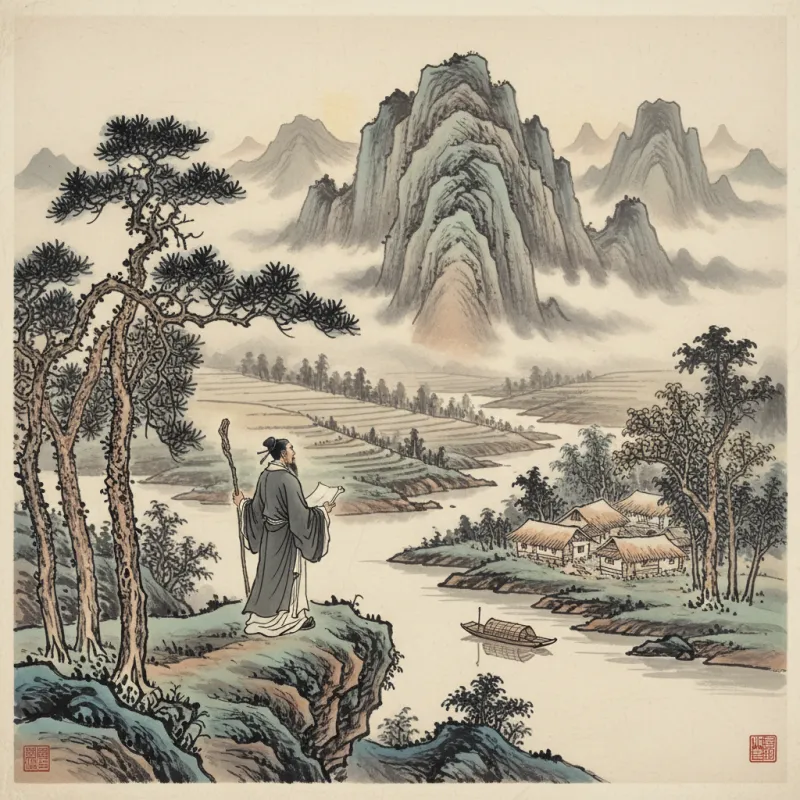
When Li Bai (李白, Lǐ Bái) drunkenly penned verses to the moon while floating in a boat, he wasn't just writing poetry—he was crystallizing an entire philosophy of existence into twenty-eight characters. This is the magic of Chinese classical poetry: worlds compressed into syllables, lifetimes distilled into couplets. The poets of the Tang, Song, and Yuan dynasties didn't merely describe their world; they created linguistic architectures so precise that a single character could bear the weight of an entire season's longing.
The Tang Revolution: When Poetry Became the Language of Power
The Tang dynasty (618-907) transformed poetry from courtly entertainment into the very currency of political and social life. To pass the imperial examinations—the gateway to bureaucratic power—you had to master lüshi (律詩, regulated verse), with its exacting tonal patterns and structural symmetry. This wasn't arbitrary formalism; it was a test of mental discipline that mirrored the order expected in governance.
Li Bai and Du Fu (杜甫, Dù Fǔ) represent the twin poles of Tang poetic genius. Li Bai, the "Immortal of Poetry," wrote with wine-soaked spontaneity, his verses cascading like the waterfalls he loved to describe. His "Quiet Night Thought" (Jìng Yè Sī, 靜夜思) remains so embedded in Chinese consciousness that children recite it before they can write. Du Fu, by contrast, was the "Poet-Sage" whose compassion for common suffering during the An Lushan Rebellion (755-763) elevated social realism to high art. His "Spring View" (Chūn Wàng, 春望)—"The nation shattered, mountains and rivers remain"—captures how landscape endures while dynasties crumble.
But the Tang's greatest innovation was the jueju (絕句, quatrain), a four-line form that demanded absolute economy. Wang Wei (王維, Wáng Wéi) perfected this minimalism, creating what later critics called "poetry within painting, painting within poetry." His Buddhist-influenced verses on seasonal transitions and natural cycles achieved a stillness that paradoxically vibrates with life.
Song Refinement: The Inward Turn
The Song dynasty (960-1279) inherited Tang's poetic vocabulary but spoke it with a different accent—more introspective, psychologically nuanced, domestically focused. The ci (詞, lyric poetry) form, originally song lyrics set to popular tunes, became the vehicle for this new sensibility. Unlike the rigid structures of Tang lüshi, ci followed the melodic patterns of specific tunes, creating irregular line lengths that could mirror the rhythms of thought itself.
Su Shi (蘇軾, Sū Shì), known as Su Dongpo, embodied Song's philosophical breadth. Exiled multiple times for political reasons, he transformed personal adversity into universal meditation. His "Prelude to Water Melody" (Shuǐ Diào Gē Tóu, 水調歌頭), written during the Mid-Autumn Festival while separated from his brother, asks the moon: "When will the moon be clear and bright?" The poem's conclusion—that we should wish for "long life and shared moonlight across a thousand miles"—became the definitive expression of Chinese longing across distance.
Li Qingzhao (李清照, Lǐ Qīngzhào), the preeminent female poet of the era, brought unprecedented emotional directness to ci. Her early works sparkle with youthful playfulness, but after the Jin invasion forced her south and her husband died, her poetry darkened into something almost unbearably poignant. "Searching and searching, cold and desolate, miserable and mournful"—the opening of her "Slow Slow Song" (Shēng Shēng Màn, 聲聲慢) uses fourteen characters of overlapping sounds to create a sonic landscape of grief.
The Song poets also pioneered what we might call "poetry of small things." Jiang Kui (姜夔, Jiāng Kuí) could devote an entire ci to the angle of plum blossoms against snow. This wasn't escapism but a philosophical stance: in a world of political instability, the precise observation of beauty became an act of resistance against chaos.
Yuan Complexity: Poetry Under Foreign Rule
The Yuan dynasty (1271-1368), established by Mongol conquerors, created a peculiar cultural situation. The traditional path to power through poetry and examinations was largely closed to Han Chinese scholars, yet this very marginalization produced unexpected literary fruits. Many educated Chinese turned to sanqu (散曲, free verse), a more colloquial form that borrowed from folk songs and theatrical traditions.
Ma Zhiyuan (馬致遠, Mǎ Zhìyuǎn) wrote what might be the most famous sanqu in Chinese literature: "Autumn Thoughts" (Tiān Jìng Shā · Qiū Sī, 天淨沙·秋思). In just twenty-eight characters, he creates a complete emotional landscape: "Withered vines, old trees, evening crows / Small bridge, flowing water, someone's home / Ancient road, west wind, lean horse / Sunset in the west / A heartbroken person at the edge of the world." Notice how he lists images without explicit connection—the reader's mind supplies the emotional links, making the loneliness more acute.
Yuan poets also developed a self-conscious relationship with their Tang and Song predecessors. They wrote with the weight of tradition pressing down, sometimes playfully subverting classical forms, sometimes attempting to recapture lost glories. This anxiety of influence produced poetry that was often more intellectually complex, layered with allusions that assumed deep literary knowledge in readers.
The Architecture of Feeling: How Form Shapes Meaning
What makes Chinese classical poetry uniquely powerful is the inseparability of form and content. The tonal patterns of lüshi—alternating level and oblique tones in prescribed positions—aren't decorative but structural. They create a musical architecture that reinforces semantic meaning. When Du Fu writes about the chaos of war, the regulated form itself becomes ironic, a reminder of the order that's been lost.
The parallelism required in lüshi couplets forces poets to think in balanced oppositions: near/far, old/new, movement/stillness. This isn't just aesthetic preference but reflects deeper Chinese philosophical concepts of complementary forces. When Wang Wei writes "The desert is vast, smoke rises straight / The long river sets, the sun is round," the parallel structure embodies the harmony he perceives in nature.
Character choice matters profoundly in a language where each syllable is a semantic unit. Classical Chinese poetry exploits this density ruthlessly. A single character can function as noun, verb, and adjective depending on context, creating ambiguities that English translation can only approximate. The famous debate over whether a character in one of Wang Wei's poems means "return" or "look back" isn't pedantic—it changes the entire emotional trajectory of the verse.
Seasonal Consciousness: The Rhythm of Natural Time
Chinese classical poetry is saturated with seasonal awareness in ways that go beyond mere description. Each season carries specific emotional and philosophical associations codified over centuries. Spring brings renewal but also the melancholy of transience—blossoms fall almost as soon as they bloom. Autumn is the season of parting and decline, yet also of harvest and clarity. Understanding these seasonal frameworks is essential to reading the poetry deeply.
The poets developed an elaborate vocabulary of seasonal markers: certain flowers, birds, weather patterns, agricultural activities. When Li Bai mentions "falling petals," educated readers immediately understand this signals spring's end and triggers associations with youth's passing. When Du Fu describes "autumn wind," it carries centuries of accumulated meaning about separation and aging.
This seasonal consciousness wasn't decorative but philosophical. The cyclical nature of seasons offered comfort against the linear tragedy of individual human life. If spring always returns, perhaps there's hope even in winter's depths. The Song poet Yang Wanli (楊萬里, Yáng Wànlǐ) specialized in finding unexpected joy in seasonal transitions, his poems celebrating the precise moment when one season yields to another.
The Living Tradition: Why These Poems Still Matter
These aren't museum pieces. Chinese classical poetry remains vibrantly alive in contemporary Chinese culture in ways that, say, Chaucer doesn't in English-speaking countries. People still quote Li Bai at dinner parties, still use Du Fu's phrases in everyday conversation, still set Song ci to modern music. The poems have become part of the language itself, their phrases woven into the fabric of how Chinese speakers express emotion.
Part of this endurance comes from the poems' compression. Because they're short and structurally memorable, they lodge in memory easily. But more importantly, they articulated fundamental human experiences—longing, loss, joy, wonder—with such precision that later generations keep returning to them, finding their own feelings reflected in verses written a millennium ago.
The Tang, Song, and Yuan poets created a vocabulary of interiority that Chinese culture still uses to understand itself. When modern Chinese people feel lonely, they might think of Ma Zhiyuan's traveler at the edge of the world. When separated from loved ones, Su Shi's moon poem provides the words. This isn't nostalgia but recognition: these poets mapped the human heart with such accuracy that their charts remain reliable guides.
Reading Across the Centuries
To read Chinese classical poetry well requires patience with ambiguity and comfort with multiple simultaneous meanings. A single poem might work on literal, allegorical, and philosophical levels at once. The surface describes a landscape; the subtext addresses political corruption; the deep structure meditates on Buddhist emptiness. All three readings are valid, even necessary.
It also requires understanding that translation inevitably loses the music. When you read Li Bai in English, you're reading a shadow of the original—the tonal patterns gone, the character ambiguities resolved, the cultural resonances explained in footnotes. This doesn't mean translation is worthless, but it means approaching these poems with humility, recognizing that something essential remains just beyond reach.
Yet even in translation, the power comes through. The precision of observation, the emotional honesty, the philosophical depth—these transcend language barriers. When Li Qingzhao writes about searching for something she can't name, when Du Fu describes refugees fleeing war, when Wang Wei captures the silence of mountains at dusk, they're speaking to experiences that remain fundamentally human across time and culture. The forms may be distinctly Chinese, but the feelings are universal.
Related Reading
- Tao Yuanming: The Recluse Who Found Paradise
- The Four Great Classical Novels of Chinese Literature
- Friendship and Farewell: Poems of Parting
Explore Chinese Culture
- Explore the Tang dynasty's golden age
- Explore Daoist themes in classical poetry
- Explore Chinese literary traditions