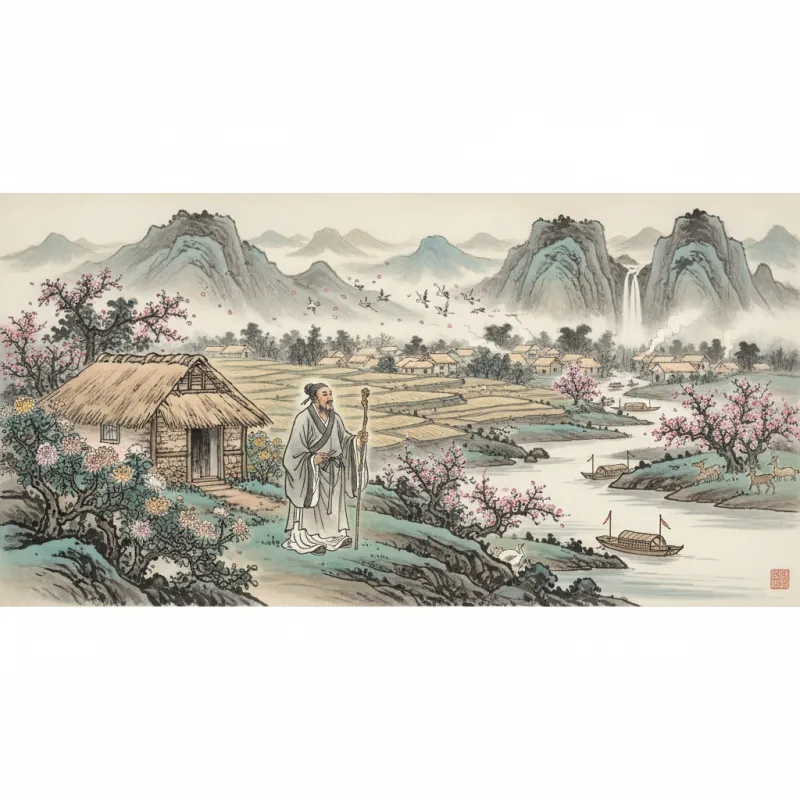
Picture this: a middle-aged bureaucrat storms out of his government office, rips off his official sash, and declares he won't "bow and scrape for five pecks of rice." That bureaucrat was Tao Yuanming (陶淵明, Táo Yuānmíng, 365–427 CE), and his dramatic resignation after just 83 days as a county magistrate would make him the most influential dropout in Chinese literary history. While his contemporaries scrambled up the ladder of officialdom, Tao walked away to plant beans at the foot of the southern mountain—and in doing so, created a template for authenticity that poets would chase for the next 1,600 years.
The Man Who Quit
Tao Yuanming wasn't born a recluse. His great-grandfather was a distinguished general, and despite his family's declining fortunes, young Tao harbored the same ambitions as any educated man of the Eastern Jin dynasty: pass the exams, serve the state, bring honor to the family name. He tried. Five times he took minor official posts, and five times he quit, each stint shorter than the last. The final straw came in 405 CE when, as magistrate of Pengze County, he was told to dress up and grovel before a visiting inspector. His response? "I cannot bow like a servant for five pecks of rice"—the meager salary of his position.
What makes Tao remarkable isn't just that he quit, but that he meant it. He went home to his tumbledown cottage, his weedy fields, and his wine jug, and he stayed there. No dramatic hermit posturing in the mountains, no strategic retreats waiting for a better political climate. Just a man, his family, genuine poverty, and an unshakeable conviction that a life of integrity beat a life of compromise.
The Poetry of Ordinary Things
Tao's poems read like nothing else in the classical Chinese canon. While court poets were crafting elaborate parallel couplets about palace banquets and imperial hunts, Tao wrote about pulling weeds, drinking bad wine, and watching clouds drift over his bean field. His most famous line—"I pluck chrysanthemums by the eastern fence, and gaze afar toward the southern mountain" (采菊東籬下,悠然見南山, cǎi jú dōng lí xià, yōu rán jiàn nán shān)—captures his entire aesthetic: simple action, natural observation, and that untranslatable word youran (悠然), meaning something like "leisurely," "carefree," "at ease with the universe."
His "Drinking Wine" series (飲酒, Yǐn Jiǔ) contains twenty poems that are essentially philosophical meditations disguised as casual drinking songs. In one, he writes: "I built my hut in a zone of human habitation, yet near me there is no noise of horse or carriage." How is this possible? "When the heart is distant, the place itself grows remote." This isn't escapism—it's a radical reorientation of what matters. Tao discovered that paradise isn't a place you find; it's a way of seeing.
The Peach Blossom Spring
If you want to understand Tao's vision at its purest, read "The Peach Blossom Spring" (桃花源記, Táohuā Yuán Jì). This short prose tale tells of a fisherman who stumbles through a cave into a hidden valley where descendants of Qin dynasty refugees have lived for centuries, untouched by war, taxes, or emperors. They farm, they feast, they've forgotten the outside world exists. When the fisherman returns and tries to find the valley again, he can't. The path has vanished.
Scholars have debated for centuries whether this is utopian fantasy, political allegory, or Daoist parable. The answer is probably all three. But what strikes me most is how ordinary Tao's paradise is. No immortals, no magic peaches of longevity, no floating palaces. Just people living simply, working their fields, unburdened by the machinery of civilization. It's the anti-Confucian dream: a society that functions perfectly because it's forgotten all the rules about how societies should function.
The tale's influence on Chinese culture is hard to overstate. "Peach Blossom Spring" became shorthand for any idealized refuge from the world's chaos. Poets from Li Bai to Wang Wei would invoke it, and countless gardens and retreats were named after it. But none of them quite captured what Tao understood: that the real Peach Blossom Spring isn't a hidden valley—it's the ability to be content with what you have, where you are.
Wine, Poverty, and Authenticity
Let's be honest: Tao Yuanming drank. A lot. Wine appears in his poems more than any other single image except perhaps chrysanthemums. He wrote an entire biography of a fictional "Master Five Willows" (himself, thinly disguised) whose defining characteristics were reading without seeking deep understanding, forgetting what he read immediately, and drinking whenever wine was available. His friends knew that if they wanted to see him, they should bring alcohol.
But Tao's drinking wasn't the romantic intoxication of later poets like Li Bai, who claimed to write best when drunk. Tao's wine was cheap, often homemade, sometimes just dregs. He drank because he was poor, because he was cold, because the harvest failed again, because wine made the gap between his ideals and his reality a little easier to bear. There's a heartbreaking poem where he writes about having no wine for days, then a friend brings some, and he drinks it all immediately, gets drunk, writes some verses, and forgets them. That's not romantic—that's real.
This authenticity is what sets Tao apart. He didn't aestheticize poverty; he lived it. His poems mention empty granaries, patched robes, begging from neighbors. When he writes about contentment, it's not from a position of comfortable retirement—it's a hard-won philosophical stance against genuine hardship. That's why his work has such staying power. It's easy to praise simplicity when you're wealthy enough to choose it. Tao praised it while his children cried from hunger.
The Recluse Who Changed Everything
Here's the paradox: Tao Yuanming, who rejected fame and officialdom, became one of the most famous and influential poets in Chinese history. During his lifetime, he was barely known. For two centuries after his death, he was a footnote. Then the Tang dynasty poets discovered him, and everything changed.
Du Fu, the great realist poet, called Tao his master and wrote poems in his style. Wang Wei built his entire poetic persona around Tao's model of the gentleman farmer-poet. By the Song dynasty, Tao had become the gold standard for authenticity in poetry. The scholar-official Su Shi wrote that reading Tao was like "drinking from a clear spring"—simple, pure, essential.
What the Tang and Song poets recognized was that Tao had solved a problem that plagued every educated Chinese man: how to maintain integrity in a corrupt system. The Confucian ideal said you should serve the state; Daoist philosophy said you should withdraw from it. Tao showed there was a third way: withdraw physically but remain engaged spiritually. Tend your garden, write your poems, maintain your principles. Let the empire collapse or flourish without you.
Why Tao Matters Now
Reading Tao Yuanming in the 21st century feels oddly relevant. We live in an age of performative authenticity, where people curate their "simple living" on Instagram and write bestselling books about minimalism from their book-filled apartments. Tao would have found this hilarious. His simplicity wasn't a lifestyle brand; it was a necessity that he transformed into a philosophy.
What Tao offers modern readers isn't a how-to guide for dropping out—most of us can't and shouldn't quit our jobs to plant beans. What he offers is a way of thinking about success, contentment, and what makes a life meaningful. In a culture obsessed with achievement, optimization, and getting ahead, Tao asks: ahead of what? Toward what? And at what cost?
His answer was radical in the 5th century and remains radical now: maybe the point isn't to get anywhere. Maybe the point is to be fully present where you are, to notice the chrysanthemums by the fence, to watch the mountain emerge from mist, to share wine with friends, to write a few honest lines. Not because these things will make you famous or successful, but because they're worth doing for their own sake.
The Legacy of Doing Nothing
Tao Yuanming died poor, probably in his early sixties, in the same ramshackle cottage where he'd spent his last twenty years. He left behind a small collection of poems and prose pieces, a reputation for eccentricity among his neighbors, and not much else. No disciples, no school, no grand literary theory.
And yet his influence ripples through Chinese literature like a stone dropped in still water. Every poet who ever withdrew from court, every scholar who chose integrity over advancement, every artist who valued authenticity over recognition—they all walked a path Tao cleared. He proved that you could opt out of the system and still matter, that failure by conventional standards could be success by deeper ones, that a life of obscurity could be more meaningful than a life of fame.
The greatest irony is that Tao, who wanted nothing more than to be left alone with his wine and his weeds, became immortal. His Peach Blossom Spring, which could never be found twice, has been found by millions of readers across fifteen centuries. His simple poems about ordinary things have been analyzed, imitated, and celebrated by the most sophisticated literary minds in Chinese history.
Maybe that's the final lesson: authenticity can't be faked, and it can't be forgotten. Tao wrote what he saw, felt what he felt, lived as he believed. In a literary tradition often dominated by artifice and convention, that simple honesty was revolutionary. It still is.
Related Reading
- Bai Juyi: The Song of Everlasting Sorrow
- Women Poets of China: Voices Across Three Millennia
- Li Bai: The Life of China's Most Legendary Poet
- Li Shangyin: Master of Romantic Ambiguity
- Du Fu: The Conscience of Chinese Poetry
- Buddhist Poetry in Chinese Literature: Enlightenment in Twenty Characters
- The Harmony of Nature in Chinese Classical Poetry: Tang, Song, and Yuan Dynasties
- Xin Qiji: The Warrior Poet
Explore Chinese Culture
- Explore the Tang dynasty's golden age
- Explore Daoist themes in classical poetry
- Explore Chinese literary traditions