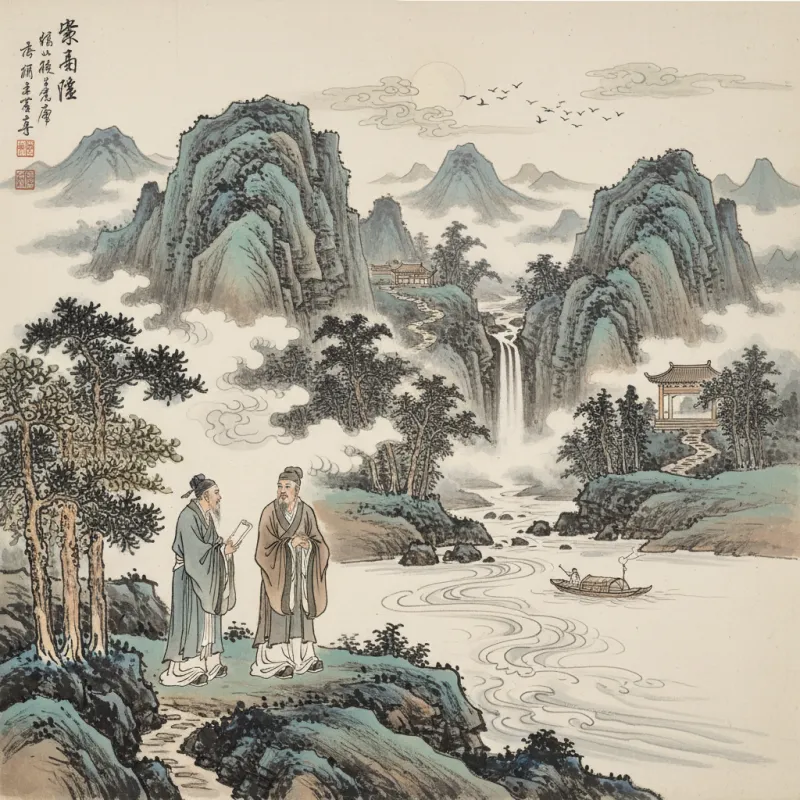
When Li Bai stood on the Yellow Crane Tower watching his friend Meng Haoran's boat disappear into the mist toward Yangzhou, he didn't write about missing him—he wrote about the loneliness of a sail vanishing into blue emptiness. This is the genius of Tang Dynasty farewell poetry: it never tells you how to feel. Instead, it places you at the river's edge, wine cup in hand, watching distance swallow someone you love.
The Ritual of Parting
Farewell wasn't casual in Tang and Song China. When friends separated, they performed songbie (送别, sòngbié)—literally "sending off"—a ritualized departure that could last days. You'd travel together to the city gates or a river crossing, share wine at a pavilion, break willow branches as parting gifts, and compose poems on the spot. The willow (liu, 柳, liǔ) was chosen because its name sounds like "to stay" (liu, 留, liú), a linguistic pun that turned a simple branch into a plea: don't go.
These weren't melodramatic displays. The poems that emerged from these moments—collected in categories like songbie shi (送别诗, sòngbié shī)—achieved something remarkable: they transformed personal grief into universal art. Wang Wei's "Seeing Off Yuan Er on a Mission to Anxi" became so famous that people sang it at every parting for centuries. Three cups of wine, a dusty road west, and suddenly your own goodbyes feel ancient and dignified.
Distance as Emotional Architecture
Tang poets understood that separation's pain isn't in the moment of goodbye—it's in the expanding distance afterward. Look at how they structure space in these poems. Wang Changling writes of friends "beyond the mountains," Li Bai places them "at the edge of heaven," and Du Fu imagines letters that must cross "ten thousand li" (里, lǐ, roughly 500 kilometers). They're not being vague. They're building emotional architecture where physical distance mirrors psychological separation.
The most sophisticated poets made landscape do the emotional work. In Meng Haoran's poems, mountains don't just separate friends—they accumulate between you, range after range, until reunion becomes geographically impossible. Rivers flow in one direction, carrying boats away, never back. Even the sky participates: it's always "vast" (miao, 渺, miǎo) or "empty" (kong, 空, kōng), emphasizing how small and alone you are once your friend leaves.
This spatial thinking connects to broader themes in Nature and Landscape Poetry, where the external world becomes a mirror for internal states. But farewell poems add urgency—nature isn't just beautiful or contemplative, it's actively taking someone from you.
The Politics of Friendship
Here's what Western readers often miss: many Tang farewell poems are about political exile, not voluntary travel. When Li Bai writes "I entrust my grief to the bright moon / to follow you to Yelang," he's addressing a friend banished to what was then considered the edge of civilization. When Liu Yuxi bids farewell to someone heading to a remote posting, he's watching a career end, possibly a life.
The Tang Dynasty's bureaucratic system meant educated men spent their lives being transferred between posts, often to places they'd never return from. Malaria-ridden southern provinces, frozen northern garrisons, western deserts—these weren't adventures, they were punishments or at best, career dead-ends. So when poets write about parting, they're often writing about permanent loss disguised as temporary separation.
This political dimension adds weight to seemingly simple poems. Wang Wei's "Seeing Off" poems aren't just about missing friends—they're about watching talented men disappear into administrative obscurity, their potential wasted on provincial postings. The grief is personal, but it's also about a system that scattered brilliant minds across an empire too vast to hold them together.
Wine, Willows, and Symbolic Language
Farewell poetry developed its own symbolic vocabulary, a shared language that let poets communicate complex emotions through simple images. Wine (jiu, 酒, jiǔ) appears in nearly every parting poem, not because Tang poets were alcoholics (though some were), but because wine represented the temporary dissolution of social barriers. When you're drunk together, rank and formality disappear. You can say what you really mean.
Willow branches (yangliu, 杨柳, yángliǔ) carried multiple meanings beyond the linguistic pun. Their drooping form suggested sadness, their flexibility represented the friend's ability to bend but not break in adversity, and their early spring growth symbolized renewal and hope. Breaking a willow branch and giving it to a departing friend was like handing them a poem in plant form—every element meant something.
Autumn (qiu, 秋, qiū) dominates the seasonal imagery, not just because it's melancholic, but because it's the season of imperial examinations and official appointments. Friends separated in autumn, when new postings began. The falling leaves, migrating geese, and cooling weather weren't just atmospheric—they marked the time when the bureaucratic machine reshuffled lives.
Women's Voices in Parting
The canonical farewell poems are mostly by men writing to men, but women poets of the Tang and Song dynasties wrote their own parting verses, often with sharper edges. When Yu Xuanji writes about separation, she doesn't romanticize distance—she's angry about being left behind. When Li Qingzhao describes her husband's departure, she focuses on the empty house, the cold bed, the wine that tastes wrong when drunk alone.
Women's farewell poems often subvert the genre's conventions. Where male poets find nobility in separation and promise reunion "when the swallows return," women poets tend to be more skeptical. They know that men who leave don't always come back, that promises made at the city gate fade with distance. Their poems ask uncomfortable questions: What if you forget me? What if you find someone else? What if "temporary" becomes permanent?
This gendered difference reflects social reality. Men traveled for careers, examinations, and official duties, with the expectation of return. Women who were left behind had no such certainty, and their poems reflect that precarity. For more on women's perspectives in classical poetry, see Women Poets of the Tang Dynasty.
The Aesthetics of Restraint
What makes Tang farewell poetry great isn't emotional excess—it's restraint. The best poems never say "I'm devastated" or "I'll miss you terribly." Instead, they show you a lone sail, a empty road, a cup of wine poured for someone who's already gone. The emotion lives in the gap between what's described and what's felt.
This restraint is technical. Classical Chinese poetry's compressed form—especially the jueju (绝句, juéjù) four-line form and lüshi (律诗, lǜshī) eight-line form—forces economy. You can't waste characters on emotional explanation. Every image must work triple-duty: establishing scene, conveying emotion, and connecting to the broader symbolic vocabulary readers expect.
The result is poetry that feels modern despite being over a thousand years old. When Wang Wei writes "Spring grass will be green again next year / But will you return, my prince?" he's using a technique contemporary poets would recognize: letting a natural image (grass regrowing) create emotional contrast (you might not). The question hangs unanswered because answering it would ruin everything.
Legacy and Influence
These farewell poems didn't stay in the Tang Dynasty. They became templates that later poets reworked, referenced, and argued with for centuries. Song Dynasty poets like Su Shi wrote farewell poems that deliberately echoed Tang predecessors, creating conversations across time. Japanese poets absorbed the tradition through cultural exchange, developing their own wakare no uta (parting poems) that show clear Chinese influence.
The themes persist because the emotions are universal, but the treatment is distinctively Chinese. The emphasis on landscape as emotional correlative, the use of shared symbolic language, the restraint that lets readers complete the emotional work—these techniques shaped how East Asian poetry handles separation and loss. Even contemporary Chinese poets writing in free verse often structure farewell poems around images inherited from the Tang: rivers, mountains, wine, willow branches.
For Western readers, these poems offer something our own tradition sometimes lacks: a way to write about grief that's neither sentimental nor cold. The Tang poets found a middle path—deeply felt but formally controlled, personal but universally resonant. When you read Li Bai watching that sail disappear, you're not just reading about his friend. You're reading about every goodbye you've ever said, every distance that's opened between you and someone you love, every time you've stood at the edge of something vast and empty, watching someone vanish into it.
Related Reading
- Nature in Chinese Poetry: Mountains, Rivers, and the Mirror of the Soul
- Exploring the Themes of Love, Nature, and Society in Chinese Classical Poetry
- Moonlight in Chinese Poetry: Why the Moon Means Everything
- Nature and Seasons in Chinese Poetry
- Unraveling Themes in Chinese Classical Poetry: Insights from Tang, Song, and Yuan Dynasties
- The Harmony of Nature in Chinese Classical Poetry: Tang, Song, and Yuan Dynasties
- Ci (词): The Song Lyrics That Became High Art
- Zhuangzi's Butterfly Dream: The Most Famous Thought Experiment in Chinese Philosophy
Explore Chinese Culture
- Explore the Tang dynasty's golden age
- Explore Daoist themes in classical poetry
- Explore Chinese literary traditions