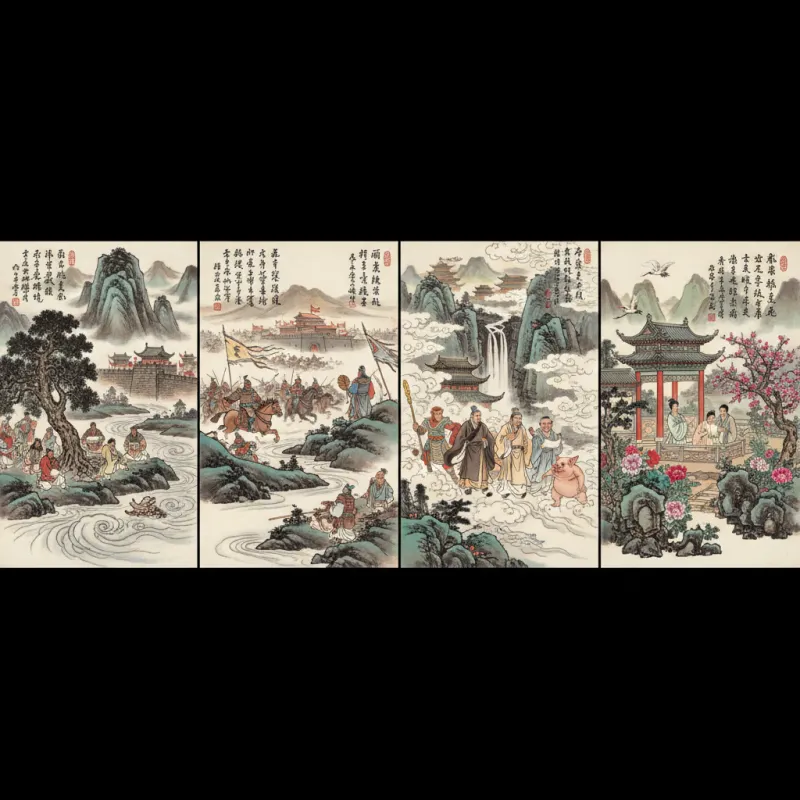
Four men sit around a table in a teahouse in 1920s Shanghai. One mentions his boss, and another immediately responds: "Ah, a real Cao Cao" — crafty, suspicious, brilliant. Everyone nods. No explanation needed. This is the cultural power of the Four Great Classical Novels (四大名著 Sì Dà Míngzhù), texts so deeply embedded in Chinese consciousness that their characters have become shorthand for human types, their plots the template for countless retellings, and their language the source of idioms that pepper everyday speech. To understand Chinese culture without knowing these novels is like trying to grasp Western literature while skipping Shakespeare, Dante, and the Bible.
The Canon That Wasn't Planned
Here's something most people don't realize: the "Four Great Classical Novels" weren't always four, and they weren't chosen by imperial decree or scholarly consensus. The grouping emerged organically during the Ming and Qing dynasties, solidified in the early 20th century, and has been debated ever since. Some scholars argue for including The Plum in the Golden Vase (金瓶梅 Jīn Píng Méi) or The Scholars (儒林外史 Rúlín Wàishǐ). But the four that stuck — Romance of the Three Kingdoms (三国演义 Sānguó Yǎnyì), Water Margin (水浒传 Shuǐhǔ Zhuàn), Journey to the West (西游记 Xīyóu Jì), and Dream of the Red Chamber (红楼梦 Hónglóu Mèng) — represent something more than literary excellence. They capture four fundamental aspects of Chinese imagination: political strategy, martial brotherhood, spiritual quest, and domestic tragedy.
What unites them is their vernacular language. Unlike the classical poetry of the Tang Dynasty or the refined essays of earlier literati, these novels were written in the language people actually spoke. This was revolutionary. It meant that stories previously confined to oral storytellers in marketplaces could now be read by anyone with basic literacy. The novels democratized literature, and in doing so, they shaped the modern Chinese language itself.
Romance of the Three Kingdoms: The Art of War as Literature
Romance of the Three Kingdoms, attributed to Luo Guanzhong and published in the 14th century, takes the chaotic period following the fall of the Han Dynasty (220-280 CE) and transforms it into an epic of loyalty, betrayal, and strategic genius. The novel opens with one of the most famous lines in Chinese literature: "The empire, long divided, must unite; long united, must divide" (话说天下大势,分久必合,合久必分 Huàshuō tiānxià dàshì, fēn jiǔ bì hé, hé jiǔ bì fēn). This cyclical view of history pervades the entire work.
The novel's genius lies in its characterization. Cao Cao is brilliant but paranoid, willing to kill innocents on the principle "better to wrong the world than let the world wrong me." Liu Bei is the virtuous underdog, weeping at every setback yet somehow inspiring absolute loyalty. Zhuge Liang, the strategic mastermind, can predict weather patterns and manipulate human psychology with equal ease. And Guan Yu, the warrior with the magnificent beard, becomes so loyal to his sworn brothers that he's later deified as the God of War and Righteousness.
The novel's influence on Chinese strategic thinking cannot be overstated. Business executives study it for management principles. Military academies analyze its battles. The famous "Empty Fort Strategy," where Zhuge Liang sits calmly playing a zither atop city walls while enemy armies approach, only to have them retreat in fear of a trap, has become a metaphor for psychological warfare. When you hear Chinese people discuss "三十六计" (the Thirty-Six Stratagems), many of those tactics come directly from this novel's pages.
Water Margin: Outlaws as Heroes
Water Margin, attributed to Shi Nai'an and dating to the 14th century, tells the story of 108 outlaws who gather at Mount Liang to resist corrupt officials. It's essentially a medieval Chinese version of Robin Hood, except with more violence, more moral ambiguity, and far more interesting female characters than the English legend ever managed.
The novel's structure is episodic — each of the 108 heroes gets an origin story explaining how they ended up as outlaws. Some are genuinely wronged by the system, like Lin Chong, a military instructor framed by a corrupt official who coveted his wife. Others are simply violent men who found their calling in banditry, like Li Kui, who kills with an axe and asks questions never. This moral complexity is what makes Water Margin fascinating. These aren't simple heroes; they're complicated people pushed to the margins of society.
The novel's treatment of women is particularly interesting and problematic. Pan Jinlian, the adulterous wife who poisons her husband, becomes the archetype of the dangerous, sexually transgressive woman in Chinese culture. Yet the novel also features Sun Erniang, the fierce innkeeper who runs a restaurant serving human meat buns, and Gu Dasao, the skilled martial artist. These women are agents of their own destinies, even if the novel doesn't always approve of their choices.
Water Margin speaks to something deep in Chinese culture: the tension between loyalty to the state and loyalty to one's personal code of honor. The outlaws repeatedly claim they're loyal to the emperor, just not to his corrupt officials. This distinction — between the ideal of righteous governance and the reality of corrupt bureaucracy — resonates through Chinese history and literature, including the poetry of social criticism from various dynasties.
Journey to the West: Buddhism Meets Monkey Business
Journey to the West, attributed to Wu Cheng'en and published in the 16th century, is the most fantastical of the four novels. Based loosely on the real 7th-century monk Xuanzang's pilgrimage to India to obtain Buddhist scriptures, the novel transforms a historical journey into a supernatural adventure featuring demons, gods, and one very troublesome monkey.
Sun Wukong, the Monkey King, is one of world literature's great characters. Born from a stone, he learns magic, declares himself "Great Sage Equal to Heaven," fights the entire celestial bureaucracy to a standstill, and is only subdued when Buddha traps him under a mountain for 500 years. When he's finally released to accompany the monk Xuanzang on his journey, he's fitted with a golden headband that tightens painfully whenever the monk recites a certain sutra — the ultimate supernatural leash.
The novel works on multiple levels. For children, it's an adventure story with monsters and magic. For adults, it's a Buddhist allegory about the journey toward enlightenment, with each demon representing a different obstacle to spiritual progress. The pig-demon Zhu Bajie represents gluttony and lust. The river demon Sha Wujing represents the need for patience and humility. And Sun Wukong himself represents the wild, undisciplined mind that must be tamed through practice.
But here's what makes Journey to the West endure: it's genuinely funny. The Monkey King's irreverence toward authority, his clever solutions to impossible problems, and his constant bickering with Zhu Bajie create a comic energy that never flags across 100 chapters. The novel has spawned countless adaptations, from Peking opera to the Japanese manga Dragon Ball to the recent video game Black Myth: Wukong. Sun Wukong has become a global icon, recognizable even to people who've never read the novel.
Dream of the Red Chamber: The Masterpiece
Dream of the Red Chamber, written by Cao Xueqin in the 18th century, is different from the other three novels in almost every way. Where they are episodic and action-driven, Dream is introspective and psychological. Where they feature heroes conquering external obstacles, Dream shows a wealthy family's slow, inevitable decline. Where they end with triumph or transcendence, Dream ends in loss and dissolution.
The novel centers on Jia Baoyu, a sensitive young man born with a jade stone in his mouth, and his relationships with two cousins: Lin Daiyu, the melancholic poet, and Xue Baochai, the practical beauty. But reducing Dream of the Red Chamber to a love triangle is like calling War and Peace a book about Napoleon. The novel contains over 400 characters, each precisely drawn, and explores themes of fate, desire, illusion, and the Buddhist concept that all worldly things are ultimately empty.
What makes Dream the most studied of the four novels is its literary sophistication. Cao Xueqin embedded layers of symbolism, poetry, and philosophical reflection into every chapter. The novel contains dozens of original poems, each revealing character psychology. The descriptions of gardens, clothing, food, and social rituals provide an unmatched window into Qing Dynasty aristocratic life. Scholars have spent careers analyzing the novel's structure, its unfinished ending (Cao died before completing it), and its possible autobiographical elements.
The novel's influence on Chinese aesthetics is profound. The concept of "红楼梦式" (Hónglóu Mèng shì) — "in the style of Dream of the Red Chamber" — describes a particular kind of refined, melancholic beauty. The tragic love between Baoyu and Daiyu has become the template for countless romantic stories. And the novel's Buddhist-Daoist philosophy, which sees worldly success as ultimately illusory, offers a counterpoint to the Confucian emphasis on achievement and social harmony found in works like classical prose essays.
Why These Four Still Matter
In an age of streaming video and social media, why should anyone care about novels written centuries ago? Because these four books contain something that transcends their historical moment: they capture fundamental human experiences with a depth and complexity that remains unsurpassed in Chinese literature.
Romance of the Three Kingdoms shows us that politics is theater, that loyalty can be both noble and foolish, and that the line between hero and villain depends entirely on perspective. Water Margin reminds us that society's outcasts often have the clearest view of its corruption, even if their solutions are violent and flawed. Journey to the West teaches that the spiritual path requires both discipline and irreverence, that enlightenment comes through struggle, and that humor is essential to surviving impossible journeys. And Dream of the Red Chamber reveals that beauty and loss are inseparable, that desire creates suffering, and that the most important battles happen inside the human heart.
These novels also demonstrate the power of vernacular literature. By writing in the language people spoke rather than the classical language of scholars, these authors created works that could speak to everyone. They proved that "popular" literature could be as profound as any classical text, a lesson that resonates in every culture's literary history.
Reading Them Today
If you're approaching these novels for the first time, start with Journey to the West — it's the most accessible and entertaining. Then try Romance of the Three Kingdoms if you like political intrigue, or Water Margin if you prefer action and moral complexity. Save Dream of the Red Chamber for last; it requires patience and attention, but rewards both with an emotional and intellectual experience unlike any other novel.
Modern translations have made these works available to English readers, though something is always lost in translation. The puns, the poetry, the rhythms of the original language — these can only be approximated. But the stories, the characters, and the wisdom remain. These four novels have survived centuries because they speak to something permanent in human nature. They remind us that great literature doesn't just reflect culture; it creates it, shapes it, and gives it a language to understand itself.
Related Reading
- Zhuangzi's Butterfly Dream: The Most Famous Thought Experiment in Chinese Philosophy
- Ouyang Xiu and The Drunkard's Pavilion: Getting Drunk on Mountains
- Classical Chinese Prose: The Essays That Shaped a Civilization
- Sun Tzu's Art of War: The Complete Guide for Modern Readers
- Exploring Love in Chinese Classical Poetry: Tang, Song, and Yuan Poets’ Romantic Artistry
- Why Some Chinese Poems Are Untranslatable: The Beauty That Gets Lost
- Unveiling the Rich Tapestry of Chinese Classical Poetry: Insights from Tang, Song, and Yuan Dynasties
Explore Chinese Culture
- Explore the Tang dynasty's golden age
- Explore Daoist themes in classical poetry
- Explore Chinese literary traditions