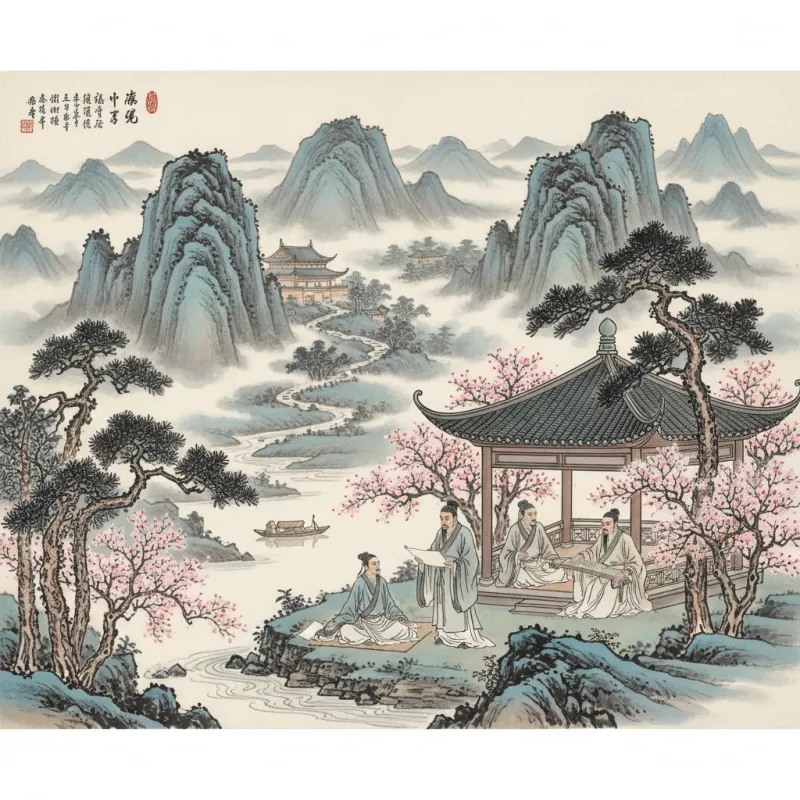
Picture this: a government official exiled to a remote province, standing on a moonlit riverbank, composing verses that would outlive empires. This wasn't just poetry—it was survival, rebellion, and transcendence all at once. The Song Dynasty (宋朝, Sòng Cháo, 960-1279 CE) produced poets who transformed personal anguish into art so potent that readers still weep over their words nearly a millennium later.
When Poetry Became Everyone's Language
The Song Dynasty didn't just tolerate poetry—it democratized it. Unlike the Tang Dynasty's aristocratic verse-making, Song poetry belonged to merchants, courtesans, scholars who failed their exams, and yes, even emperors. The ci (词, cí) form—lyric poetry set to popular melodies—emerged from wine houses and entertainment quarters before scholars claimed it as high art. This wasn't your grandfather's regulated verse. Ci poems followed the contours of existing tunes, their lines stretching and contracting like a singer's breath, creating an intimacy that the rigid structures of shi (诗, shī) poetry couldn't match.
The printing press changed everything. Suddenly, poetry collections circulated beyond elite circles. A silk merchant in Hangzhou could read the same verses as a court official in Kaifeng. This technological revolution meant poets wrote for actual audiences, not just imperial patrons or literary ghosts. The result? Poetry that spoke to real human experience—heartbreak, political frustration, the ache of exile, the pleasure of good wine on a spring evening.
Su Shi: The Poet Who Refused to Break
Su Shi (苏轼, Sū Shì, 1037-1101), better known as Su Dongpo (苏东坡, Sū Dōngpō), embodied Song Dynasty poetry's defiant spirit. Exiled multiple times for his political views, he could have written bitter screeds. Instead, he gave us "Shui Diao Ge Tou" (水调歌头, Shuǐ Diào Gē Tóu), a Mid-Autumn Festival poem so beloved that Chinese people still recite it when the moon rises full:
"When will the bright moon appear? / Wine cup in hand, I ask the blue sky."
Su Shi's genius lay in his refusal to choose between philosophical depth and emotional immediacy. He could write about Buddhist emptiness in one breath and describe perfectly cooked pork in the next (yes, Dongpo pork is named after him—the man loved food as much as metaphysics). His ci poems expanded the form's boundaries, proving that popular song structures could carry profound philosophical weight. When he wrote about missing his dead wife, the grief felt so raw that readers across centuries recognize their own losses in his words.
Li Qingzhao: Sorrow's Sharpest Voice
Li Qingzhao (李清照, Lǐ Qīngzhào, 1084-1155) remains China's most celebrated female poet, and for good reason—she wrote circles around most of her male contemporaries. Born into a literary family, she enjoyed an education rare for women of her era. Her early poems sparkle with wit and sensuality, celebrating married love with a frankness that still feels modern. But then the Jin Dynasty invaded, her husband died, and her poetry transformed into something almost unbearable in its precision.
Her later ci poems document loss with surgical accuracy. In "Sheng Sheng Man" (声声慢, Shēng Shēng Màn), she strings together fourteen reduplicative characters in the opening lines—a technical feat that creates a stuttering, searching rhythm that mirrors grief's disorientation. She writes: "Seeking, seeking, cold, cold, clear, clear, desolate, desolate, wretched, wretched." Try reading that aloud without feeling the weight of her loneliness.
Li Qingzhao also wrote literary criticism, boldly declaring most ci poetry before her time as inferior. She had standards, and she wasn't afraid to say so. Her theoretical work on ci composition influenced generations of poets who came after her, establishing principles that shaped the form's development. For more on how Song Dynasty poets refined earlier traditions, see The Evolution of Tang Poetry Forms.
Xin Qiji: The Warrior-Poet's Rage
Xin Qiji (辛弃疾, Xīn Qìjí, 1140-1207) brought martial energy to a literary form associated with romantic longing. A military commander who fought against the Jin Dynasty's occupation of northern China, he spent decades trying to convince the Southern Song court to launch a northern expedition. They ignored him. So he channeled his frustration into poetry that crackles with barely contained violence.
His ci poems smuggle military strategy and political critique into love song structures. When he writes about a beautiful woman, he's often really writing about the lost northern territories. His famous "Po Zhen Zi" (破阵子, Pò Zhèn Zǐ) doesn't bother with metaphor—it's a straight-up battlefield fantasy: "Drunk, I light the lamp to examine my sword / Dreaming, I return to the camp of bugles and horns."
Xin Qiji proved that ci poetry could handle any subject matter. He wrote over 600 ci poems, more than any other Song Dynasty poet, ranging from tender domestic scenes to philosophical meditations to barely disguised political manifestos. His work influenced later patriotic poetry traditions, showing how personal artistic expression could serve national consciousness. The relationship between individual voice and collective identity in Song poetry deserves deeper exploration—see Song Dynasty Poets and Political Expression.
The Technical Revolution: How Song Poets Bent the Rules
Song Dynasty poets inherited strict prosodic rules from their Tang predecessors but treated them more like suggestions. The ci form's flexibility allowed for experimentation that would have scandalized Tang Dynasty purists. Lines could be three characters or eleven. Rhyme schemes could shift mid-poem. Tonal patterns followed musical requirements rather than abstract principles.
This technical freedom enabled emotional precision. A poet could stretch a line to create longing, compress another to convey sudden shock. The best Song ci poems feel inevitable—as if the emotion itself dictated the form. Yet this apparent spontaneity required immense craft. Poets memorized hundreds of tune patterns (词牌, cípái), each with specific requirements for line length, rhyme, and tone.
The Song Dynasty also saw the rise of poetry criticism as a distinct genre. Poets wrote extensively about their craft, debating whether ci should remain "feminine" and delicate or could embrace "masculine" themes of politics and warfare. These debates shaped not just Song Dynasty poetry but Chinese literary theory for centuries afterward.
Why Song Poetry Still Matters
Walk through any Chinese bookstore today, and you'll find Song Dynasty poetry collections prominently displayed. These aren't dusty classics gathering cobwebs—they're living texts that people actually read. Why? Because Song poets mastered the art of making the personal universal. Su Shi's exile poems speak to anyone who's felt displaced. Li Qingzhao's grief resonates with anyone who's lost someone irreplaceable. Xin Qiji's frustration echoes in anyone who's watched their ideals ignored.
Song Dynasty poetry also represents a crucial moment when Chinese literature turned inward, prioritizing individual emotional truth over public performance. This shift influenced everything that came after, from Ming Dynasty drama to modern Chinese poetry. The Song poets proved that intimate, personal expression could achieve the same cultural significance as grand historical epics.
Their technical innovations continue to influence Chinese poetry. Contemporary poets still write ci, still grapple with the tension between form and freedom that Song Dynasty poets navigated so brilliantly. The question of how to balance tradition with innovation—central to Song Dynasty poetics—remains urgent for artists working in any traditional form today.
Reading Song Poetry Now: A Practical Approach
Approaching Song Dynasty poetry requires patience. These poems reward slow reading, attention to sound patterns, and willingness to sit with ambiguity. Start with Su Shi if you want philosophical depth mixed with human warmth. Choose Li Qingzhao for emotional precision that cuts to the bone. Pick Xin Qiji if you prefer your poetry with a side of righteous anger.
Don't worry too much about understanding every classical allusion on first reading. Song poets themselves often layered meanings, expecting readers to discover new depths with each encounter. A good translation helps, but even in English, the emotional core comes through. Look for translators who prioritize the poems' music and feeling over literal accuracy—Song ci poems were meant to be heard, not just read.
For those interested in how Song Dynasty poets built upon and diverged from earlier traditions, exploring the connections between Tang and Song poetic practices offers fascinating insights into Chinese literary evolution. The conversation between these two great poetic eras shaped Chinese literature's trajectory for centuries.
The Song Dynasty poets didn't just write beautiful verses—they demonstrated that art could be both deeply personal and culturally significant, that technical mastery could serve emotional truth, and that poetry could matter even when empires crumbled. Nearly a thousand years later, their words still prove them right.
Related Reading
- The Timeless Art of Song Poets: A Deep Dive into Classical Chinese Poetry
- Poetic Forms in Chinese Literature: The Rules That Set Poetry Free
- Tonal Patterns Explained: The Music Inside Chinese Poetry
- Love and Longing in Chinese Classical Poetry: Tang, Song, and Yuan Dynasties Explored
Explore Chinese Culture
- Explore the Tang dynasty's golden age
- Explore Daoist themes in classical poetry
- Explore Chinese literary traditions