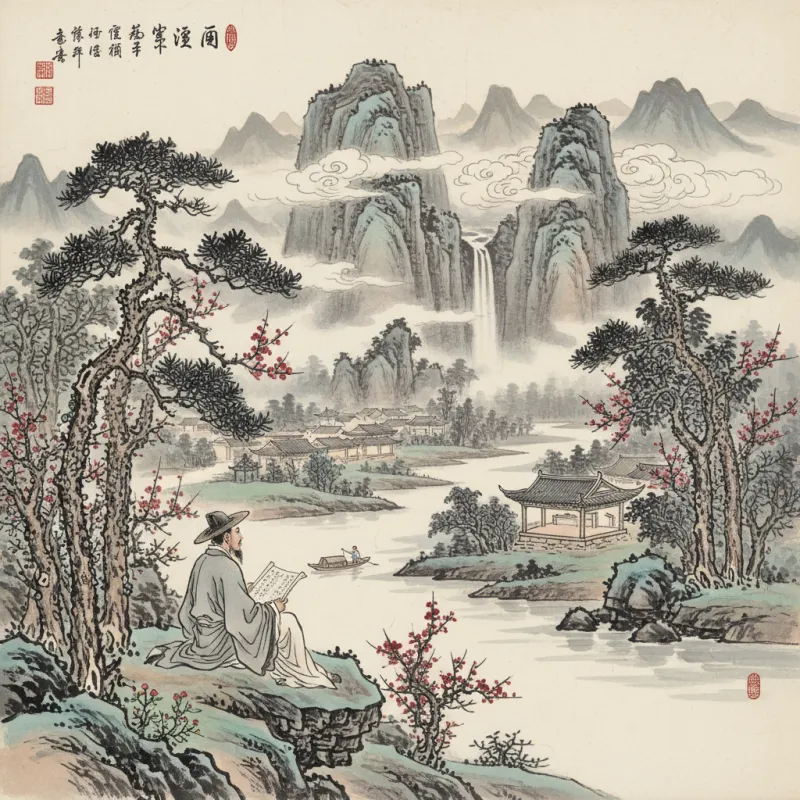
Picture this: a government official exiled to a remote province, standing on a moonlit riverbank, composing verses that would outlive empires. Not on paper—on the walls of a tavern, using wine as ink. This wasn't rebellion; this was Tuesday for Song Dynasty poets. While their Tang predecessors chased immortality through rigid forms and cosmic themes, Song poets (960-1279 CE) did something radical: they wrote about being human.
When Poetry Became Personal
The Song Dynasty didn't just produce poets—it produced a cultural shift that redefined what poetry could be. After the Tang Dynasty's fall in 907 CE, China fragmented into chaos. When the Song reunified the realm, something fundamental had changed in the Chinese psyche. The grand, sweeping gestures of Tang poetry—Li Bai's celestial wanderings, Du Fu's epic laments—gave way to something more intimate, more psychologically complex.
Enter the ci (词, cí) form, originally lyrics for popular songs that scholars considered beneath serious literature. Song poets grabbed this "low" art form and transformed it into high literature. Unlike the rigid shi (诗, shī) poetry of the Tang, ci allowed irregular line lengths, varied tonal patterns, and—crucially—the space to explore emotional nuance that formal poetry couldn't accommodate. Think of it as the difference between a formal portrait and a candid photograph.
The Revolutionaries in Scholar's Robes
Su Shi (苏轼, Sū Shì, 1037-1101), also known as Su Dongpo, embodied this transformation. Exiled multiple times for political reasons, he didn't write bitter screeds against injustice. Instead, he wrote about making the best pork belly dish during his exile (yes, Dongpo pork is named after him), about the moon's reflection on water, about getting drunk with friends. His famous "Prelude to Water Melody" (水调歌头, Shuǐdiào Gētóu) asks the moon about palace life in heaven—but really, it's about missing his brother. That's the Song genius: cosmic imagery serving deeply personal emotion.
Li Qingzhao (李清照, Lǐ Qīngzhào, 1084-1155) took this intimacy further. As one of the few celebrated female poets in Chinese history, she wrote with a directness that still feels modern. Her early poems capture newlywed joy with sensual detail—yellow flowers, thin silk curtains, wine-flushed cheeks. After her husband's death and the fall of Northern Song, her later work carries a grief so specific you can feel it across nine centuries. She didn't write "I am sad." She wrote about being too listless to comb her hair, about how even beautiful scenery feels like an accusation when you're alone.
The Aesthetic Philosophy Behind the Words
Song poets operated under a concept called yijing (意境, yìjìng)—roughly "artistic conception" or "mood-realm." This wasn't about describing a scene; it was about creating an emotional atmosphere where the reader completes the experience. A Tang poet might describe a mountain in exquisite detail. A Song poet would mention a single falling leaf and let you feel autumn's melancholy yourself.
This connects to the Song Dynasty's broader cultural obsessions. This was the era of landscape painting masters who left vast portions of silk scrolls empty—negative space as powerful as brushstrokes. Song philosophers developed Neo-Confucianism, which emphasized internal cultivation over external ritual. Everything pointed inward: examine your mind, refine your character, find truth in subtle observation rather than grand pronouncement.
Lu You (陆游, Lù Yóu, 1125-1210) exemplified this inward turn while maintaining outward passion. A patriot who watched the Jurchen Jin Dynasty conquer northern China, he wrote over 9,000 poems—more than any other classical Chinese poet. But his most famous work isn't a battle cry. It's "The Phoenix Hairpin" (钗头凤, Chāitóu Fèng), written on a garden wall to his first wife, from whom he'd been forcibly separated by his mother. Decades later, his ex-wife visited the same garden, read his poem, and wrote a response on the same wall. She died shortly after. He kept writing about her for the next forty years.
Technical Innovation and Formal Experimentation
The ci form's flexibility allowed Song poets to match form to feeling in ways shi poetry couldn't. Each ci poem followed a specific tune pattern (cipai, 词牌, cípái) with predetermined tonal and rhythmic structures—but within those structures, poets could vary line length from one character to eleven. It's like jazz: strict underlying structure enabling improvisational freedom.
Take the cipai "Slow Slow Song" (声声慢, Shēngshēng Màn). Li Qingzhao's famous poem using this pattern opens with seven consecutive characters that repeat sounds: "寻寻觅觅,冷冷清清,凄凄惨惨戚戚" (xúnxún-mìmì, lěnglěng-qīngqīng, qīqī-cǎncǎn-qīqī). In English: "Seeking, seeking, searching, searching / Cold, cold, clear, clear / Sorrowful, sorrowful, miserable, miserable, grieving, grieving." The repetition isn't decorative—it mimics the obsessive circling of a depressed mind. You can't achieve that effect in regulated shi verse.
The Social World of Song Poetry
Song Dynasty poetry wasn't solitary genius in a garret. It was profoundly social. Officials wrote poems as part of diplomatic correspondence. Friends exchanged poems instead of letters. Poets wrote on restaurant walls, on fans, on gifts. The printing press (invented during the Song) meant poetry collections circulated widely. For the first time, poets could have "fans" beyond their immediate circle.
This social dimension shaped the poetry itself. Many Song poems are responses to other poems, creating chains of literary conversation spanning decades. Ouyang Xiu (欧阳修, Ōuyáng Xiū, 1007-1072) would write a poem; his student Su Shi would respond; Su Shi's friend Huang Tingjian (黄庭坚, Huáng Tíngjian, 1045-1105) would add his voice. Reading Song poetry means entering an ongoing conversation among brilliant minds who knew they were brilliant and weren't shy about it.
The civil service examination system meant most Song poets were also government officials, which created a peculiar dynamic. They wielded real political power but expressed dissent through poetry's coded language. When Su Shi criticized the emperor's policies, he did it through poems about farming and rain. Everyone understood the subtext. The emperor understood too—hence the exiles.
Why Song Poetry Still Matters
Song Dynasty poetry's influence extends far beyond literature. The aesthetic principles Song poets developed—subtlety over statement, suggestion over description, emotional authenticity over formal perfection—became foundational to Chinese art. When you see a Chinese landscape painting with more empty space than brushwork, that's Song aesthetic philosophy. When you read a haiku that captures a moment without explaining it, that's the yijing concept traveling to Japan.
Modern Chinese still quotes Song ci in everyday conversation. Li Qingzhao's line "这次第,怎一个愁字了得" (zhè cì dì, zěn yī gè chóu zì liǎo dé—"How can a single word 'sorrow' suffice?") appears in text messages, social media posts, anywhere someone needs to express that their feelings exceed vocabulary. Su Shi's "大江东去" (dà jiāng dōng qù—"The great river flows east") titles everything from restaurants to TV shows.
The Living Tradition
What makes Song poetry timeless isn't its historical importance—it's that these poets cracked something fundamental about human experience. They understood that the most universal emotions emerge from the most specific details. Li Qingzhao's grief isn't abstract; it's the weight of her husband's book collection that she had to abandon while fleeing war. Lu You's patriotism isn't propaganda; it's an old man dreaming of cavalry charges he'll never ride in.
The Song poets proved that poetry doesn't need to be grand to be great. A falling flower, a cup of wine, a letter that never arrives—these small moments contain everything. They wrote about being stuck in middle management, about bad weather ruining travel plans, about getting older and wondering what it all meant. They wrote, in other words, about being alive in a way that transcends dynasty, language, and century.
When you read Song poetry today, you're not studying artifacts. You're eavesdropping on people who felt exactly what you feel, who struggled with the same questions about meaning and connection and loss. They just happened to express it in language so precise, so musical, so emotionally intelligent that it survived a millennium intact. That's not just good poetry. That's poetry doing what it's supposed to do: proving that human experience, however separated by time and culture, remains fundamentally shared.
Related Reading
- The Enchantment of Song Dynasty Poets: A Deep Dive into Their Timeless Verses
- Xin Qiji: The Warrior Poet Who Never Got His War
- The Harmony of Nature in Chinese Classical Poetry: Tang, Song, and Yuan Dynasties
- Zen Koans in Poetry Form: When Chinese Verse Became a Riddle
Explore Chinese Culture
- Explore the Tang dynasty's golden age
- Explore Daoist themes in classical poetry
- Explore Chinese literary traditions