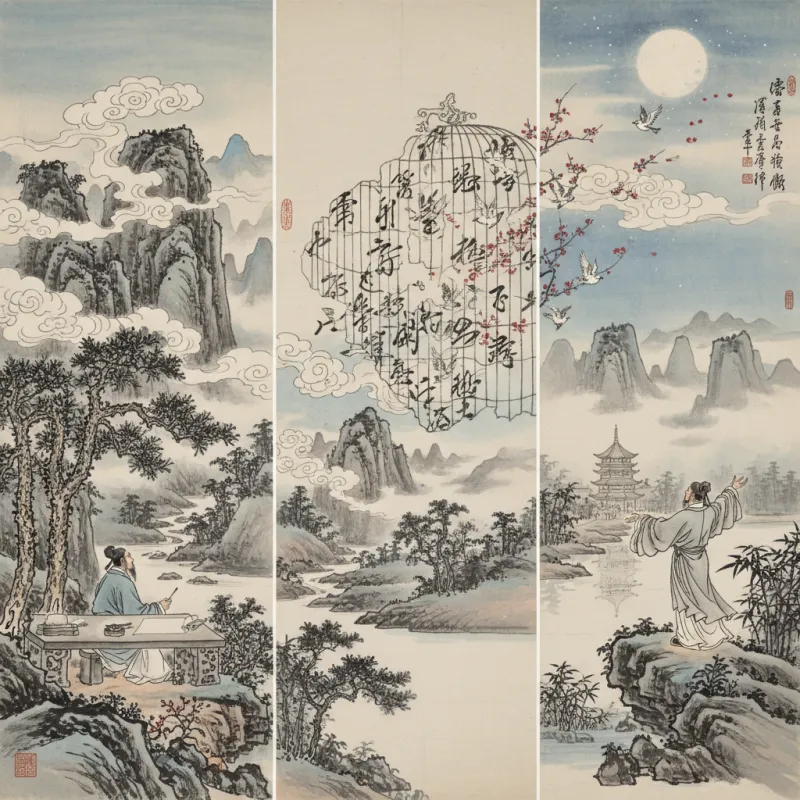
Picture a Tang dynasty poet sitting for the imperial examination, brush poised over paper. He has exactly four lines to prove his genius. Twenty-eight characters. No more, no less. Each line must have seven syllables. The tones must alternate in a precise pattern. The second and fourth lines must rhyme. And within these iron constraints, he must capture the essence of autumn, express political loyalty, and demonstrate mastery of classical allusion.
He passes. His poem is brilliant.
This is the paradox at the heart of Chinese classical poetry: the strictest formal rules in world literature produced some of its most expressive, emotionally resonant verse. While Western poetry spent the 20th century breaking free from meter and rhyme, Chinese poets spent a millennium proving that freedom lives inside the cage.
The Architecture of Constraint
Chinese classical poetry operates on multiple simultaneous rule systems, each layer adding complexity. At the most basic level, there's line length: poems use lines of consistent character count, typically five or seven. Then there's rhyme, which in Chinese means matching both sound and tone. Then tonal patterns — the rising and falling pitches of Middle Chinese must alternate in prescribed sequences. Then parallelism — certain couplets must mirror each other in grammatical structure and semantic category.
The regulated verse (律詩, lǜshī) form exemplifies this layered constraint. Eight lines, either five or seven characters each. Lines two, four, six, and eight must rhyme. The middle two couplets must exhibit strict parallelism. And the entire poem must follow one of four acceptable tonal patterns, where each character's tone (level, rising, departing, or entering) occupies a specific position in an alternating sequence.
Du Fu wrote hundreds of regulated verses. Li Bai, despite his reputation for spontaneity, mastered the form. Wang Wei used it to paint landscapes in words. The form didn't limit them — it focused them.
The Compression Engine
Consider the quatrain (絕句, juéjù): four lines, twenty or twenty-eight characters total. This is the haiku's older, stricter cousin. A quatrain must establish scene, develop mood, execute a turn, and achieve resolution. It must feel complete, not truncated. It must carry weight without feeling dense.
Wang Zhihuan's "Climbing Stork Tower" does this in twenty characters. First line: the sun sinks into mountains. Second line: the Yellow River flows to the sea. Third line: to see a thousand miles further. Fourth line: climb one more story. Scene, expansion, desire, action. A complete philosophical statement about ambition and perspective, compressed into the space of a tweet.
The compression isn't arbitrary. Each character in classical Chinese carries more semantic weight than an English word — it's simultaneously sound, meaning, and visual image. The formal constraints force poets to choose each character with surgical precision. There's no room for filler, no space for the merely decorative. Every element must work triple-duty.
This is why translation often expands Chinese poems to three times their original length. The English needs more words to carry the same freight.
Parallelism as Thought Structure
The parallelism requirements in regulated verse do something remarkable: they force poets to think in paired opposites. The middle two couplets must mirror each other — if line three mentions mountains, line four should mention water. If one line uses a verb of motion, its partner should too. If one references the past, the other should reference the present.
This isn't mere decoration. It's a cognitive framework. Chinese philosophy thinks in complementary pairs: yin and yang, heaven and earth, stillness and motion. The formal requirement for parallel couplets embeds this worldview into the poem's structure. The form teaches the poet to see relationships, to think in balanced contrasts.
Du Fu's "Spring View" demonstrates this perfectly. "Nation broken, mountains and rivers remain" pairs political collapse with natural permanence. "City in spring, grass and trees deepen" pairs human space with vegetative time. The parallelism isn't just pretty — it's the poem's argument, built into its architecture.
Western poetry occasionally uses parallelism for effect. Chinese regulated verse makes it mandatory, training generations of poets to perceive the world in complementary structures.
The Tonal Music
Middle Chinese had four tones: level (平, píng), rising (上, shǎng), departing (去, qù), and entering (入, rù). Regulated verse requires these tones to alternate in specific patterns across each line and between lines. The second character in line one must have the opposite tone category from the second character in line two. The pattern cascades through the entire poem.
Modern readers can't hear this music — the entering tone disappeared from Mandarin centuries ago, and the other tones shifted. But Tang dynasty audiences heard regulated verse as a kind of tonal melody, the pitch patterns creating a sonic architecture beneath the semantic meaning.
This is why Chinese poetry resists translation more stubbornly than most. You can translate the images, approximate the compression, even preserve some parallelism. But the tonal music is untranslatable. It's like trying to convey a symphony by describing the instruments.
The tonal rules also created a technical challenge that separated masters from amateurs. Anyone can write four lines about autumn. Only a skilled poet can write four lines about autumn where every character falls in the correct tonal position while maintaining natural syntax and fresh imagery. The form is a filter for excellence.
When Rules Become Invisible
The strange thing about mastery is that constraints disappear. A beginning poet struggles with tonal patterns, counting on fingers, consulting rhyme dictionaries. An accomplished poet internalizes the rules so completely that they become unconscious. The form stops being a restriction and becomes the natural shape of thought.
Li Bai's quatrains feel effortless, spontaneous, as if he simply opened his mouth and perfect poems emerged. But that effortlessness is the product of complete technical mastery. He's not fighting the form — he's thinking in the form. The rules have become invisible.
This is the deeper paradox: strict formal constraints, fully internalized, produce the sensation of freedom. The poet isn't choosing from infinite possibilities (which is paralyzing) but from a limited set of optimal solutions (which is liberating). The form provides a path through the wilderness of language.
Western free verse offers different freedoms and different challenges. But the Chinese classical tradition proves that formal constraint isn't the opposite of creative freedom — it's one reliable path toward it. The rules don't imprison the poet. They set the poet free to focus on what matters: precision, compression, music, and truth.
The Living Tradition
These forms aren't museum pieces. Contemporary Chinese poets still write regulated verse and quatrains, though modern Mandarin's tonal system makes the classical patterns impossible to reproduce exactly. The forms have adapted, loosened, but not disappeared.
More importantly, the aesthetic principles embedded in these forms — compression, parallelism, tonal awareness, the value of constraint — continue to influence Chinese poetry even when it abandons classical forms entirely. The tradition taught poets how to think, not just how to write.
For readers approaching Chinese poetry, understanding these formal structures illuminates why the poems work the way they do. The compression isn't arbitrary — it's required. The parallel couplets aren't decorative — they're structural. The apparent simplicity conceals immense technical sophistication.
And for poets in any language, the Chinese classical tradition offers a powerful counter-argument to the assumption that freedom requires the absence of rules. Sometimes the strictest constraints produce the most liberated art. Sometimes the cage is where the bird learns to sing.
The Tang poets proved this eight hundred years before Western modernism discovered it: form isn't the enemy of expression. Form is the instrument of expression. The rules don't limit what you can say — they sharpen how you say it. And that sharpening, that compression, that discipline, is what transforms language into poetry.
Related Reading
- Ci (词): The Song Lyrics That Became High Art
- Modern Chinese Poetry: From Classical Forms to Free Verse
- Fu: The Grand Rhapsody Form
- Jueju: The Art of the Four-Line Poem
- Ci Poetry: When Poems Were Songs
- Discovering the Rich Legacy of Tang, Song, and Yuan Poetry
- Su Shi: The Renaissance Man of Chinese Literature
- Li Bai vs Du Fu: The Rivalry That Defined Chinese Poetry
Explore Chinese Culture
- Explore the Tang dynasty's golden age
- Explore Daoist themes in classical poetry
- Explore Chinese literary traditions