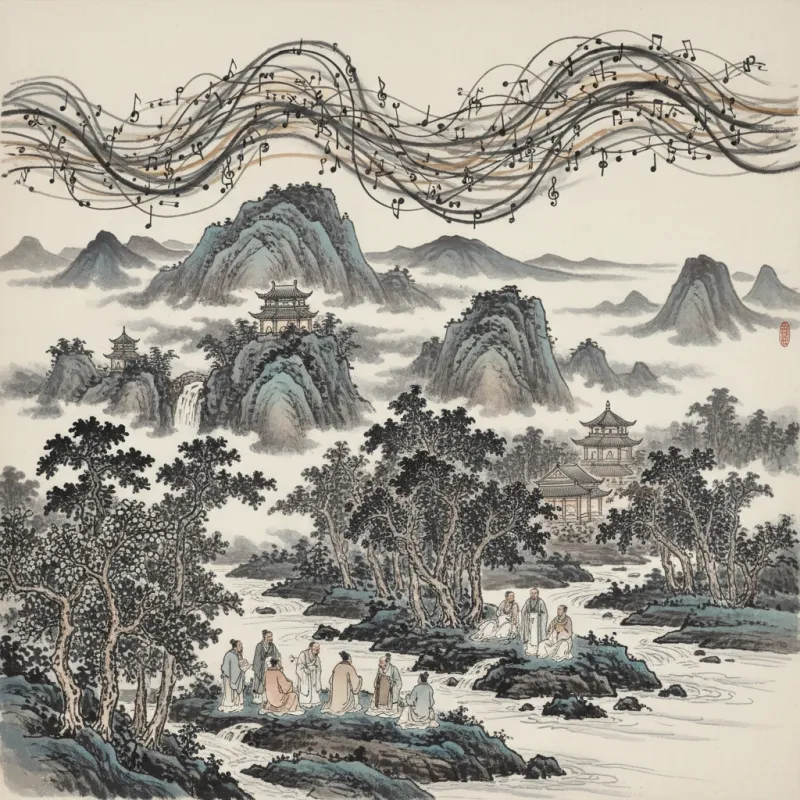
Read a Tang poem out loud in Mandarin and something happens that doesn't happen with English poetry. The words rise and fall in pitch like a melody. Not randomly — in precise, alternating patterns that Chinese poets spent centuries perfecting. Miss one tone and the whole thing sounds wrong, the way a wrong note ruins a chord. This is the tonal system (声律 shēnglǜ), and understanding it changes everything about how you hear Chinese poetry.
Tones Are Not Optional
Modern Mandarin has four tones plus a neutral tone. Say "ma" four different ways and you get four different words: 妈 (mā, mother), 麻 (má, hemp), 马 (mǎ, horse), 骂 (mà, to scold). Classical Chinese poetry used a different tonal system — Middle Chinese had four tone categories called 平 (píng, level), 上 (shǎng, rising), 去 (qù, departing), and 入 (rù, entering). But the principle is identical: every syllable carries a pitch contour, and poets treated these tones like musical notes.
The Tang Dynasty poets didn't just notice tones existed. They built an entire prosodic architecture around them. By the time Du Fu (杜甫) was writing in the 8th century, the rules for regulated verse (律诗 lǜshī) were so strict that breaking them was considered amateur. The tones had to alternate in specific patterns, position by position, line by line. It's like writing a sonnet where every syllable's stress is predetermined — except instead of stress, it's pitch.
Here's what makes this wild: Chinese doesn't have the stressed/unstressed rhythm that drives English poetry. No iambic pentameter, no trochees. The rhythm comes entirely from tonal alternation. A line of poetry is a sequence of rising and falling pitches, and the pattern matters more than the meaning. Well, not more — but equally. A Tang poet had to satisfy both semantic sense and tonal music simultaneously.
The Two-Tone System That Changed Everything
Classical Chinese poetry simplified the four Middle Chinese tones into two categories: 平 (píng, level) and 仄 (zè, oblique). The level tone was the first tone — a sustained, even pitch. The oblique tones were everything else — rising, departing, and entering tones, all grouped together because they shared one quality: they weren't level.
This binary system made the rules manageable. Instead of tracking four different tones, poets only had to think in terms of level versus oblique. The basic principle: alternate them. If position two in a line uses a level tone, position four should use oblique. If line one ends with level, line two should end with oblique. The patterns get more complex, but that's the foundation.
The entering tone (入声 rùshēng) deserves special mention because it's disappeared from modern Mandarin but was crucial in classical poetry. It was a short, abrupt tone that ended in a stop consonant — think of how "cat" ends versus how "car" ends. Many characters that were entering tone in Middle Chinese are now distributed across the other tones in Mandarin, which is why modern readers sometimes struggle to scan classical poems correctly. You have to know the historical tone category, not just the modern pronunciation.
Wang Wei (王维) was a master of tonal patterning. His famous quatrain "Deer Enclosure" (鹿柴 Lùzhài) demonstrates perfect tonal balance. Every position follows the prescribed pattern. Read it aloud in reconstructed Middle Chinese and you hear the alternation clearly — level tones sustaining, oblique tones shifting. It's not decoration. It's structural.
Regulated Verse and Its Iron Rules
Regulated verse (律诗 lǜshī) emerged during the early Tang Dynasty and became the gold standard for serious poetry. Eight lines, five or seven characters per line, with tonal patterns so rigid they make a sonnet look freeform. The rules governed not just which positions should be level or oblique, but also how lines related to each other tonally.
The second and fourth positions in each line were critical — these had to follow the pattern strictly. Positions one, three, and five had more flexibility, though not complete freedom. And the final character of each couplet had to match tonally with its partner line in specific ways. Lines two and four had to rhyme, and the rhyme had to use level tone characters. Lines one and three could rhyme or not, depending on the form.
Du Fu's "Spring View" (春望 Chūn Wàng) is a textbook example. Every line follows the tonal prescription. The second and fourth positions alternate perfectly. The rhymes fall on level tones. The parallelism in the middle couplets — which regulated verse also required — is enhanced by the tonal symmetry. When Du Fu writes about broken mountains and rivers, the form itself is unbroken, mathematically precise.
Breaking these rules wasn't just sloppy — it was considered a failure of craft. The Tang Dynasty examination system tested candidates on their ability to write regulated verse correctly. If you wanted a government position, you had to prove you could handle tonal patterns. Poetry wasn't an art separate from technical skill. It was technical skill made art.
Why Tones Matter More Than You Think
The tonal system isn't just about following rules. It creates a sonic texture that's impossible to replicate in translation. When you read a Tang poem in English, you're reading the semantic content — the images, the emotions, the ideas. But you're missing half the poem. The music is gone.
Think about it this way: English poetry uses rhythm and rhyme to create its music. We have iambic pentameter, we have alliteration, we have assonance. Chinese poetry has all of that too — but it also has this entire additional layer of tonal melody that operates independently of the words' meanings. A Chinese character can mean "mountain" and simultaneously function as a level tone in position four, creating a sonic pattern that has nothing to do with mountains.
This is why Chinese poetic forms developed so differently from Western forms. The constraints were different. A Tang poet wasn't thinking about stressed syllables — they were thinking about pitch contours. The resulting aesthetic is fundamentally different. It's not better or worse, just different in a way that's hard to appreciate if you only know English poetry.
Li Bai (李白), despite his reputation as a wild, spontaneous genius, followed tonal rules meticulously in his regulated verse. His famous "Quiet Night Thought" (静夜思 Jìng Yè Sī) is a quatrain with perfect tonal balance. The level and oblique tones alternate exactly as prescribed. The genius isn't in breaking the rules — it's in making the rules invisible, so the poem feels natural despite its technical precision.
The Parallel Couplet Problem
Regulated verse required the middle two couplets to be parallel (对仗 duìzhàng) — not just tonally, but grammatically and semantically. If line three has a noun in position two, line four needs a noun in position two. If line five mentions a color, line six should mention a color. And all of this has to happen while maintaining the tonal pattern.
This is where the form gets genuinely difficult. You're juggling multiple constraints simultaneously: tonal alternation, grammatical parallelism, semantic coherence, and actual poetic meaning. It's like writing a sonnet where every line has to be an anagram of the previous line. Except harder, because you're also trying to say something meaningful about the human condition.
Du Fu excelled at this. His parallel couplets are famous for being both technically perfect and emotionally devastating. In "Autumn Meditations" (秋兴八首 Qiū Xìng Bā Shǒu), he writes couplets where the tonal patterns mirror each other, the grammatical structures align perfectly, and the images create a cumulative emotional effect. It's not showing off — it's using the form's constraints to generate meaning.
The parallel couplet requirement also explains why Tang poetry is so imagistic. When you need to match structures precisely, you tend toward concrete nouns and vivid verbs. Abstract philosophical statements are harder to parallelize. So the form itself pushed poets toward the kind of sharp, visual imagery that Tang Dynasty poetry is famous for.
What Happens When You Break the Rules
Not all classical Chinese poetry followed these strict tonal patterns. Ancient style verse (古体诗 gǔtǐshī) predated the regulated verse system and had much looser requirements. Poets like Li Bai wrote plenty of ancient style poems where tonal patterns were more flexible, where lines could be different lengths, where the rules were more like guidelines.
But here's the thing: even in ancient style verse, poets were aware of tones. They might not follow the strict alternation patterns of regulated verse, but they still used tonal variation for musical effect. Complete randomness would sound wrong. The tones still had to create some kind of pleasing pattern, even if it wasn't the prescribed one.
The Song Dynasty poet Su Shi (苏轼) sometimes bent the rules deliberately. He'd write regulated verse that was almost correct but had one or two positions that violated the pattern. This wasn't incompetence — Su Shi knew the rules perfectly. It was a choice, a way of creating a slightly different sonic effect, or sometimes a way of prioritizing semantic precision over tonal correctness.
Modern Chinese poetry has largely abandoned strict tonal patterns. Free verse doesn't require them. But the tones are still there, inherent in the language. Contemporary Chinese poets still think about how their words sound tonally, even if they're not following Tang Dynasty prescriptions. The music hasn't disappeared — it's just become less regulated.
Learning to Hear the Patterns
If you want to really understand Tang poetry, you need to learn to hear the tonal patterns. This is difficult if you don't speak Chinese, but not impossible. Start by learning the four modern Mandarin tones. Then learn which characters were level versus oblique in Middle Chinese — there are dictionaries for this. Then read Tang poems aloud, paying attention to the pitch contours.
It's like learning to hear chord progressions in music. At first, you just hear sounds. Then you start noticing patterns. Then you start predicting what comes next. Eventually, you can hear when something's off, when a tone is in the wrong position, when the pattern breaks.
The best way to learn is to memorize poems. Not just read them — memorize them, so you can recite them without thinking about the words. When you know a poem by heart, you start to feel the tonal rhythm physically. Your voice naturally rises and falls in the prescribed pattern. The music becomes embodied.
This is how Chinese children traditionally learned poetry. They memorized hundreds of Tang poems before they understood what the words meant. The tonal patterns got into their bodies first, the meanings came later. It's not a bad method. The music is the foundation. Everything else is built on top of it.
Related Reading
- How to Read a Chinese Poem: A Practical Guide for English Speakers
- Lost in Translation: Famous Challenges in Translating Chinese Poetry
- How to Actually Read Classical Chinese Poetry: A Practical Guide
- How to Read Chinese Poetry: A Guide for English Speakers
- Su Shi's Red Cliff Odes: Philosophy in Poetry
- Poetry as Philosophy: How Chinese Poets Think
- The Complete Guide to Chinese Classical Poetry: From Tang Poems to Song Ci
Explore Chinese Culture
- Explore the Tang dynasty's golden age
- Explore Daoist themes in classical poetry
- Explore Chinese literary traditions