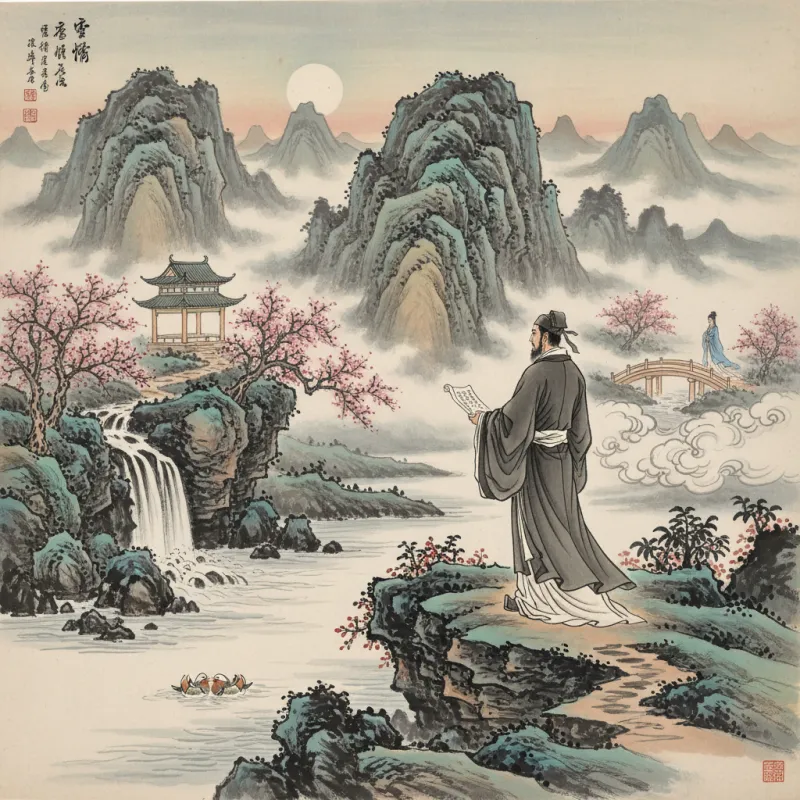
When Li Bai stood drunk beneath the moon, composing verses to an absent lover, he wasn't just writing poetry—he was channeling a thousand years of Chinese literary tradition into a form so potent it would echo for another millennium. Love poetry in classical China wasn't the domain of starry-eyed romantics alone; it was serious business, a proving ground where the empire's finest minds wrestled with desire, separation, and the ache of unfulfilled longing.
The Tang Dynasty: When Love Poetry Became High Art
The Tang dynasty (618-907 CE) transformed love poetry from courtly entertainment into a sophisticated literary form. This wasn't accidental. The Tang examination system demanded that aspiring officials master poetry, and what better subject to demonstrate emotional depth and technical skill than love? The result was an explosion of romantic verse that ranged from the playfully erotic to the devastatingly melancholic.
Li Bai (李白, Lǐ Bái, 701-762) approached love with characteristic abandon. His "Changgan xing" (长干行, Chánggàn Xíng) traces a woman's love from childhood playmates to married separation, each stage rendered with precise emotional detail. But it's the waiting that kills: "At fifteen I stopped scowling, / I desired my dust to be mingled with yours / Forever and forever and forever." The repetition of "forever" (永, yǒng) isn't just emphasis—it's obsession made linguistic.
Du Fu (杜甫, Dù Fǔ, 712-770), typically known for his social conscience, revealed unexpected tenderness in poems to his wife. During the An Lushan Rebellion, separated by war, he wrote "Moonlit Night" imagining her watching the same moon, their children too young to understand why father hasn't returned. The genius lies in the reversal—he doesn't describe his own longing but projects himself into her experience, a radical act of empathy that deepens the emotional impact.
Yet the Tang's most influential contribution to love poetry might be the ci (词, cí) form's precursor in regulated verse. The strict tonal patterns and caesuras of Tang poetry forced poets to compress emotion into crystalline moments. When Wang Wei (王维, Wáng Wéi) writes of red beans growing in southern lands as tokens of longing, he's not being quaint—he's encoding an entire emotional vocabulary that later poets would spend centuries unpacking.
The Song Dynasty: Intimacy and Interiority
The Song dynasty (960-1279) took Tang innovations and turned inward. If Tang love poetry was often public performance, Song poetry became private confession. The ci form, now fully developed, allowed for irregular line lengths and more colloquial language—perfect for capturing the messy reality of romantic feeling.
Li Qingzhao (李清照, Lǐ Qīngzhào, 1084-1155) remains the undisputed master of Song love poetry. Her early works, written during her happy marriage to Zhao Mingcheng, sparkle with playful eroticism. In one famous ci, she describes being "too lazy to paint my eyebrows" after her husband's departure, then worrying he'll return to find her unpresentable. The domestic detail—those unpainted eyebrows—does more emotional work than a thousand declarations of devotion.
After Zhao's death, Li Qingzhao's poetry transformed into something almost unbearable in its grief. Her "Sheng sheng man" (声声慢, Shēng Shēng Màn) opens with seven repeated characters suggesting searching and seeking, a linguistic stutter that mirrors her psychological state. She's not just sad—she's trapped in a loop of loss, and the form itself enacts that entrapment.
The Song also saw male poets exploring vulnerability in new ways. Su Shi (苏轼, Sū Shì, 1037-1101), better known as Su Dongpo, wrote "Jiangcheng zi" (江城子, Jiāngchéng Zǐ) ten years after his first wife's death. The poem's power comes from its restraint—he doesn't describe her directly but focuses on the dream where they met, her hair already white, both of them speechless. The silence between them says everything.
What distinguishes Song love poetry is its psychological realism. These poets understood that love isn't just longing—it's also resentment, boredom, guilt, and a hundred other contradictory feelings. They gave themselves permission to be complicated, and their poetry is richer for it. For more on how Song poets revolutionized emotional expression, see The Evolution of Ci Poetry in the Song Dynasty.
The Yuan Dynasty: Love Under Foreign Rule
The Yuan dynasty (1271-1368), established by Mongol conquerors, created a strange paradox for Chinese poets. The traditional examination system was suspended, eliminating poetry's role as a path to power. Freed from official constraints but also from official patronage, poets turned to drama and the sanqu (散曲, sǎnqǔ) form—a looser, more vernacular style of lyric poetry.
Yuan love poetry often carries an undercurrent of political allegory. When Guan Hanqing (关汉卿, Guān Hànqīng, c. 1220-1300) wrote plays featuring star-crossed lovers, audiences understood the subtext: love between Chinese and Mongol, or between different social classes now scrambled by conquest, reflected the dynasty's upheaval. His "Dou E yuan" (窦娥冤, Dòu É Yuān) isn't primarily a love story, but its treatment of a widow's loyalty to her dead husband's memory resonated in an era when traditional values seemed under siege.
The sanqu form allowed for unprecedented colloquialism. Ma Zhiyuan (马致远, Mǎ Zhìyuǎn, c. 1250-1321) could write about love using marketplace language, even slang. His "Autumn Thoughts" isn't explicitly about romantic love, but its depiction of a traveler's loneliness—"withered vines, old trees, evening crows"—captures the isolation that makes love's absence so acute.
What's fascinating about Yuan love poetry is how it democratized the form. Without the examination system's gatekeeping, more voices entered the conversation. We have more poetry by women, by merchants, by people outside the traditional literati class. The emotional range expanded too—Yuan poets were more willing to write about sexual desire directly, about the physical aspects of love that Tang and Song poets often encoded in metaphor.
Recurring Themes: The Architecture of Longing
Across all three dynasties, certain images recur with almost obsessive frequency. The moon, obviously—but not just as a symbol of beauty. The moon is what separated lovers see simultaneously, a celestial meeting point when earthly reunion is impossible. When Zhang Jiuling (张九龄, Zhāng Jiǔlíng) writes "The moon, grown full now over the sea, / Brightening the whole of heaven," he's not describing astronomy but creating a shared space for lovers divided by distance.
Autumn appears constantly in love poetry, and not just because Chinese poets loved seasonal imagery. Autumn is the season of separation—when officials left for distant posts, when military campaigns ended, when the year itself began dying. The falling leaves weren't just pretty; they were a countdown to winter's isolation.
Dreams occupy a special place in this tradition. In dreams, the dead return, the absent appear, social barriers dissolve. But Yuan Zhen (元稹, Yuán Zhěn, 779-831) understood the cruelty of dreams too. His poem to his dead wife Wei Cong describes dreaming of her, then waking to find "the quilt cold, the lamp dim." The dream doesn't console—it makes the loss sharper by contrast.
Water imagery—rivers, rain, tears—flows through these poems, often blurring together. Is the river the tears, or are tears the river? The ambiguity is intentional. These poets understood that emotional states and natural phenomena mirror each other, that the pathetic fallacy isn't a fallacy at all but a recognition of how thoroughly our feelings color our perception.
Gender and Voice: Who Speaks for Whom?
One of the most interesting aspects of Chinese classical love poetry is the prevalence of male poets writing in female voices. This wasn't considered strange or appropriative—it was a demonstration of skill, the ability to inhabit another's perspective. But it also raises questions about whose experiences these poems actually represent.
When Li Bai writes as an abandoned woman, is he channeling real female experience or performing an idealized version of feminine devotion? The answer is probably both. Male poets had access to women's poetry and conversation, especially in the courtesan culture of the Tang. They weren't writing in a vacuum. But they were also writing for male audiences, and their female speakers often embody male fantasies about female constancy.
Li Qingzhao's poetry matters partly because it provides a counterpoint. Her female speakers are more complex, more willing to express anger or frustration. When she writes about missing her husband, she also writes about being annoyed with him, about the mundane irritations of marriage. Her women are people, not symbols.
The Yuan dynasty, with its social disruption, seems to have created more space for actual female voices. We have more poetry by courtesans, by nuns, by women outside the aristocratic class. Their love poetry is often more pragmatic, less idealized—love as economic arrangement, as survival strategy, as well as emotional bond. For a deeper exploration of female voices in classical poetry, see Women Poets of the Tang and Song Dynasties.
Literary Techniques: How Longing Takes Shape
Chinese classical poets had a sophisticated toolkit for expressing love and longing. Parallelism, a fundamental feature of Chinese poetry, allowed them to create emotional resonance through structural balance. When Du Fu writes "The stars lean down from open space, / And the moon comes running up the river," the parallel structure suggests a universe in motion, everything rushing toward connection—except the separated lovers.
Allusion was another crucial technique. A single reference to an earlier poem could invoke an entire emotional context. When a Song poet mentions the "blue bird" (青鸟, qīng niǎo), educated readers immediately thought of the messenger between the Queen Mother of the West and her mortal lover—a whole mythology of impossible love compressed into two characters.
The use of empty space in Chinese poetry mirrors the use of empty space in Chinese painting. What's not said matters as much as what is. When Li Shangyin (李商隐, Lǐ Shāngyǐn, 813-858) writes his famously ambiguous love poems, the obscurity isn't a failure of communication—it's the point. Love, especially forbidden or lost love, exists in the realm of the unsayable.
Tonal patterns in regulated verse created emotional effects that don't translate into English. The rising and falling tones could suggest questions, assertions, hesitations—a whole emotional landscape encoded in sound. Modern readers miss this dimension, but it was crucial to how these poems worked on their original audiences.
Legacy and Influence: Love Poetry's Long Shadow
The love poetry of the Tang, Song, and Yuan dynasties didn't just influence later Chinese literature—it shaped how Chinese culture thinks about romantic love. The ideal of the devoted wife waiting for her traveling husband, the scholar pining for an unattainable beauty, the widow remaining faithful to her dead spouse—these became cultural templates, for better and worse.
Modern Chinese poets still wrestle with this tradition. Some embrace it, finding in classical forms a connection to cultural roots. Others rebel against it, seeing in its idealized love a constraint on authentic feeling. But even in rebellion, they're in dialogue with Li Bai, Li Qingzhao, and their peers.
What makes this poetry endure isn't just its technical brilliance or historical importance. It's the recognition that love—in all its joy, pain, and complexity—is fundamentally the same across centuries. When we read Li Qingzhao describing her unpainted eyebrows, or Du Fu imagining his wife watching the moon, we're not accessing some exotic foreign emotion. We're recognizing ourselves.
The greatest achievement of Tang, Song, and Yuan love poetry might be its refusal to simplify. These poets understood that love is never just one thing—it's desire and duty, passion and pragmatism, ecstasy and grief, often simultaneously. They gave us a language for that complexity, and we're still learning to speak it. For those interested in how these themes evolved in later periods, explore Love and Loss in Ming and Qing Poetry.
Related Reading
- Love Poetry in Chinese Literature: The Art of Saying Everything by Saying Nothing
- Love Poetry in Classical Chinese: The Art of Saying Everything by Saying Almost Nothing
- Li Qingzhao: China's Greatest Female Poet
- The 10 Greatest Chinese Love Poems of All Time
- Poems of Separation: The Chinese Art of Saying Goodbye
- War Poetry of the Tang Dynasty: When Soldiers Became Poets
- Mountain and Water Poetry (山水诗): When Landscape Becomes Literature
- Women Poets of China: Voices Across Three Millennia
Explore Chinese Culture
- Explore the Tang dynasty's golden age
- Explore Daoist themes in classical poetry
- Explore Chinese literary traditions