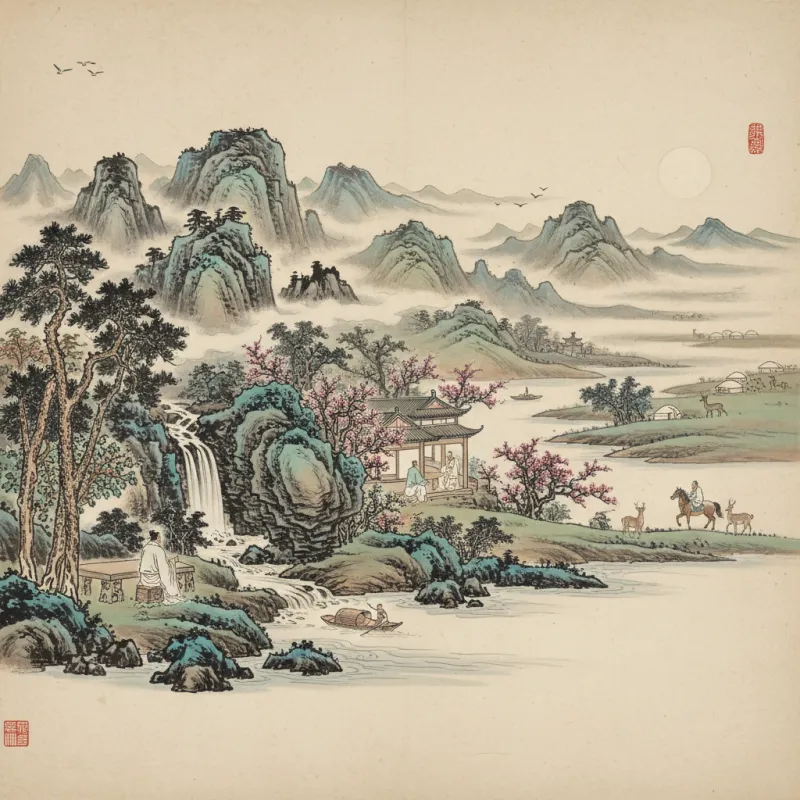
A single crane lifts from the marshland at dawn, and in that moment, a Tang dynasty poet sees not just a bird but the entire cosmos in motion. This is the peculiar genius of Chinese classical poetry—the ability to collapse vast philosophical truths into a dewdrop on a lotus leaf, to hear the turning of seasons in the rustle of bamboo. From the 7th to the 14th centuries, poets of the Tang, Song, and Yuan dynasties didn't merely describe nature; they dissolved the boundary between observer and observed, creating a literary tradition where mountains think and rivers remember.
The Tang Dynasty: When Mountains Had Voices
The Tang dynasty (618-907) produced what many consider the golden age of Chinese poetry, and at its heart was an almost mystical relationship with the natural world. Wang Wei (王维, Wáng Wéi), the poet-painter who retreated to his estate in the Zhongnan Mountains, perfected what scholars call "landscape poetry" (山水诗, shānshuǐ shī)—but this term barely captures what he achieved. In poems like "Deer Park" (鹿柴, Lù Zhài), Wang Wei writes of empty mountains where no one appears, yet human voices echo. The paradox is intentional: nature in Tang poetry is never truly empty, never merely backdrop.
Li Bai (李白, Lǐ Bái), the "Immortal of Poetry," took a different approach. Where Wang Wei meditated, Li Bai celebrated. His famous "Drinking Alone Beneath the Moon" positions the poet with the moon and his shadow as drinking companions—nature not as separate from human experience but as participant in it. The moon doesn't just illuminate; it joins the party. This wasn't metaphor for Tang poets; it was cosmology. The concept of tianren heyi (天人合一, tiānrén héyī)—the unity of heaven and humanity—wasn't abstract philosophy but lived experience on the page.
Du Fu (杜甫, Dù Fǔ), often paired with Li Bai as the dynasty's greatest poets, brought political consciousness to nature poetry. When he writes of autumn winds breaking his thatched roof, he's simultaneously describing weather and the collapse of social order during the An Lushan Rebellion. Nature in Du Fu's hands becomes a language for speaking about human suffering without sentimentality. The seasonal imagery he employs carries weight beyond mere description—falling leaves aren't just autumn; they're the fall of dynasties.
Song Dynasty: The Inward Turn
The Song dynasty (960-1279) inherited Tang poetry's nature obsession but refined it, made it more introspective, more philosophical. This was partly circumstance—the Song never matched the Tang's territorial expanse or military confidence. Song poets turned inward, and nature became a mirror for examining consciousness itself.
Su Shi (苏轼, Sū Shì), known by his courtesy name Su Dongpo, exemplifies this shift. His "Red Cliff Ode" doesn't just describe the Yangtze River; it meditates on the relationship between permanence and change, using the river as a vehicle for Buddhist and Daoist philosophy. The water flows endlessly, yet is never the same water—a observation that becomes a treatise on existence. Su Shi's innovation was making nature poetry think harder, dig deeper into questions of meaning and mortality.
The Song dynasty also saw the rise of ci (词, cí) poetry, lyric verses set to musical patterns. Li Qingzhao (李清照, Lǐ Qīngzhào), the most celebrated female poet of the era, used natural imagery with devastating emotional precision. Her descriptions of yellow flowers and autumn winds aren't decorative—they're psychological landscapes. When she writes of being "thinner than the yellow flowers," she's collapsed the distance between inner emotional state and outer natural world completely. The symbolism of flowers in her work operates on multiple registers simultaneously.
Song nature poetry also became more technical, more concerned with craft. The "regulated verse" (律诗, lǜshī) form demanded precise tonal patterns and parallelism, forcing poets to work within strict constraints. This limitation paradoxically produced greater freedom—like a jazz musician working within chord changes, Song poets found infinite variation within formal boundaries. The natural world provided an inexhaustible vocabulary for these formal experiments.
Yuan Dynasty: Nature Under Foreign Rule
The Yuan dynasty (1271-1368), established by Mongol conquerors, created a peculiar situation for Chinese literati. Many educated Chinese, barred from government service under foreign rule, retreated—literally and figuratively—into nature. The poetry of this period carries an undertone of resistance, though often subtle.
Ma Zhiyuan (马致远, Mǎ Zhìyuǎn), a master of the sanqu (散曲, sǎnqǔ) form—a freer, more colloquial verse style—wrote "Autumn Thoughts," which became one of the most famous Chinese poems. Its opening lines catalog natural images: withered vines, old trees, evening crows, small bridges, flowing water, people's homes. Each image is simple, almost plain, but their accumulation creates overwhelming melancholy. This is nature poetry as emotional architecture, building feeling through careful placement of elements.
Yuan dynasty poets often adopted the persona of the recluse, the hermit who withdraws from corrupt society into mountain solitude. This wasn't always literal—many "recluse" poets lived in cities—but the stance was ideologically significant. Nature became a space of moral purity in contrast to the compromised political world. The bamboo, which bends but doesn't break, became a favorite symbol of the principled scholar maintaining integrity under pressure.
The Yuan also saw increased interest in drama, and nature imagery migrated into theatrical works. Guan Hanqing (关汉卿, Guān Hànqīng) and other playwrights incorporated seasonal settings and natural metaphors into their plays, extending the poetic tradition into new forms. The natural world remained central to Chinese literary imagination even as genres evolved.
Philosophical Foundations: Daoism, Buddhism, and Confucianism
Understanding Chinese nature poetry requires grasping its philosophical underpinnings. These aren't academic abstractions but lived worldviews that shaped how poets perceived and represented the natural world.
Daoism, with its emphasis on naturalness (自然, zìrán) and non-action (无为, wúwéi), encouraged poets to see nature as teacher and model. The Daoist sage doesn't impose will on the world but moves with it, like water flowing around obstacles. This philosophy produced poetry that values spontaneity, simplicity, and the wisdom of observing natural processes. Wang Wei's quiet mountain poems are essentially Daoist meditation in verse form.
Buddhism, particularly Chan (Zen) Buddhism, contributed the concept of sudden enlightenment through direct perception. The natural world became a trigger for awakening—a falling flower, a bird's cry could precipitate understanding beyond words. This influenced poetry toward compression, toward the moment of insight rather than extended description. The haiku tradition in Japan, which developed from Chinese poetry, took this tendency to its logical extreme.
Confucianism, often seen as more concerned with social order than nature, actually provided crucial context. The Confucian emphasis on moral cultivation meant that nature wasn't escape from human concerns but a realm where ethical principles could be observed and learned. The pine tree standing firm through winter became a lesson in constancy; the lotus rising pure from muddy water demonstrated the possibility of maintaining virtue in corrupt times.
Technical Mastery: Form and Function
Chinese classical poetry operates under constraints that English-language readers often don't appreciate. The tonal system of Classical Chinese—with its four tones in Middle Chinese—created musical patterns that are lost in translation. Regulated verse required not just rhyme but specific tonal patterns in specific positions, creating a sonic architecture as important as semantic meaning.
Parallelism, another key feature, demanded that lines mirror each other in grammatical structure and often in meaning. A line about mountains would be balanced by a line about rivers; a reference to spring would find its counterpart in autumn. This wasn't mere decoration but a formal embodiment of the philosophical principle of balance and complementarity. Nature provided the perfect vocabulary for these parallel structures—the natural world is full of paired opposites that nonetheless form unified wholes.
The compression of Classical Chinese—where a single character can carry multiple meanings and grammatical functions—allowed poets to pack enormous complexity into brief forms. A five-character line might contain a complete scene, an emotional state, and a philosophical observation simultaneously. This density makes Chinese poetry notoriously difficult to translate; what takes five characters in Chinese might require twenty words in English, losing the compression that's essential to the effect.
Legacy and Influence
The nature poetry of the Tang, Song, and Yuan dynasties didn't end with those periods—it established templates and expectations that shaped Chinese literature for centuries. Even modern Chinese poets, writing in vernacular language and free verse, carry the weight of this tradition. The assumption that nature and human experience are intimately connected, that landscape can be psychological as well as physical, that seasonal change mirrors emotional states—these remain fundamental to Chinese literary consciousness.
The influence extended beyond China's borders. Japanese poetry absorbed and transformed Chinese models, creating its own nature-focused traditions. Korean and Vietnamese literatures similarly drew on Chinese classical poetry as foundation and inspiration. In the 20th century, as Chinese poetry became available in translation, Western poets from Ezra Pound to Gary Snyder found in it alternatives to European literary traditions, different ways of positioning the human in relation to the natural world.
What makes this poetry endure isn't just aesthetic beauty—though it has that in abundance—but its fundamental insight: that we are not separate from nature, observing it from outside, but part of its processes. The crane lifting from the marsh, the moon reflected in the wine cup, the autumn wind scattering leaves—these aren't symbols standing for something else. They are the thing itself, and we are in them as they are in us. This is the harmony that Chinese classical poetry achieved, and why, more than a millennium later, we still return to these poems seeking not just beauty but a way of being in the world.
Related Reading
- The Four Seasons in Chinese Poetry: A Seasonal Reading Guide
- Nature Poetry in the Tang Dynasty: Mountains, Rivers, and the Art of Seeing
- The Moon in Chinese Poetry: 50 Ways to Say 'I Miss You'
- Mountain and Water Poetry (山水诗): When Landscape Becomes Literature
- Nature Poetry in Chinese Literature: Seeing the World as the Poets Saw It
- Delving into the Techniques of Chinese Classical Poetry: Insights from Tang, Song, and Yuan Poets
- Why Some Chinese Poems Are Untranslatable: The Beauty That Gets Lost
- Zen Poetry: Enlightenment in Seventeen Syllables
Explore Chinese Culture
- Explore the Tang dynasty's golden age
- Explore Daoist themes in classical poetry
- Explore Chinese literary traditions