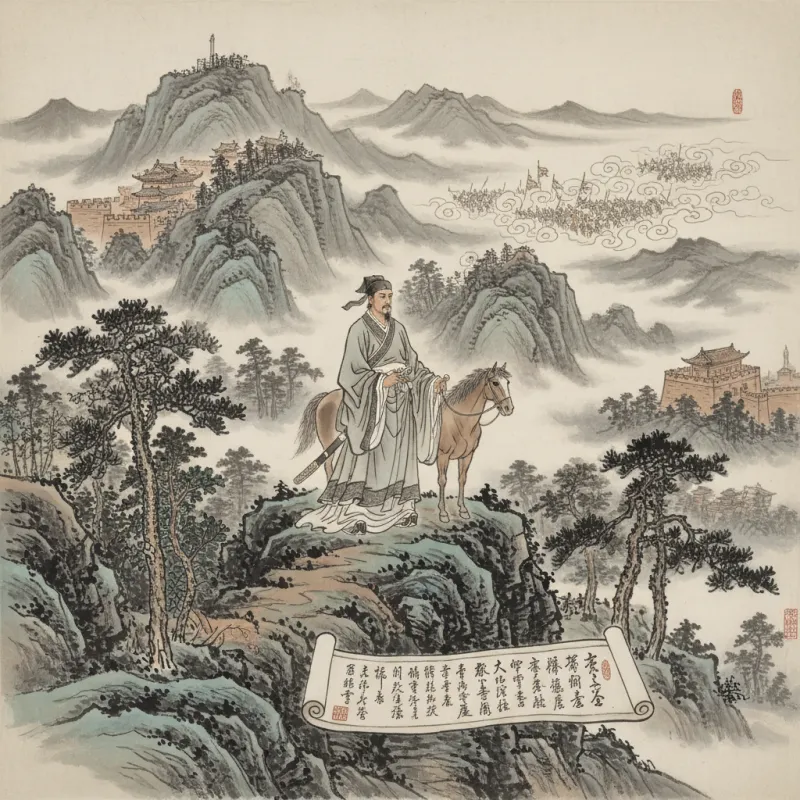
Picture this: A 21-year-old man rides through enemy lines with fifty cavalry, crashes a military camp of fifty thousand soldiers, drags out a traitor, and escapes alive. That man was Xin Qiji (辛弃疾, Xīn Qìjí, 1140–1207), and it was the most action he'd see in his entire life. The Southern Song government made sure of that.
For the next forty years, one of China's greatest military minds wrote poetry instead of battle plans. Not because he wanted to — because his own government wouldn't let him fight. The result? Some of the most emotionally raw, militarily obsessed, and technically brilliant ci poetry (词, cí) ever written. Xin Qiji turned his rage, his nostalgia, and his wasted potential into words. And those words hit harder than most poets' entire careers.
Born Behind Enemy Lines
Xin Qiji entered the world in 1140 in Jinan, Shandong province — territory that had been under Jurchen Jin dynasty (金朝, Jīn Cháo) control for thirteen years. The Jingkang Incident of 1127 had split China in half: the Jin ruled the north, the Song retreated south of the Huai River. Xin grew up watching Han Chinese officials collaborate with foreign rulers, learning both Chinese classics and the bitter taste of occupation.
His grandfather, Xin Zan, never accepted Jin rule. He took young Xin Qiji on trips to scout Jin military positions, disguised as innocent travel. The old man was planning something — a return to Song loyalty, a future resistance. He died before he could act, but he'd already planted the seed in his grandson.
By 1161, when Xin was 21, that seed had grown into a guerrilla army. The Jin emperor Wanyan Liang launched a massive invasion of the south, and northern China erupted in rebellion. Xin Qiji raised two thousand men. His commander, a monk named Geng Jing, led a larger force of twenty-five thousand. For a brief moment, it looked like the north might liberate itself.
Then a traitor named Zhang Anguo murdered Geng Jing and prepared to surrender the entire rebel army to the Jin. Xin Qiji took fifty horsemen, rode into Zhang's camp of fifty thousand soldiers, captured the traitor, and brought him back alive. Three days later, he delivered Zhang to the Southern Song court — along with a rebel army ready to fight for Chinese reunification.
The Song officials thanked him politely and gave him a minor bureaucratic position. The war he'd risked everything for? Not interested.
The Government That Wouldn't Fight
The Southern Song dynasty (南宋, Nán Sòng, 1127–1279) had a problem: it was run by people who'd made peace with losing. After the catastrophic loss of the north, the court had relocated to Hangzhou, rebuilt, and settled into a comfortable stalemate. Yes, they'd lost half the country. Yes, they paid humiliating tribute to the Jin. But Hangzhou was prosperous, the Yangzi River valley was rich, and war was expensive and unpredictable.
Xin Qiji represented everything this government feared: aggressive military action, risky northern campaigns, the kind of bold strategy that could either reconquer the north or provoke a Jin invasion that would destroy the south. The court had already executed Yue Fei (岳飞, Yuè Fēi), their most successful general, in 1142 for being too effective against the Jin. They weren't about to let another military hardliner destabilize their careful diplomatic balance.
So they buried Xin in civilian administration. Governor of small prefectures. Commissioner of tea and salt monopolies. Pacification commissioner — a title dripping with irony for a man who wanted to wage war. He wrote proposal after proposal for northern campaigns, detailed military strategies, plans for training troops and building supply lines. The court filed them away and did nothing.
Twice, he was dismissed from office entirely, accused of being too aggressive or too critical of peace policies. He spent years in forced retirement on his estate in Jiangxi province, watching his military prime slip away while bureaucrats in Hangzhou debated whether to send another tribute mission to the Jin.
The frustration was unbearable. And it poured into his poetry.
Ci Poetry as Battlefield
Ci poetry started as entertainment music — song lyrics for banquets, usually about romance, nature, and the melancholy of separation. Poets like Liu Yong had expanded its emotional range, but it was still considered a "minor" form compared to the serious shi poetry (诗, shī) tradition. Xin Qiji took ci and turned it into a weapon.
His ci poems are full of swords, horses, military camps, and blood. He writes about polishing armor, about cavalry charges, about the specific sound of a horn at the northern frontier. In "Poshan Xi" (破阵子, Pòzhèn Zǐ, "Breaking Through Enemy Lines"), he describes:
"Drunk, I light the lamp to examine my sword / Dreaming, I return to the camp of linked bugles / Eight hundred li of troops under my command / Fifty strings turning on the frontier / Autumn soldiers on the battlefield"
This isn't metaphor. This is a man describing the military career he never got to have, in a poetic form traditionally reserved for describing pretty women and spring flowers.
He also brought a new linguistic roughness to ci. Where earlier poets polished every character to jewel-like perfection, Xin Qiji threw in colloquialisms, military slang, and deliberately jarring juxtapositions. He'd quote Confucian classics in one line and describe getting drunk in a village tavern in the next. He mixed high and low registers the way Su Shi had done, but with more violence, more anger, more barely-contained rage at his wasted life.
His technical skill was undeniable. He mastered every ci tune pattern, wrote in both the shorter xiaodiao (小调, xiǎodiào) and longer manci (慢词, màncí) forms, and could shift emotional registers within a single poem with devastating effect. But what made his work revolutionary was the subject matter: a warrior writing poetry because he wasn't allowed to fight.
The Poems Everyone Remembers
"Qingyu An" (青玉案, Qīngyù Àn, "Green Jade Table") is probably Xin's most famous poem, written for the Lantern Festival. It starts with a gorgeous description of festival lights and crowds, then ends with a sudden turn:
"In the crowd I searched for her a thousand times / Suddenly turning my head / There she was, where the lights were dying"
Generations of readers have interpreted this as a love poem. But Xin Qiji scholars know better — the woman in the shadows represents his abandoned ideals, his lost military ambitions, everything he searched for and couldn't find in the bright, busy world of Southern Song politics.
"Yongyule · Jingkou Beiguting Huaigu" (永遇乐·京口北固亭怀古, Yǒngyùlè · Jīngkǒu Běigùtíng Huáigǔ, "Eternal Happiness · Remembering the Past at Jingkou's Beiguting Pavilion") is his most explicitly political work. Written at age 66, it compares the current Song emperor to Liu Yu, the general who'd briefly reconquered the north in 420 CE. The poem is full of historical allusions, military references, and barely-disguised criticism of the court's passivity. The final lines are devastating:
"I can still remember / Beneath Beaver Shrine / A scene of bustling life / But who would ask / If Lian Po in his old age / Can still eat?"
Lian Po was a Warring States general who, in exile and old age, proved he could still fight by eating a huge meal and riding a horse. Xin is asking: I'm old now, but I can still fight. Will anyone give me the chance? The answer, of course, was no.
The Jiaxuan Style
Xin Qiji's literary name was Jiaxuan (稼轩, Jiàxuān, "Harvest Studio"), and his style became known as the haofang (豪放, háofàng, "heroic and unrestrained") school of ci poetry. Where the wanyue (婉约, wǎnyuē, "graceful and restrained") style emphasized delicate emotions and refined language, haofang ci was bold, masculine, and often angry.
But here's what's interesting: Xin could write in the wanyue style too. He wrote tender poems about his wife, gentle nature observations, and delicate emotional sketches. He chose not to limit himself to that style because it couldn't contain what he needed to say. The haofang style wasn't just an aesthetic choice — it was a psychological necessity.
His influence on later ci poetry was enormous. Poets like Liu Chenweng (刘辰翁, Liú Chénwēng) and Wen Tianxiang (文天祥, Wén Tiānxiáng) — the latter a general who actually got to fight the Mongol invasion and died for it — looked to Xin as a model for how to write politically engaged, emotionally intense ci. Even poets who didn't share his military obsessions borrowed his technical innovations: the colloquial language, the historical allusions, the sudden emotional pivots.
The War That Finally Came (Too Late)
In 1206, the aging Song court finally decided to launch a northern campaign. Xin Qiji was 66 years old. They appointed him Pacification Commissioner of Zhejiang and Fujian, with orders to prepare troops for the invasion.
He threw himself into the work with the energy of a young man. After forty years of forced inaction, he was finally going to fight. He organized supplies, trained soldiers, and prepared detailed campaign strategies. This was it. This was what he'd been waiting for his entire life.
He died in September 1207, before the campaign launched. His last words, according to his biography, were: "Sha zei! Sha zei!" (杀贼!杀贼! Shā zéi! Shā zéi!) — "Kill the enemy! Kill the enemy!"
The northern campaign, when it finally happened in 1208, was a disaster. The Song forces were poorly coordinated, the Jin counterattacked successfully, and the whole operation collapsed within months. It's hard not to wonder what would have happened if they'd listened to Xin Qiji forty years earlier, when he was young and the Jin were weaker.
Why Xin Qiji Still Matters
There's something uniquely painful about Xin Qiji's story. He wasn't a failed warrior who turned to poetry as consolation. He was a successful warrior who was never allowed to fight, who had to channel all that military energy into words instead. His poetry is what happens when you take a man built for action and force him into contemplation.
This makes his work different from other politically frustrated poets. Du Fu (杜甫, Dù Fǔ) witnessed the An Lushan Rebellion and wrote about war's devastation. Xin Qiji witnessed peace and wrote about war's absence. His poems aren't about the trauma of violence — they're about the trauma of being prevented from acting, of watching your country stay divided because the people in power are too comfortable to risk change.
Modern readers sometimes struggle with Xin's militarism. All those poems about swords and battles and reconquest can feel uncomfortably aggressive, especially when we know that the Song dynasty's eventual fall came from overextension and military adventurism (just not the kind Xin advocated). But his poetry isn't really about war — it's about purpose, about having the skills and will to do something important and being systematically prevented from doing it.
That frustration is universal. How many people spend their lives in jobs that don't use their real talents? How many watch problems they could solve go unsolved because the people in charge won't take risks? Xin Qiji wrote 600 ci poems about that feeling, and they still sting 800 years later.
His technical innovations — the rough language, the military imagery, the political directness — opened up new possibilities for what ci poetry could do and say. But his real legacy is emotional: he proved that poetry could contain rage, frustration, and unfulfilled ambition without losing its artistic power. Sometimes the most beautiful art comes from the ugliest feelings.
The Southern Song dynasty lasted another 72 years after Xin Qiji's death. In 1279, the Mongols conquered the last Song remnants. The north and south were finally reunified — just not the way Xin had imagined. His poems survived the dynasty that wouldn't let him fight. That's probably the best revenge a poet can get.
Related Reading
- Su Shi: The Renaissance Man of Chinese Literature
- Li Qingzhao: The Greatest Female Poet in Chinese History
- What Is Song Ci? A Guide to China's Other Great Poetry Tradition
- Song Ci: The Lyrics That Broke Poetry's Rules
- Mountain and Water Poetry (山水诗): When Landscape Becomes Literature
- The Spiritual Depth of Chinese Classical Poetry: Insights from Tang, Song, and Yuan Poets
- The Banana Garden Poetry Club: When Women Took Over Chinese Poetry
Explore Chinese Culture
- Explore the Tang dynasty's golden age
- Explore Daoist themes in classical poetry
- Explore Chinese literary traditions