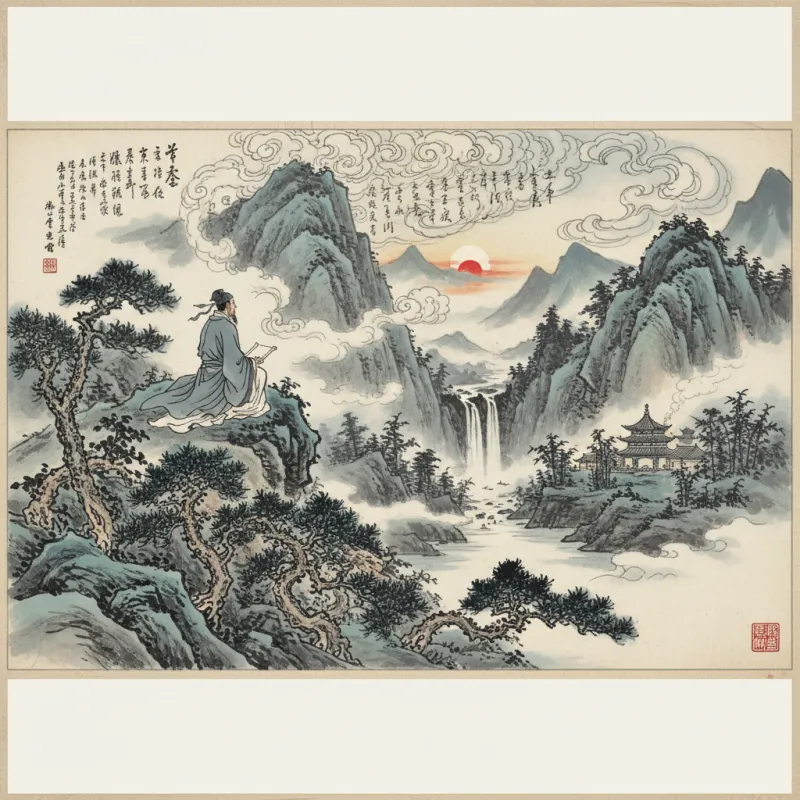
A monk asks his master: "What is Buddha?"
The master replies: "Three pounds of flax."
If that exchange makes no sense to you, congratulations — you're having the correct response. Koans (公案, gōng'àn) aren't supposed to make sense. They're supposed to break your mind open like an egg, and what hatches is supposed to be enlightenment.
What's less well known outside specialist circles is that Chinese poets spent centuries turning this same principle into verse. Not poems about koans — poems that are koans. Verses designed to function the way a master's shout functions: as a sudden interruption of ordinary thinking. These weren't devotional hymns or philosophical treatises dressed up in meter. They were literary hand grenades, and the poets who wrote them knew exactly what they were doing.
The Legal Origins of Spiritual Confusion
The word 公案 (gōng'àn) literally means "public case" — a legal term, like a court record. In Chan Buddhist practice, koans are paradoxical statements or questions that resist logical analysis. They're the recorded exchanges between masters and students, preserved not as historical curiosities but as active teaching tools.
The earliest collections appeared during the Tang Dynasty (618-907), but the form crystallized during the Song (960-1279). The Blue Cliff Record (碧巖錄, Bìyán Lù), compiled in 1125, and the Gateless Gate (無門關, Wúmén Guān) from 1228 became the canonical texts. Each case presents a moment of teaching — often bewildering, sometimes violent, always designed to short-circuit conceptual thinking.
But here's what makes the Chinese tradition distinctive: these cases weren't just prose dialogues. Masters began appending verses to them, commentary poems that didn't explain the koan but deepened its mystery. And eventually, poets started writing verses that functioned as standalone koans, needing no prose frame at all.
When Monks Started Writing Like Poets
The pivot point comes with Xuedou Chongxian (雪竇重顯, 980-1052), a Chan master who was also a genuinely gifted poet. For each of the hundred cases in what would become the Blue Cliff Record, Xuedou wrote a verse. These weren't explanatory footnotes. They were poetic koans responding to prose koans, creating a hall of mirrors effect.
Take Case 18, where a monk asks Zhaozhou (趙州, 778-897): "Does a dog have Buddha-nature?"
Zhaozhou answers: "Mu" (無) — literally "no" or "nothing."
Xuedou's verse response:
Dog, Buddha-nature —
The pronouncement, perfect and complete.
Before you say it has or has not,
You are a dead man.
Notice what he's doing. He's not explaining why Zhaozhou said "mu." He's creating another trap door beneath your feet. The verse is the teaching, not commentary on the teaching.
This approach influenced generations of poet-monks who followed. The line between Chan practice and poetic composition blurred until it essentially disappeared. Writing a poem became a form of meditation, and meditation produced poems that couldn't be distinguished from spiritual instruction.
The Structure of Poetic Paradox
These koan-poems follow certain patterns, though calling them "patterns" feels wrong — like describing a Zen garden as "organized rocks." Still, you can identify recurring techniques.
Sudden reversal: The poem sets up an expectation, then demolishes it in the final line. Yuanwu Keqin (圓悟克勤, 1063-1135) was a master of this. His verses often build a seemingly coherent image, then end with something that makes you question whether you understood anything at all.
Impossible imagery: Describing things that can't exist or situations that violate basic logic. "The wooden man sings at midnight" or "stone women dance at dawn." These aren't metaphors to be decoded. They're meant to jam your interpretive machinery.
Direct pointing: Sometimes the poem abandons imagery entirely and just... points. "This!" or "Look!" The most famous example might be from Dongshan Liangjie (洞山良价, 807-869): "Just this person" (只這個人, zhǐ zhè gè rén). Three words that generations of students have broken their heads against.
Seasonal juxtaposition: Using natural imagery in ways that create cognitive dissonance. Spring and autumn in the same line. Snow and blossoms. The natural world becomes unnatural, which is somehow more natural than our concepts of nature.
The form most commonly used was the jueju (絕句), the four-line regulated verse that Tang poets had perfected. But in the hands of Chan poets, the jueju became something stranger. The parallelism that usually creates balance instead creates tension. The tonal patterns that should produce harmony produce dissonance.
Shitou Xiqian and the Poetry of Non-Duality
Shitou Xiqian (石頭希遷, 700-790) wrote what might be the most influential koan-poem in Chinese Buddhism: the Sandokai (參同契, Cāntóng Qì), "Harmony of Difference and Equality." It's 224 characters of pure philosophical poetry, and it's still chanted in Zen monasteries worldwide.
The opening lines:
The mind of the great sage of India
Is intimately transmitted from west to east.
While human faculties are sharp or dull,
The Way has no northern or southern ancestors.
This doesn't sound like "three pounds of flax," does it? It's more philosophical, more systematic. But watch what happens as the poem develops. Shitou builds a framework of light and dark, difference and sameness, then systematically undermines every distinction he's made. By the end, you're not sure what anything means, but you feel like you understand something.
That's the koan-poem at its most sophisticated. It uses the appearance of logic to transcend logic. It's philosophy that eats itself and becomes something else.
The Sandokai influenced the entire trajectory of Chan poetry. Later poets learned they could work at this larger scale, creating extended meditations that functioned as koans. The poem could be a teaching tool, a practice method, and a work of art simultaneously.
The Song Dynasty Explosion
During the Song Dynasty, this tradition reached its peak. The number of literate monks increased dramatically. Printing technology made texts more widely available. And the Song literati class was obsessed with Chan Buddhism — it was fashionable in a way that earlier Buddhism hadn't been.
Poets like Dahui Zonggao (大慧宗杲, 1089-1163) wrote thousands of verses, many functioning as koans. His style was aggressive, confrontational. He'd challenge students with poems that were essentially verbal attacks, designed to provoke sudden realization.
Meanwhile, the Caodong school (曹洞宗, Cáodòng Zōng) — which emphasized gradual cultivation — developed a gentler style of koan-poetry. Their verses used natural imagery more extensively, creating what looked like landscape poetry but functioned as spiritual instruction. A poem about mountains and rivers was simultaneously about mountains and rivers and about the nature of mind.
This is where the tradition intersects most clearly with mainstream Chinese poetry. Poets like Su Shi (蘇軾, 1037-1101) weren't monks, but they studied Chan Buddhism seriously and incorporated its techniques into their work. Su Shi's poetry often has a koan-like quality — moments where the ordinary world suddenly becomes strange, where a simple observation opens into something vast.
The influence ran both ways. Chan poets absorbed the technical sophistication of literati poetry, while literati poets borrowed the spiritual intensity of Chan verse. The result was a hybrid tradition that's uniquely Chinese, neither purely religious nor purely aesthetic.
Reading What Can't Be Read
So how do you approach these poems? The honest answer is: you probably can't, not in the way you read other poetry. They're not designed to be understood through analysis.
Traditional Chan training involves sitting with a koan for months or years. You don't solve it like a puzzle. You live with it until it dissolves the boundary between you and the question. The same principle applies to koan-poems.
But that doesn't mean we can't appreciate them on other levels. The craftsmanship is real. These poets were working within strict formal constraints — tonal patterns, line lengths, rhyme schemes — while trying to express something that transcends form. That's a genuine artistic achievement, regardless of whether you're pursuing enlightenment.
And there's something valuable in encountering language that refuses to be domesticated. In a world where everything gets explained, analyzed, and packaged for consumption, these poems remain stubbornly opaque. They won't give you what you want. They might give you what you need, but you won't know until later, and you might not recognize it when it arrives.
The best approach might be what the tradition itself suggests: read them out loud, repeatedly, without trying to figure them out. Let the sounds and rhythms work on you. Notice what images stick in your mind. Pay attention to the moments when your understanding seems to slip.
The Tradition's Legacy
This fusion of poetry and koan practice didn't stay confined to China. When Chan Buddhism traveled to Japan and became Zen, the tradition went with it. Japanese monks continued writing koan-poems, though the style evolved in new directions. Dogen (道元, 1200-1253), founder of the Soto school, wrote extensive poetry that functions this way.
In modern times, the tradition has fragmented. Some contemporary Zen teachers still write verses in this mode, but it's become more self-conscious, more aware of itself as a tradition. The spontaneity that characterized the Tang and Song masters is harder to achieve when you're working within a recognized genre.
Still, you can find echoes of this approach in unexpected places. Some contemporary poets — often without any direct connection to Buddhism — write in ways that create similar effects. The language poetry movement, for instance, shares some techniques with koan-poetry, though the philosophical foundations are completely different.
What persists is the basic insight: that poetry can do more than describe or express. It can function as a tool for transformation. It can create experiences that change how you perceive reality. Whether you call that enlightenment or something else, it's a real possibility that these Chinese poet-monks explored more thoroughly than almost anyone else in literary history.
The Unanswerable Question
Let's return to where we started: "What is Buddha?" "Three pounds of flax."
After everything we've discussed, does that exchange make any more sense? It shouldn't. If it does, you've probably misunderstood something.
But maybe you've noticed that the question itself has changed. It's no longer "What does this mean?" but "What is this doing?" And that shift — from content to function, from meaning to effect — is exactly what these poems are designed to produce.
The Chan masters who wrote these verses weren't trying to communicate information. They were trying to create a specific kind of experience in the reader's mind. An experience of sudden opening, of boundaries dissolving, of the ordinary world becoming luminous and strange.
Whether they succeeded is something only you can determine. And you won't determine it by thinking about it.
The tradition of koan-poetry represents one of the most sophisticated attempts in world literature to use language against itself, to make words point beyond words. It's related to the broader tradition of Buddhist poetry in Chinese literature, but it takes the project to an extreme. Where devotional poetry praises the Buddha and philosophical poetry explains the dharma, koan-poetry tries to be the dharma, to function as a direct transmission of awakening.
Does it work? Ask me again when you've sat with "three pounds of flax" for a few years. Or better yet, don't ask. Just sit.
The final word should probably go to Xuedou, whose verses we discussed earlier. In his commentary on Case 46 of the Blue Cliff Record, he writes:
Everywhere is the Way —
Pick it up, it fills your hand.
Everything you encounter is the source —
Obvious, but hard to see.
That's a koan-poem about koan-poems. It tells you everything and nothing. It's perfectly clear and completely opaque. It's exactly what it needs to be.
And if you still don't understand, well — that's the point.
Related Reading
- Cold Mountain Poems of Hanshan: The Hermit Who Wrote on Rocks
- Buddhist Poetry in Chinese Literature: Enlightenment in Twenty Characters
- Wang Wei's Buddhist Nature Poems: Silence as Spiritual Practice
- The Spiritual Depth of Chinese Classical Poetry: Insights from Tang, Song, and Yuan Poets
- Buddhist Impermanence in Tang Poetry: Everything You Love Will Disappear
- Regulated Verse (律诗): The Strictest Form in World Poetry
- Wine Poetry: The Chinese Tradition of Drinking and Writing
- Bai Juyi: The Song of Everlasting Sorrow
Explore Chinese Culture
- Explore the Tang dynasty's golden age
- Explore Daoist themes in classical poetry
- Explore Chinese literary traditions