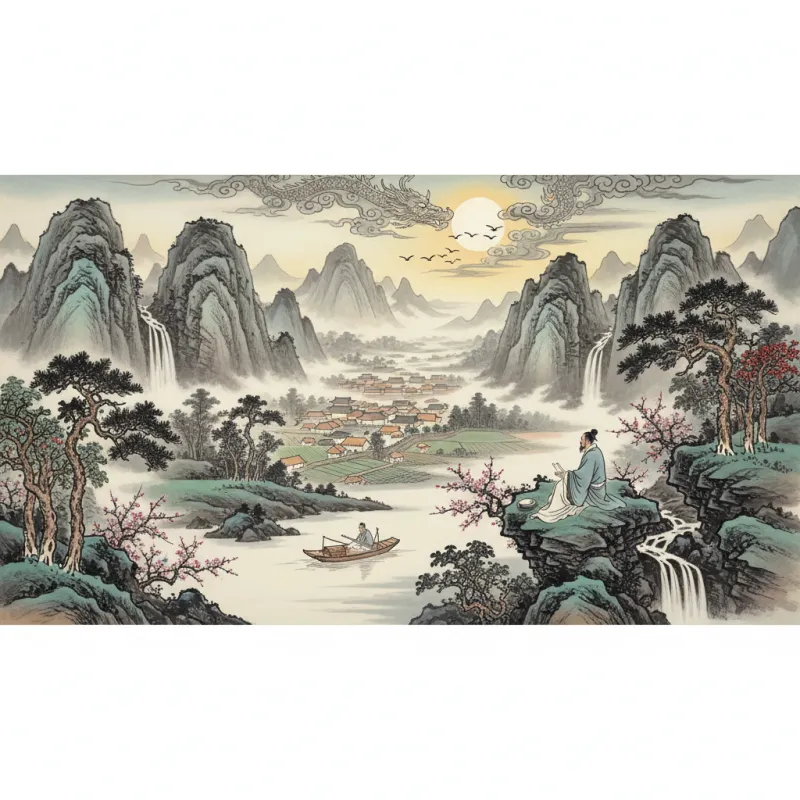
Picture this: It's 742 AD in Chang'an, the world's largest city, and a drunk poet named Li Bai (李白, Lǐ Bái) is being summoned to the imperial palace. Emperor Xuanzong wants poetry—now. Li Bai staggers in, demands that a court official remove his boots, and proceeds to compose verses so brilliant that the emperor forgives everything. This wasn't an isolated incident. This was the Tang dynasty, where poetry mattered more than military rank, where a single couplet could make or break a career, and where the greatest minds of an empire poured their genius into five or seven-character lines that still make readers weep thirteen centuries later.
Why These Three Dynasties Changed Poetry Forever
The Tang (618–907), Song (960–1279), and Yuan (1271–1368) dynasties didn't just produce good poetry—they fundamentally transformed what poetry could be. The Tang perfected regulated verse (lǜshī, 律诗) with its strict tonal patterns and parallelism, creating a form so demanding that mastering it became the ultimate test of literary skill. The Song dynasty poets, living in a more introspective age after the Tang's cosmopolitan confidence had faded, turned inward and developed the ci (词) form—lyric poetry set to musical patterns that allowed for irregular line lengths and more personal expression. Then came the Mongol Yuan dynasty, which paradoxically gave Chinese poetry new life through the sanqu (散曲) form, a freer style that incorporated colloquial language and challenged the aristocratic refinement of earlier periods.
What makes this progression fascinating is how each dynasty's poetry reflected its political reality. Tang poets wrote with the swagger of an empire at its peak—Du Fu (杜甫, Dù Fǔ) could describe a palace banquet and a peasant's suffering in the same breath because Tang society contained both extremes. Song poets, governing a smaller, more threatened state, developed an aesthetic of restraint and melancholy that perfectly captured their historical moment. And Yuan poets, many of them Chinese literati serving Mongol rulers or refusing to serve at all, used poetry as a form of cultural resistance, preserving Chinese literary traditions even as the political order collapsed.
The Tang Masters and Their Impossible Standards
When we talk about Tang poetry, we're really talking about an embarrassment of riches. Li Bai wrote as if drunk on moonlight and wine—which he often was—producing spontaneous-seeming verses that were actually crafted with meticulous care. His "Quiet Night Thought" (静夜思, Jìng Yè Sī) is so simple that Chinese children memorize it, yet so perfect that translators despair of capturing its essence. Du Fu, his contemporary and stylistic opposite, wrote with a social conscience that made him the "poet-historian" of his age. While Li Bai was imagining conversations with the moon, Du Fu was documenting the An Lushan Rebellion's devastation in poems like "Spring View" (春望, Chūn Wàng), where even flowers seem to weep at the state's collapse.
But the Tang dynasty produced hundreds of major poets beyond these two giants. Wang Wei (王维, Wáng Wéi) merged Buddhist philosophy with landscape poetry in ways that influenced Chinese painting for centuries. Bai Juyi (白居易, Bái Jūyì) wrote in a deliberately accessible style because he believed poetry should be understood by common people, not just scholars—a radical position that made him wildly popular. And then there's Li Shangyin (李商隐, Lǐ Shāngyǐn), whose late-Tang poems are so densely allusive and emotionally complex that scholars still argue about their meanings. His "Untitled" poems (无题, Wútí) use romantic imagery that might be about love, politics, or metaphysical longing—probably all three simultaneously.
The examination system made poetry a practical necessity for anyone seeking government office, which meant that Tang China produced more skilled poets per capita than any society before or since. This wasn't poetry as a hobby—it was poetry as a survival skill, a social currency, and a path to power.
Song Dynasty: When Poetry Became Personal
The Song dynasty inherited the Tang's poetic forms but couldn't match its confidence. How could they? The Tang had been a superpower; the Song was constantly threatened by northern invaders and eventually lost half its territory. This anxiety produced a different kind of poetry—more introspective, more concerned with private emotions than public themes, more willing to find beauty in small moments rather than grand gestures.
Su Shi (苏轼, Sū Shì), known by his courtesy name Su Dongpo, embodied this shift. He wrote in every form available—regulated verse, ci lyrics, prose essays—and brought a philosophical depth influenced by Buddhism, Daoism, and Confucianism. His "Red Cliff Odes" (赤壁赋, Chìbì Fù) contemplate mortality and meaning while describing a boat trip, turning a simple excursion into a meditation on human existence. When he was exiled to Huangzhou after political troubles, he didn't write angry denunciations—he wrote about cooking pork and finding contentment in simplicity.
The ci form reached its peak during the Song dynasty, and poets like Li Qingzhao (李清照, Lǐ Qīngzhào) showed what it could do. As one of the few female poets whose work survived in significant quantity, Li Qingzhao wrote ci that moved from youthful romance to the grief of widowhood and war with devastating honesty. Her late poems, written after fleeing the Jurchen invasion that destroyed the Northern Song, contain some of the most powerful expressions of loss in Chinese literature. The ci form's flexibility—its ability to shift between long and short lines, to modulate tone within a single poem—perfectly suited this kind of emotional complexity.
Yuan Dynasty: Poetry Under Foreign Rule
The Mongol conquest in 1279 should have been a disaster for Chinese poetry. The examination system was suspended for decades, meaning the traditional path to poetic fame was closed. Many educated Chinese refused to serve the Yuan government, retreating to private life. Yet this period produced remarkable poetry, partly because poets had to find new audiences and new purposes for their art.
The sanqu form emerged as the Yuan dynasty's distinctive contribution, and it was deliberately different from earlier poetry. Where Tang regulated verse demanded tonal precision and Song ci required matching established musical patterns, sanqu incorporated colloquial language, folk elements, and a looser structure. Poets like Guan Hanqing (关汉卿, Guān Hànqīng) and Ma Zhiyuan (马致远, Mǎ Zhìyuǎn) used sanqu to write about everyday life, romantic love, and the pleasures of retirement with a directness that would have seemed crude to Tang purists.
Ma Zhiyuan's "Autumn Thoughts" (天净沙·秋思, Tiānjìngshā·Qiūsī) is only 28 characters long but creates an entire landscape of loneliness: withered vines, old trees, crows at dusk, a small bridge, flowing water, an ancient road, a west wind, a thin horse, and the sun setting as a heartbroken person stands at the edge of the world. This compression of imagery became a hallmark of Yuan poetry—saying more with less, trusting the reader to feel the emotional weight without elaborate explanation.
The Technical Brilliance Behind the Beauty
Understanding what made Tang, Song, and Yuan poetry great requires appreciating the technical constraints poets worked within. Tang regulated verse (lǜshī) demanded that the second and third couplets use strict parallelism—matching parts of speech, balancing tones, creating symmetry while avoiding monotony. The tonal patterns of Classical Chinese, with its four tones, created musical effects that are impossible to reproduce in English. A skilled Tang poet could make the sound of the poem reinforce its meaning, using level tones for calm passages and deflected tones for moments of tension.
The prosody rules were so complex that poets spent years mastering them, yet the best poems make these constraints invisible. When Du Fu writes about watching his country fall apart, you don't notice that he's following strict rules about which syllables must be level-toned and which must be deflected. You just feel the weight of his grief and anger.
Song ci added another layer of complexity because each poem had to match a specific tune pattern (cipai, 词牌), with predetermined line lengths, rhyme schemes, and tonal requirements. There were hundreds of these patterns, each with its own name and associations. Writing a ci to the tune of "Ripples Sifting Sand" (浪淘沙, Làng Táo Shā) meant working within a completely different structure than "The River Is Red" (满江红, Mǎn Jiāng Hóng). Poets had to master these forms so thoroughly that they could express spontaneous emotion within rigid structures—like jazz musicians improvising within complex chord changes.
Why This Poetry Still Matters
These poems aren't museum pieces. They're living texts that Chinese speakers still memorize, quote in conversation, and reference in everything from political speeches to pop songs. When a modern Chinese person wants to express loneliness, they might quote Ma Zhiyuan's "Autumn Thoughts." When celebrating friendship, they turn to Li Bai. When facing hardship, Du Fu's resilience speaks across centuries.
The influence extends beyond China. Japanese poetry absorbed Chinese forms and created its own variations. Korean sijo poetry developed in dialogue with Chinese models. Vietnamese poetry used Chinese characters and forms until the 20th century. Even contemporary American poets like Gary Snyder and Kenneth Rexroth found inspiration in Tang dynasty nature poetry, though their translations often simplified the originals' technical complexity.
What makes this poetry universal is its combination of specific cultural detail and fundamental human emotion. You don't need to understand Tang dynasty politics to feel Li Bai's loneliness when he writes about drinking alone with the moon as his companion. You don't need to know Song history to understand Su Shi's meditation on mortality at Red Cliff. The best poems from these dynasties work on multiple levels—as historical documents, as technical achievements, as philosophical statements, and as pure emotional expression.
Reading These Poems Today
Approaching Tang, Song, and Yuan poetry as a modern reader means accepting that something is always lost in translation. The tonal music of Classical Chinese, the layers of historical and literary allusion, the visual impact of calligraphy—none of this survives the journey into English. But something essential does survive: the human voice speaking across time about love, loss, nature, friendship, and the search for meaning.
Start with anthologies that provide context and multiple translations. Compare different English versions of the same poem to see how translators make different choices. Learn a few poems in Chinese, even if you don't speak the language—hearing the sounds helps you understand why these poems mattered. And remember that Tang dynasty poets themselves were reading and responding to earlier traditions, just as Song and Yuan poets were responding to the Tang. This is poetry in conversation with itself across centuries, and you're invited to join that conversation.
The greatest gift of Tang, Song, and Yuan poetry is its reminder that technical mastery and emotional authenticity aren't opposites—they're partners. These poets proved that working within strict formal constraints can actually deepen expression rather than limiting it. In an age of free verse and casual communication, there's something bracing about poetry that demands everything from its creators: perfect technique, deep learning, and absolute honesty. That's why, thirteen centuries after Li Bai staggered into the imperial palace, we're still reading his poems and still finding new meanings in them.
Related Reading
- Exploring Chinese Classical Poetry: Tang, Song, and Yuan Poets’ Literary Legacy
- Confucian Values in Classical Chinese Poetry: Duty, Loyalty, and the Weight of the World
- The Timeless Art of Song Poets: A Deep Dive into Classical Chinese Poetry
- Poetry Drinking Games: When Literature Met Entertainment
Explore Chinese Culture
- Explore the Tang dynasty's golden age
- Explore Daoist themes in classical poetry
- Explore Chinese literary traditions