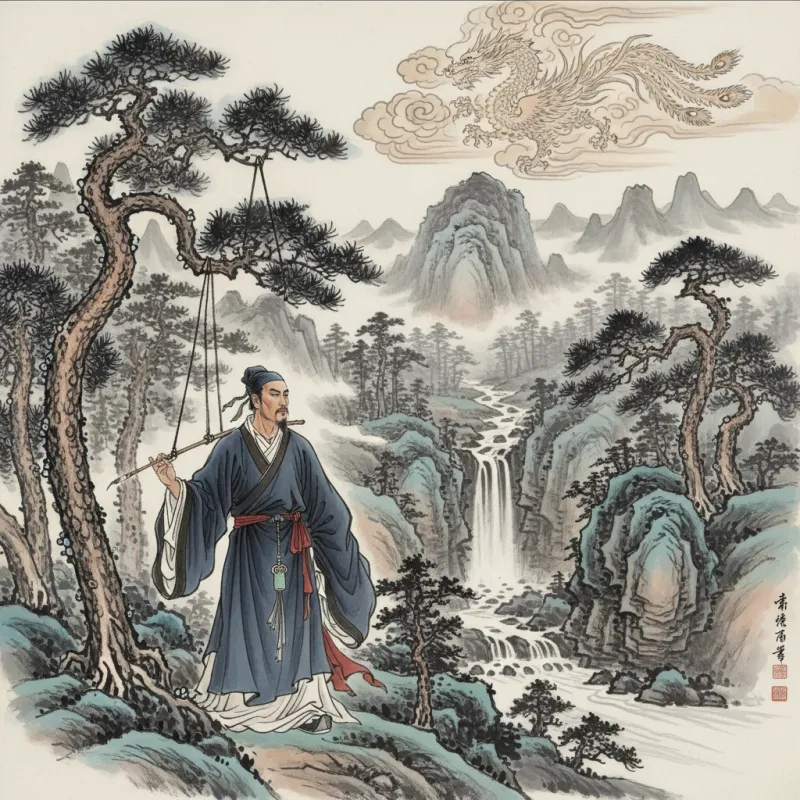
A Tang dynasty official stands at his desk before dawn, brush in hand, staring at a blank sheet of paper. Outside, the empire is fracturing. Rebels control three provinces. The emperor has fled the capital. His own family is scattered, possibly dead. He dips his brush and writes: "The nation broken, mountains and rivers remain" (国破山河在, guó pò shān hé zài). This is Du Fu (杜甫, Dù Fǔ, 712–770), and he's about to demonstrate what happens when Confucian values collide with poetic genius under impossible pressure.
The weight Du Fu carried wasn't just personal grief — it was the accumulated moral burden of an entire philosophical tradition that insisted poetry must serve society. When Confucius said "Poetry can be used to inspire, to observe, to bring people together, and to express grievances" (诗可以兴,可以观,可以群,可以怨, shī kěyǐ xīng, kěyǐ guān, kěyǐ qún, kěyǐ yuàn), he wasn't offering a suggestion. He was defining what poetry is in a properly ordered world. For the next two millennia, Chinese poets would wrestle with this definition, and the best of them — Du Fu, Bai Juyi (白居易, Bái Jūyì, 772–846), Lu You (陆游, Lù Yóu, 1125–1210) — would create masterpieces precisely because they took the burden seriously.
The Confucian Contract: Poetry as Moral Technology
Confucius didn't invent Chinese poetry, but he did something more influential: he made it morally necessary. In the Analects (论语, Lúnyǔ), he repeatedly emphasizes the Book of Songs (诗经, Shījīng) as essential to education. "If you don't study the Songs," he tells his son, "you'll have nothing to say in conversation." But this isn't about cocktail party small talk. The Songs, in Confucian thought, are a technology for moral cultivation. They teach you to feel the right things at the right times, to recognize virtue and vice in human behavior, to understand the relationship between individual emotion and social order.
This creates a peculiar pressure on poets. Your job isn't just to write beautifully — it's to write in a way that makes society better. The concept of zai dao (载道, "carrying the Way") becomes central to Chinese poetics. Poetry is a vehicle, and what it carries is moral truth. This is why Chinese literary criticism spends so much time debating whether a poem is "correct" (正, zhèng) or "deviant" (邪, xié). These aren't aesthetic judgments — they're moral ones.
The three Confucian values that dominate classical poetry are duty (yi, 义), loyalty (zhong, 忠), and filial piety (xiao, 孝). But in practice, these values often conflict. What do you do when your duty to the people conflicts with your loyalty to an incompetent emperor? What happens when serving your parents means abandoning your post? The greatest Confucian poetry emerges from these contradictions, not from their resolution.
Du Fu: The Poet Who Couldn't Look Away
Du Fu is the ultimate Confucian poet, which means he's the ultimate sufferer. His most famous poem, "Spring View" (春望, Chūn Wàng), written during the An Lushan Rebellion (755–763), opens with that devastating line about the broken nation. But watch what he does next: "City in spring, grass and trees grow deep. / Feeling the times, flowers bring tears. / Hating separation, birds startle the heart" (城春草木深。感时花溅泪,恨别鸟惊心, chéng chūn cǎomù shēn. Gǎn shí huā jiàn lèi, hèn bié niǎo jīng xīn).
This is Confucian observation (guan, 观) at its finest. Du Fu isn't just describing nature — he's showing how a morally cultivated person experiences nature during a national crisis. The flowers make him cry not because they're beautiful, but because their beauty exists alongside human suffering. The birds startle him because in a properly ordered world, birds should be comforting. Everything in nature becomes a moral commentary on the state of human affairs.
Du Fu's sense of duty is almost pathological. In "Ballad of the Army Carts" (兵车行, Bīng Chē Xíng), he describes conscripts being dragged away to endless frontier wars: "At fifteen they went north to guard the river, / At forty they're still farming military colonies in the west" (十五北防河,四十西营田, shíwǔ běi fáng hé, sìshí xī yíng tián). He can't write a simple nature poem without thinking about the peasants whose labor makes his leisure possible. In "Thatched Hut Damaged by Autumn Wind" (茅屋为秋风所破歌, Máo Wū Wéi Qiūfēng Suǒ Pò Gē), his own roof is blown off, but he immediately pivots to imagining "a great mansion with ten thousand rooms / To shelter all the world's poor scholars in joy" (安得广厦千万间,大庇天下寒士俱欢颜, ān dé guǎng shà qiān wàn jiān, dà bì tiānxià hán shì jù huān yán).
This is what Confucian duty looks like in poetry: you literally cannot think about your own suffering without immediately connecting it to everyone else's. It's exhausting to read, and it must have been excruciating to live.
Loyalty's Impossible Demands
Loyalty (zhong, 忠) in Confucian thought isn't blind obedience — it's something more complicated and more painful. You're supposed to be loyal to the ruler, yes, but also to remonstrate when the ruler is wrong. You're supposed to serve the state, but the state is supposed to embody moral principles, and when it doesn't, what then?
Qu Yuan (屈原, Qū Yuán, c. 340–278 BCE), though pre-Confucian, becomes the patron saint of this dilemma. Exiled by a king who wouldn't listen to his advice, he drowns himself in the Miluo River rather than serve a corrupt court or abandon his principles. His "Encountering Sorrow" (离骚, Lí Sāo) is 373 lines of gorgeous, anguished loyalty to an ideal that no longer exists in reality. "Many are the burdens I carry in my heart," he writes, "and I grieve that I was born in such an age" (余固知謇謇之為患兮,忍而不能舍也, yú gù zhī jiǎn jiǎn zhī wéi huàn xī, rěn ér bù néng shě yě).
The Tang and Song dynasties are full of poets wrestling with this same problem. Bai Juyi, demoted for criticizing government policy, writes "Watching the Wheat Reapers" (观刈麦, Guān Yì Mài), where he observes peasants working themselves to death to pay taxes while he, a government official, collects a salary "without farming or raising silkworms" (不种不蚕, bù zhǒng bù cán). The poem is an act of loyalty — he's pointing out systemic injustice — but it's also an admission of complicity. He's part of the system he's criticizing.
Lu You, watching the Song dynasty crumble before Jurchen invasions, writes poem after poem demanding military action to recover lost territory. In "Shown to My Sons" (示儿, Shì Ér), written on his deathbed, he tells his children: "When the royal armies recover the Central Plains, / Don't forget to tell your father at the family sacrifice" (王师北定中原日,家祭无忘告乃翁, wáng shī běi dìng zhōng yuán rì, jiā jì wú wàng gào nǎi wēng). He dies still loyal to a cause that will never succeed, still believing the empire can be restored. It's heartbreaking and, from a practical standpoint, completely pointless. But that's what Confucian loyalty demands: you don't give up just because the situation is hopeless.
The Family Trap: Filial Piety vs. Public Service
Filial piety (xiao, 孝) is supposed to be the foundation of all other virtues. If you can't serve your parents properly, how can you serve the state? But classical Chinese poetry is full of officials who can't do both. The government sends you to a distant post, and your parents are old, possibly dying, and you're not there. What do you do?
Meng Jiao (孟郊, Mèng Jiāo, 751–814) writes "Song of the Wandering Son" (游子吟, Yóu Zǐ Yín), one of the most famous poems about maternal love in Chinese literature: "The thread in a loving mother's hands / Becomes the clothes on a wandering son's body" (慈母手中线,游子身上衣, cí mǔ shǒu zhōng xiàn, yóu zǐ shēn shàng yī). The poem ends with a question that has no good answer: "Who says the heart of an inch of grass / Can repay three springs of sunshine?" (谁言寸草心,报得三春晖, shuí yán cùn cǎo xīn, bào dé sān chūn huī). You can't repay your parents. The debt is infinite. And yet you're supposed to leave them to serve the state.
Wang Wei (王维, Wáng Wéi, 699–759), usually known for his serene Buddhist-influenced nature poetry, writes "Thinking of My Brothers on the Double Ninth Festival" (九月九日忆山东兄弟, Jiǔ Yuè Jiǔ Rì Yì Shāndōng Xiōngdì) while serving far from home: "Alone in a strange land, a stranger among strangers, / At every festival I think of my family twice as much" (独在异乡为异客,每逢佳节倍思亲, dú zài yì xiāng wéi yì kè, měi féng jiā jié bèi sī qīn). The poem is simple, almost plain, but it captures the essential loneliness of the Confucian official: you're supposed to serve the public good, but the cost is permanent separation from the people you actually love.
This tension never gets resolved in classical poetry. It just gets repeated, in different forms, across centuries. The poets don't offer solutions because there aren't any. They just document the cost.
When the Weight Becomes Unbearable: Complaint and Critique
Confucius said poetry can "express grievances" (yuan, 怨), and this becomes the escape valve for the entire system. When duty, loyalty, and filial piety become impossible to fulfill simultaneously, you're allowed to complain — but only in specific, sanctioned ways. You can criticize bad officials, but not the system itself. You can lament your exile, but you have to frame it as longing to serve. You can express personal suffering, but you have to connect it to larger social problems.
The "New Yuefu" (新乐府, Xīn Yuèfǔ) movement, led by Bai Juyi, tries to use poetry as direct social criticism. These poems describe specific abuses: corrupt tax collectors, brutal military conscription, peasants starving while officials feast. "The Elderly Charcoal Seller" (卖炭翁, Mài Tàn Wēng) tells the story of an old man who spends all year making charcoal, only to have palace eunuchs confiscate it for a pittance. The poem ends with devastating understatement: "Half a bolt of red gauze and one zhang of silk / Tied to the ox's head as the price for the charcoal" (半匹红绡一丈绫,系向牛头充炭直, bàn pǐ hóng xiāo yī zhàng líng, xì xiàng niú tóu chōng tàn zhí).
But even this criticism operates within Confucian bounds. Bai Juyi isn't calling for revolution — he's calling for better officials who will implement Confucian principles properly. The system itself is never questioned. This is both the strength and the limitation of Confucian poetry: it can document suffering with extraordinary precision, but it can't imagine a world fundamentally different from the one it inhabits.
The Cost of Carrying the Way
What's remarkable about Confucian poetry isn't that it succeeds in making the world better — it mostly doesn't — but that it keeps trying. Du Fu's poems didn't stop the An Lushan Rebellion. Bai Juyi's social criticism didn't reform the tax system. Lu You's patriotic verses didn't recover the Central Plains. But they kept writing as if poetry mattered, as if the right words at the right time could actually change something.
This is the real weight of Confucian values in classical poetry: not the specific moral content, but the belief that poetry has moral obligations in the first place. It's a burden that produces extraordinary work precisely because it's so heavy. When you believe your poems should inspire virtue, observe society, build community, and express legitimate grievances, you can't just write pretty descriptions of flowers. Every image becomes freighted with moral significance. Every personal emotion connects to public responsibility.
Modern readers sometimes find this exhausting. We're used to poetry as self-expression, as aesthetic experiment, as anything but moral instruction. But there's something compelling about poets who believed their work mattered beyond the page, who thought beauty and duty weren't opposites but partners. Du Fu standing at his desk before dawn, writing about a broken nation while the empire collapses around him — that's not just historical curiosity. That's a model of what it means to be a writer who refuses to look away, who insists that art has responsibilities, who carries the weight even when it's crushing.
The question isn't whether we should return to Confucian poetics — we can't and probably shouldn't. But we might ask what we've lost by abandoning the idea that poetry should do more than please us, that it might actually have work to do in the world. The Confucian poets knew that work was impossible to complete, that the weight would never get lighter, that they would probably fail. They wrote anyway. That's not just duty or loyalty or filial piety. That's something closer to faith.
For more on how philosophical traditions shaped poetic practice, see Daoist Spontaneity in Tang Poetry and Buddhist Emptiness and Song Dynasty Verse.
Related Reading
- Poetry as Philosophy: How Chinese Poets Think
- Zen Poetry: Enlightenment in Seventeen Syllables
- Daoist Poetry: The Art of Doing Nothing
- Daoist Poetry: Finding the Way Through Nature
- The Timeless Elegance of Chinese Classical Poetry: Tang, Song, and Yuan Eras
- Delving into the Techniques of Chinese Classical Poetry: Insights from Tang, Song, and Yuan Poets
- Lost in Translation: Famous Challenges in Translating Chinese Poetry
- Wang Wei's Buddhist Nature Poems: Silence as Spiritual Practice
Explore Chinese Culture
- Explore the Tang dynasty's golden age
- Explore Daoist themes in classical poetry
- Explore Chinese literary traditions