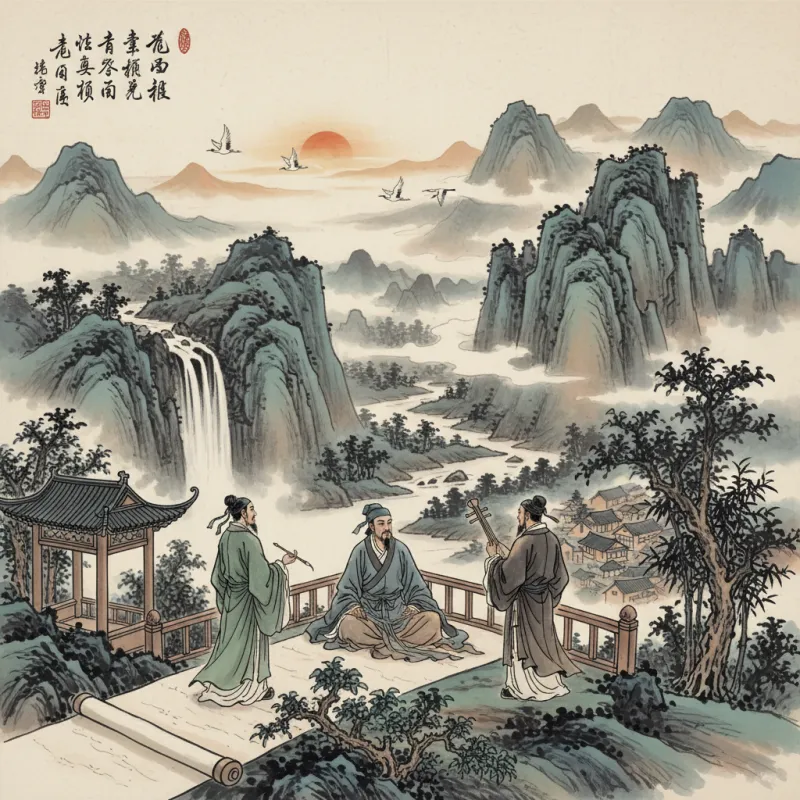
When Li Bai (李白, Lǐ Bái) drunkenly composed poems while floating down the Yangtze River, he wasn't just writing verse—he was crystallizing a thousand years of Chinese literary tradition into moments of pure linguistic alchemy. The poetry of the Tang, Song, and Yuan dynasties represents not merely a collection of beautiful words, but a living conversation across centuries about what it means to be human, to feel loss, to celebrate nature, and to grapple with the impermanence of all things.
The Tang Dynasty's Revolutionary Poetic Voice
The Tang Dynasty (618–907 CE) didn't just produce great poetry—it made poetry the currency of social advancement. Civil service examinations required mastery of regulated verse, or lüshi (律詩, lǜshī), meaning every educated person had to be a competent poet. This created an unprecedented literary ecosystem where innovation thrived alongside strict formal constraints.
Li Bai and Du Fu (杜甫, Dù Fǔ) represent two poles of Tang poetic genius. Li Bai embodied the romantic wanderer, his verses soaked in wine and moonlight, celebrating spontaneity and transcendence. His famous "Quiet Night Thought" captures homesickness in just twenty characters, yet its simplicity conceals profound emotional depth. Du Fu, by contrast, was the Confucian realist, documenting war's devastation and social inequality with unflinching precision. His "Spring View" written during the An Lushan Rebellion (755–763) transforms personal grief into universal commentary on war's futility.
What made Tang poetry revolutionary was its perfection of tonal patterns and parallelism. Each character's tone—level or oblique—had to follow prescribed patterns, creating a musical quality that's impossible to fully translate. Wang Wei (王維, Wáng Wéi) mastered this technical precision while infusing his landscape poetry with Buddhist philosophy, creating what critics call "paintings in poetry, poetry in paintings." His work influenced generations of literati painters and poets who sought to capture spiritual truth through natural imagery.
Song Dynasty's Introspective Turn
The Song Dynasty (960–1279) inherited Tang's poetic legacy but transformed it into something more introspective and philosophically complex. The ci (詞, cí) form—originally song lyrics set to popular melodies—became the dynasty's signature contribution. Unlike the rigid structures of Tang regulated verse, ci allowed variable line lengths and more flexible tonal patterns, enabling poets to explore emotional nuance with unprecedented subtlety.
Su Shi (蘇軾, Sū Shì), also known as Su Dongpo, revolutionized ci poetry by elevating it from entertainment to high art. His "Prelude to Water Melody" written during the Mid-Autumn Festival of 1076 while separated from his brother, transforms personal longing into cosmic meditation. The famous lines "People have sorrows and joys, partings and reunions / The moon waxes and wanes" became cultural touchstones, quoted in everything from modern films to wedding toasts.
Li Qingzhao (李清照, Lǐ Qīngzhào) stands as China's greatest female poet, her work spanning the Northern and Southern Song divide. Her early poems celebrate marital happiness with playful sensuality rare in classical Chinese literature. After her husband's death and the Jin invasion forced her south, her later ci became haunting meditations on loss. The line "searching, searching, cold, cold, clear, clear, sad, sad, grieved, grieved" (尋尋覓覓,冷冷清清,淒淒慘慘戚戚) uses fourteen characters of reduplication to create an almost unbearable emotional intensity.
Song poetry also saw the rise of Neo-Confucianism, which influenced poets like Lu You to blend personal emotion with political commentary. The dynasty's emphasis on introspection and philosophical depth created poetry that rewards slow, meditative reading—each line contains layers of allusion and meaning that reveal themselves gradually.
Yuan Dynasty's Multicultural Synthesis
The Yuan Dynasty (1271–1368), established by Mongol rulers, created an unexpected literary renaissance. With traditional paths to power blocked for Han Chinese scholars, many turned to drama and a new poetic form called sanqu (散曲, sǎnqǔ)—literally "scattered songs." These verses combined ci's flexibility with colloquial language and folk influences, creating poetry that was simultaneously sophisticated and accessible.
Ma Zhiyuan (馬致遠, Mǎ Zhìyuǎn) exemplified Yuan's poetic innovation. His "Autumn Thoughts" uses just twenty-eight characters to create a devastating portrait of loneliness: "Withered vines, old trees, evening crows / Small bridge, flowing water, someone's home / Ancient road, west wind, lean horse / Evening sun setting in the west / Heartbroken person at the sky's edge." The rapid-fire imagery creates a cinematic effect, each noun phrase adding to the traveler's isolation.
Yuan poetry also reflected the dynasty's multicultural character. Poets incorporated Mongolian, Persian, and Central Asian influences, expanding Chinese poetry's thematic and stylistic range. The period's relative freedom from rigid examination requirements allowed for experimentation that would influence later dynasties' literary development.
Technical Mastery and Philosophical Depth
What distinguishes Chinese classical poetry from other traditions is its integration of technical virtuosity with philosophical profundity. The language itself—with its tonal qualities, lack of inflection, and character-based writing system—creates unique poetic possibilities. A single character can function as noun, verb, or adjective depending on context, allowing for compression and ambiguity that generates multiple valid interpretations.
The concept of yijing (意境, yìjìng)—often translated as "artistic conception" or "mood"—became central to classical poetry's aesthetic. Great poems don't just describe scenes; they create atmospheric spaces where readers experience emotions directly. Wang Wei's "Deer Park" achieves this in just twenty characters: empty mountains see no one, yet hear human voices echoing. The poem doesn't explain loneliness—it makes you feel it.
Classical Chinese poetry also employed extensive allusion, with poets referencing earlier works, historical events, and philosophical texts. A single line might contain three or four layers of meaning, each accessible to readers with different levels of literary knowledge. This created poetry that functioned simultaneously as personal expression, cultural commentary, and participation in an ongoing literary conversation spanning centuries.
Enduring Influence on Modern Literature
The legacy of Tang, Song, and Yuan poetry extends far beyond historical interest. Modern Chinese writers from Lu Xun to Bei Dao have grappled with classical forms, sometimes embracing them, sometimes rebelling against their weight. The vernacular poetry movement of the early twentieth century defined itself partly in opposition to classical constraints, yet even revolutionary poets couldn't escape classical poetry's gravitational pull.
Contemporary Chinese popular culture remains saturated with classical poetry. Lines from Li Bai and Su Shi appear in pop songs, television dramas, and social media posts. During the COVID-19 lockdowns, Chinese citizens quoted Du Fu's war poetry to express their experiences of isolation and uncertainty. This isn't mere nostalgia—classical poetry provides a shared vocabulary for articulating experiences that transcend historical periods.
Western literature has also felt classical Chinese poetry's influence, particularly through Ezra Pound's translations (however inaccurate) and the Imagist movement's emphasis on concrete imagery and compression. The haiku's popularity in English owes something to Chinese regulated verse's influence on Japanese poetry. Contemporary American poets like Gary Snyder and Kenneth Rexroth have drawn directly from Chinese classical models.
Reading Classical Poetry Today
Approaching classical Chinese poetry requires patience and willingness to accept that translation always involves loss. The tonal music, visual beauty of characters, and layers of allusion rarely survive intact in English. Yet something essential does translate—the human experiences of love, loss, political frustration, and natural beauty that motivated these poets remain immediately recognizable.
The best approach combines multiple translations with attention to historical context. Understanding that Li Bai wrote during Tang's cosmopolitan peak, while Du Fu witnessed its collapse, illuminates their different sensibilities. Knowing that Li Qingzhao composed her later poems as a refugee adds poignancy to her expressions of loss. Context doesn't explain poetry, but it opens doors to deeper appreciation.
Classical Chinese poetry also rewards memorization and recitation. Even in translation, the rhythms and imagery of great poems reveal new dimensions through repeated engagement. Su Shi's moon poems become richer when read during actual full moons. Wang Wei's mountain verses resonate differently when encountered in natural settings versus urban environments.
The Living Tradition
Chinese classical poetry isn't a dead tradition preserved in museums—it remains a living practice. Contemporary poets in China, Taiwan, and the diaspora continue writing in classical forms, proving these ancient structures can still capture modern experiences. The forms' constraints, rather than limiting expression, provide frameworks that challenge poets to achieve maximum effect with minimum means.
The Tang, Song, and Yuan dynasties created poetry that transcends its historical moment precisely because it engaged so deeply with timeless human concerns. Li Bai's moon still shines on contemporary readers. Du Fu's compassion for suffering remains relevant in our age of displacement and conflict. Li Qingzhao's grief speaks to anyone who has experienced profound loss. These poets achieved what all great literature attempts—they transformed personal experience into universal truth through the alchemy of perfectly chosen words.
Related Reading
- Discovering the Rich Legacy of Tang, Song, and Yuan Poetry
- AI vs. Human Translation of Chinese Poetry: A 2024 Comparison
- Li Bai vs Du Fu: The Rivalry That Defined Chinese Poetry
- Unveiling the Essence of Chinese Classical Poetry: Insights from Tang, Song, and Yuan Poets
Explore Chinese Culture
- Explore the Tang dynasty's golden age
- Explore Daoist themes in classical poetry
- Explore Chinese literary traditions