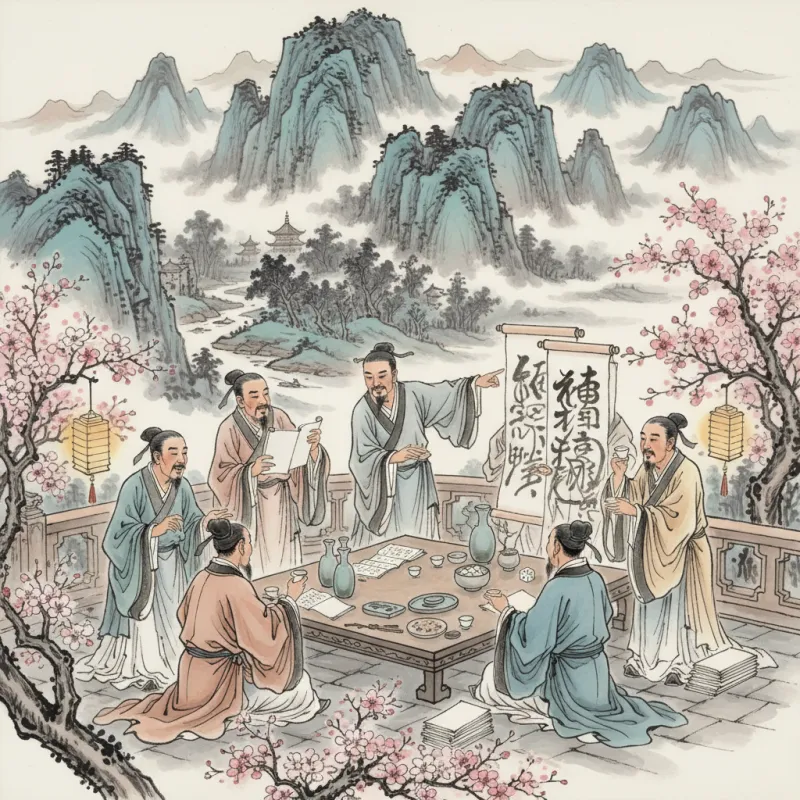
Picture this: It's 353 CE, and forty-two of China's most distinguished scholars are sitting along a winding stream, cups of wine floating toward them on the current. When a cup reaches you, you have exactly the time it takes to drift past to compose a poem. Miss your turn? Down the cup and face the shame. This wasn't just any party — this was the Orchid Pavilion Gathering (兰亭集 Lántíng Jí), and it established the template for how Chinese intellectuals would mix literature and alcohol for the next 1,700 years.
The Rules of Engagement
Tang dynasty drinking games weren't the mindless affairs we associate with modern party culture. They were structured competitions with real stakes — your reputation, your social standing, and occasionally your career prospects. The most common format was the "flowing cup" game (流觞 liúshāng), where participants sat in a circle or along a stream while a cup of wine made its rounds. When it stopped in front of you, you had to compose a poem on a given theme before the cup moved on.
The penalties were graduated based on the severity of your failure. A simple inability to produce anything? Three cups. A poem with incorrect tonal patterns (平仄 píngzè)? Five cups. Using a forbidden rhyme word that someone else had already claimed? Seven cups. And if you produced something so aesthetically offensive that it made the other scholars wince, you might be asked to drink an entire pitcher while they debated whether to invite you to the next gathering.
But here's what made these games genuinely sophisticated: the constraints were often fiendishly difficult. You might be required to compose a regulated verse (律诗 lǜshī) with eight lines, specific tonal patterns, and mandatory parallelism in the middle couplets — all while slightly drunk, under time pressure, and knowing that your peers were waiting to critique every character choice.
The Orchid Pavilion: Setting the Gold Standard
Wang Xizhi's (王羲之) Orchid Pavilion Gathering wasn't just famous because of the poetry produced that day. It was famous because Wang, who was already drunk when he wrote the preface to the collected poems, created what many consider the greatest piece of calligraphy in Chinese history. He tried to reproduce it the next day when sober and failed. The original was so prized that Emperor Taizong of Tang allegedly had it buried with him.
Of the forty-two scholars present, only twenty-six managed to produce poems. The other sixteen drank their penalties and presumably nursed their hangovers in shame. The poems that survived range from mediocre to excellent, but that wasn't really the point. The gathering established that literary culture and drinking culture were inseparable — that the slight loss of inhibition from alcohol could actually enhance creativity rather than diminish it.
This idea would echo through Chinese literary history. Li Bai (李白), perhaps the most famous poet in Chinese history, claimed he wrote his best work while drunk. His poem "Waking from Drunkenness on a Spring Day" (春日醉起言志 Chūnrì Zuì Qǐ Yán Zhì) literally argues that sobriety is a waste of time. Whether this was true or just excellent personal branding, it cemented the association between wine and poetic inspiration.
The Social Architecture of Literary Drinking
These gatherings weren't just about getting drunk and writing poems. They were carefully orchestrated social events that served multiple functions. For young scholars, they were networking opportunities — a chance to impress potential patrons or examiners who might remember your clever couplet when civil service exam results were being decided. For established poets, they were venues to maintain their reputations and mentor the next generation.
The seating arrangements mattered. At a typical literary gathering (文会 wénhuì), the most senior or accomplished poet sat at the head position. The flow of the wine cup often started with them, and their poem set the standard everyone else had to meet or exceed. This created a natural hierarchy, but also opportunities for ambitious newcomers to make their mark. Produce a poem that outshone your elder's effort, and you'd be talked about for months.
The themes were rarely arbitrary. A gathering might be held to celebrate the Double Ninth Festival (重阳节 Chóngyáng Jié), requiring poems about chrysanthemums and autumn. Or it might commemorate someone's departure for an official posting, demanding poems about separation and friendship. These constraints weren't limitations — they were the framework that made the competition meaningful. Anyone can write a poem about anything. Writing a brilliant poem about chrysanthemums in the regulated verse form while drunk and under time pressure? That's skill.
When Drinking Games Shaped Literary Forms
The pressure-cooker environment of drinking games actually influenced the development of Chinese poetic forms. The regulated verse (律诗 lǜshī) that became dominant during the Tang dynasty was perfectly suited to these competitions. Eight lines, five or seven characters per line, strict tonal patterns, mandatory parallelism — these constraints were challenging enough to separate skilled poets from pretenders, but standardized enough that everyone was competing on the same terms.
The "linked verse" form (联句 liánjù) emerged directly from drinking games. In this format, poets took turns composing couplets that had to connect thematically and tonally with what came before. It was collaborative and competitive simultaneously — you were building something together, but also trying to produce the most memorable contribution. Some of these linked verse sessions produced genuinely great poetry. Others devolved into increasingly absurd attempts to one-up the previous couplet, which was probably more fun for the participants than the readers.
The drinking game format also encouraged a certain kind of spontaneity and directness that contrasted with the more labored, polished poems scholars might produce in their studies. Some of the most famous Tang poems have a loose, improvisational quality that suggests they were composed quickly, possibly under the influence. Du Fu's (杜甫) "Drinking Alone Under the Moon" (月下独酌 Yuè Xià Dú Zhuó) captures this feeling perfectly — it's technically accomplished but feels immediate and unfiltered.
The Dark Side of Literary Drinking Culture
Not everyone thrived in this environment. The pressure to perform could be intense, and the social consequences of repeated failure were real. There are accounts of scholars who avoided literary gatherings entirely because they couldn't handle the competitive atmosphere. Others developed serious drinking problems, using alcohol as a crutch rather than a creative catalyst.
The poet Li He (李贺) reportedly carried a bag everywhere to collect poetic inspiration, but he died at twenty-seven, possibly from alcohol-related illness. The line between "drinking for inspiration" and "drinking because you're an alcoholic" was always blurry in Tang literary culture. The romanticization of the drunken poet sometimes obscured the genuine suffering that excessive drinking caused.
There was also an element of exclusivity that's uncomfortable from a modern perspective. These gatherings were almost entirely male, and they reinforced existing social hierarchies as much as they challenged them. A brilliant poem might elevate your status, but you had to be invited to the gathering in the first place. Women poets like Xue Tao (薛涛) and Yu Xuanji (鱼玄机) existed and were celebrated, but they operated in a separate sphere, often hosting their own gatherings rather than being welcomed into the mainstream literary drinking culture.
The Legacy in Modern Chinese Culture
The tradition of mixing literature and alcohol didn't end with the Tang dynasty. Song dynasty scholars continued the practice, though with somewhat less emphasis on the competitive drinking aspect. The literati of the Ming and Qing dynasties held similar gatherings, and the format influenced Japanese poetry circles when Chinese literary culture spread across East Asia.
Today, you can still find echoes of this tradition in Chinese literary culture. Modern poetry readings sometimes include drinking, though usually in a more casual, less structured way. The idea that alcohol can enhance creativity remains culturally acceptable in China in ways that might raise eyebrows in other contexts. When a contemporary Chinese poet mentions writing while drinking, they're invoking a tradition that stretches back over 1,600 years.
The drinking games themselves have largely disappeared, replaced by other forms of literary competition. But the underlying principle — that poetry is a social art, best practiced in company with others who understand and appreciate the craft — remains central to Chinese literary culture. The wine and poetry connection that those Tang dynasty scholars established continues to shape how Chinese writers think about creativity and inspiration.
What We Can Learn from Literary Drinking Games
There's something appealing about the Tang dynasty approach to poetry, even if we wouldn't want to replicate it exactly. They treated poetry as a living art form, something you did rather than just read. The competitive element kept standards high — you couldn't coast on past achievements when you had to produce something new on the spot. And the social aspect meant that poetry wasn't a solitary pursuit but a shared cultural practice.
The drinking games also embodied a particular philosophy about creativity: that constraints enhance rather than limit artistic expression. Give someone unlimited time and freedom, and they might produce nothing. Give them ten minutes, a specific theme, a rigid formal structure, and the threat of public embarrassment, and they'll often produce something remarkable. Modern writing workshops and poetry slams operate on similar principles, even if they've dropped the alcohol component.
Perhaps most importantly, these gatherings treated poetry as entertainment — not in a trivial sense, but as something that could be both intellectually serious and genuinely fun. The Tang dynasty poets who participated in these games weren't choosing between being scholars and being social creatures. They were doing both simultaneously, and their poetry was richer for it.
The next time you're at a party and someone suggests a drinking game, consider proposing a poetry competition instead. You probably won't produce anything as good as Wang Xizhi's Orchid Pavilion Preface, but you'll be participating in a tradition that's older than most countries. And who knows — maybe the combination of pressure, alcohol, and friendly competition will help you write something you couldn't have produced any other way. Just remember to drink responsibly, and maybe keep your tonal patterns straight.
Related Reading
- Drinking Poetry: Why Chinese Poets Wrote Their Best Work Drunk
- Drinking Poetry: Wine, Moonlight, and the Art of Getting Drunk with Purpose
- Wine Poetry: The Chinese Tradition of Drinking and Writing
- Unraveling the Essence of Drinking Poetry in Tang, Song, and Yuan Eras
- Li Bai's Drinking Poems: Wine, Moon, and Immortality
- Unveiling the Rich Tapestry of Chinese Classical Poetry: Insights from Tang, Song, and Yuan Dynasties
- Unveiling the Essence of Chinese Classical Poetry: Insights from Tang, Song, and Yuan Poets
- Exile Poetry: When Banishment Produced China's Greatest Literature
Explore Chinese Culture
- Explore the Tang dynasty's golden age
- Explore Daoist themes in classical poetry
- Explore Chinese literary traditions