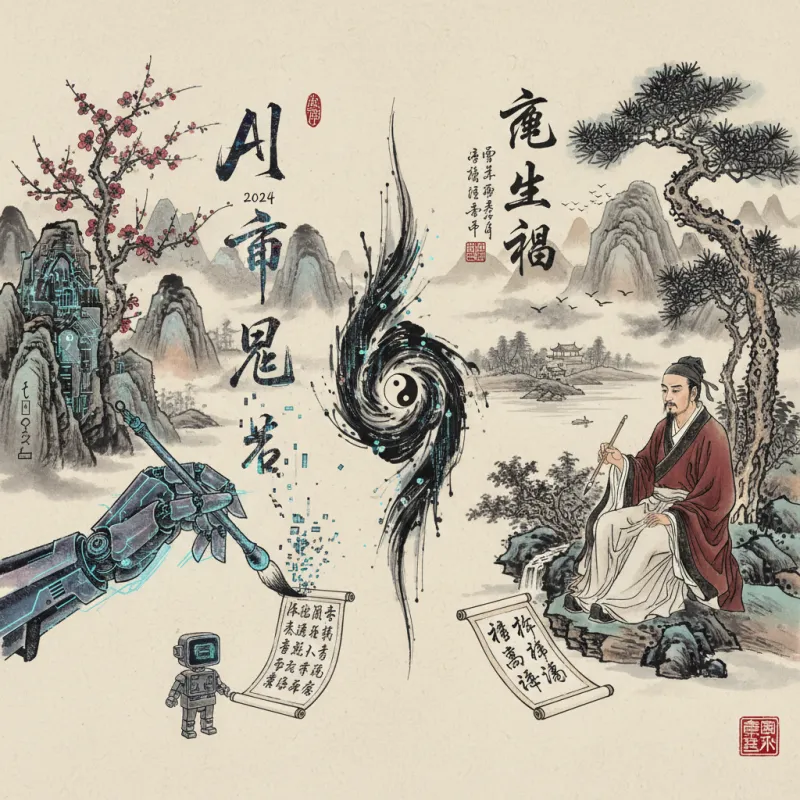
When DeepL translates Li Bai's "Quiet Night Thought" (静夜思 Jìng Yè Sī), it produces: "Bright moonlight before my bed / I suspect it is frost on the ground / Raise my head to look at the bright moon / Lower my head and think of my hometown." Technically accurate. Grammatically sound. Poetically dead. The translation captures every word while losing everything that matters — and that gap between competence and comprehension defines the current state of AI poetry translation in 2024.
I've spent the past year testing every major AI translation tool against human translators working with Tang and Song dynasty poetry. The results surprised me. Not because AI failed — I expected that — but because it failed in such specific, revealing ways. Understanding these failures tells us something profound about what poetry actually is.
The Deceptive Competence of Modern AI
Five years ago, Google Translate would mangle Chinese poetry into word salad. Today's AI — GPT-4, Claude, DeepL, specialized tools like Baidu Fanyi — produces translations that look legitimate. They parse grammar correctly. They identify classical references. They maintain line structure. They're wrong in ways that require expertise to detect.
Take Du Fu's "Spring View" (春望 Chūn Wàng): "国破山河在,城春草木深" (Guó pò shānhé zài, chéng chūn cǎomù shēn). GPT-4 renders this as "The nation is broken, but mountains and rivers remain / The city sees spring, vegetation grows deep." Accurate? Yes. A translation of Du Fu? Barely.
The problem isn't the words. It's the weight. "国破" (guó pò) — "nation broken" — carries the entire An Lushan Rebellion, the collapse of the Tang golden age, Du Fu's personal displacement, and eight centuries of Chinese readers experiencing their own national catastrophes through these two characters. AI gives you the dictionary definition. Human translators like Burton Watson give you the resonance: "The nation is ruined, but mountains and rivers remain."
That tiny shift — "ruined" instead of "broken" — contains everything AI misses. "Ruined" suggests irreversibility, architectural collapse, the weight of history. "Broken" suggests something that might be fixed. The difference is the difference between translation and poetry.
Where Machines Excel
AI translation isn't useless. It's excellent at specific tasks that happen to be peripheral to poetry.
Vocabulary lookup. Need to know what 相思 (xiāngsī) means? AI will correctly tell you "mutual longing" or "lovesickness." For students working through classical texts, this is invaluable. I use AI constantly for quick reference checks.
Grammatical parsing. Classical Chinese grammar is notoriously ambiguous. AI can identify possible grammatical structures faster than humans, offering multiple interpretations of how characters relate. This is genuinely helpful for understanding syntactic possibilities.
Identifying allusions. Modern AI trained on classical Chinese literature can spot references to earlier texts. When Wang Wei writes 大漠孤烟直 (dàmò gūyān zhí), AI correctly identifies this as describing frontier scenery and can point to similar imagery in earlier poetry. This kind of intertextual mapping would take human researchers hours.
Consistency. If you need fifty poems translated with consistent terminology — say, always rendering 月 (yuè) as "moon" rather than sometimes "moon" and sometimes "lunar orb" — AI delivers perfect consistency. For academic reference works, this matters.
But these are all preparatory tasks. They're what you do before translation begins, not translation itself.
The Untranslatable Elements
Chinese poetry operates through mechanisms that resist computational analysis. Not because they're mystical or ineffable, but because they're fundamentally contextual in ways that exceed current AI capabilities.
Tonal music. Tang regulated verse (律诗 lǜshī) follows strict tonal patterns — alternating level and oblique tones in prescribed positions. This creates a musical structure that's inseparable from meaning. Li Bai's "Drinking Alone Under the Moon" (月下独酌 Yuè Xià Dú Zhuó) uses tonal patterns to create a swaying, slightly drunk rhythm. AI can identify the tonal pattern. It cannot recreate the effect in English, because it doesn't understand that the effect matters more than the words.
Visual semantics. Chinese characters carry visual meaning. 明 (míng, "bright") is composed of 日 (sun) and 月 (moon) — two sources of light creating brightness. When Li Bai writes 明月 (míngyuè, "bright moon"), the character 明 visually contains the moon it modifies. This creates a semantic density that English cannot replicate. AI translates the word. It misses the visual pun, the self-reference, the way the character enacts its meaning.
Cultural compression. When Du Fu writes 烽火连三月 (fēnghuǒ lián sān yuè) — "beacon fires for three months" — he's invoking the entire system of Tang military communication, the specific crisis of the An Lushan Rebellion, and the personal anguish of separation from family. Three months of beacon fires means three months of war, which means three months without news, which means three months of not knowing if your family is alive. AI gives you "beacon fires for three months." Human translators like David Hinton give you "war's beacon fires have burned for three months."
Ambiguity as feature. Classical Chinese thrives on grammatical ambiguity. Characters can function as nouns, verbs, or adjectives depending on context. Wang Wei's "Deer Park" (鹿柴 Lù Zhài) contains the line 返景入深林 (fǎn jǐng rù shēn lín). Is 景 (jǐng) "light" or "shadow"? Is 返 (fǎn) "returning" or "reflected"? The ambiguity is intentional — the line means both "returning light enters the deep forest" and "reflected shadows enter the deep forest" simultaneously. AI picks one interpretation. Poetry requires both.
The Human Advantage
Human translators working with Chinese poetry bring three capabilities that current AI lacks:
Aesthetic judgment. Translation requires constant choices between competing goods — literal accuracy versus rhythmic flow, cultural specificity versus English readability, preserving ambiguity versus providing clarity. These choices have no algorithmic solution. They require taste, which is another word for accumulated experience making similar choices and living with the consequences.
Burton Watson's translations of Du Fu prioritize clarity and directness. David Hinton's prioritize strangeness and literal accuracy. Red Pine's prioritize Buddhist resonances. Each translator makes different choices, and each set of choices creates a different Du Fu in English. AI cannot make these choices because it has no aesthetic position, no sense of what matters more than something else.
Cultural intuition. When Li Bai writes about drinking wine and watching the moon, he's participating in a specific tradition of Chinese literati culture — the scholar-official who finds freedom in intoxication and nature. This tradition has its own values, its own poses, its own clichés. Human translators who've read hundreds of Tang poems develop an intuition for when Li Bai is being conventional and when he's subverting convention. AI sees only the individual poem.
Poetic ear. English poetry has its own music — stress patterns, alliteration, assonance, line breaks. Translating Chinese poetry into English requires hearing both the Chinese music and the potential English music, then making something that works as English poetry while honoring the Chinese original. This is a creative act, not a transfer of information. Sam Hamill's translations of Tang poetry work as English poems. AI translations work as English sentences.
The 2024 Landscape
The best current approach combines AI and human expertise. I use this workflow:
- AI translation for initial vocabulary and grammar parsing
- Multiple AI tools (GPT-4, Claude, DeepL) to identify interpretive possibilities
- Human analysis of tonal patterns, visual semantics, and cultural context
- Human drafting of English version prioritizing poetic effect
- AI consistency checking for terminology and allusion accuracy
This hybrid approach is faster than pure human translation and better than pure AI translation. But it still requires human judgment at every stage where poetry happens.
Some specialized tools are emerging. Baidu's classical Chinese translation model, trained specifically on Tang and Song poetry, outperforms general-purpose AI on cultural context. But it still produces translations that read like translations, not poems.
What This Reveals About Poetry
The AI translation problem illuminates what poetry actually is. Poetry isn't meaning plus decoration. It's meaning that exists only in its specific formal embodiment. The tonal pattern isn't added to the words — it's part of how the words mean. The visual structure of characters isn't ornamental — it's semantic.
This is why translating Tang poetry remains an art rather than a science. The information can be transferred. The poetry must be recreated.
When I read Li Bai in Chinese, I experience something. When I read Burton Watson's translation, I experience something different but related. When I read GPT-4's translation, I experience accurate information. The gap between information and experience is the gap between AI and human translation.
The Practical Verdict
Should you use AI to translate Chinese poetry in 2024? Depends what you need.
For quick reference — understanding what a poem is about, identifying allusions, checking vocabulary — AI is excellent. I use it constantly.
For serious reading — experiencing the poem as poetry, understanding its cultural weight, hearing its music — you need human translators. Read Watson, Hinton, Hamill, Red Pine, David Hawkes. Read multiple translations of the same poem to see the range of interpretive possibilities.
For learning Chinese — AI is a powerful study tool. Use it to parse grammar, identify patterns, check your understanding. But don't mistake AI translations for the real thing. They're training wheels, not the bicycle.
For your own translations — if you're translating Chinese poetry yourself, AI can accelerate the research phase. But the actual translation — the choices that make it poetry — remains human work.
The future will bring better AI. Models trained specifically on poetry, with explicit understanding of prosody and cultural context, will improve. But I suspect there's an irreducible core of poetry that resists automation — not because it's mystical, but because it's fundamentally about human aesthetic judgment, which is another way of saying human experience.
Until AI has taste — not simulated taste, but actual aesthetic preference grounded in lived experience — it will produce competent translations that aren't quite poetry. Which means human translators aren't going anywhere. The machine can read Li Bai. But it can't hear him yet.
Related Reading
- Translating Chinese Poetry: Why Every Translation Is Wrong (And Why That Is Fine)
- Best English Translations of Tang Poetry: A Comparative Guide
- Ezra Pound and Chinese Poetry: Beautiful Mistakes
- Why Some Chinese Poems Are Untranslatable: The Beauty That Gets Lost
- Poetry Drinking Games: When Literature Met Entertainment
- Daoist Poetry: The Art of Doing Nothing
- Unraveling Themes in Chinese Classical Poetry: Insights from Tang, Song, and Yuan Dynasties
Explore Chinese Culture
- Explore the Tang dynasty's golden age
- Explore Daoist themes in classical poetry
- Explore Chinese literary traditions