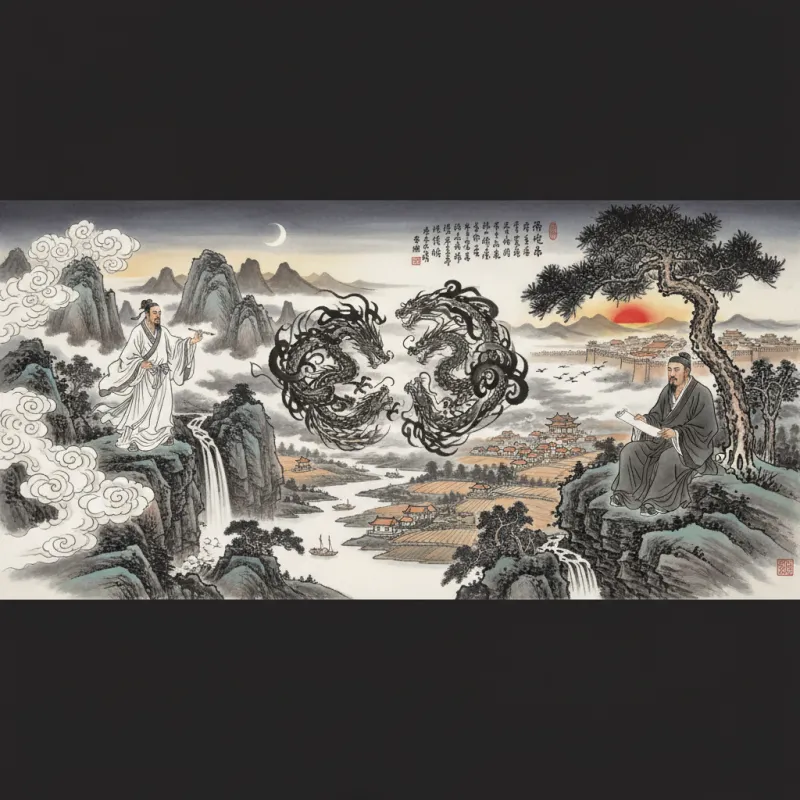
They met only once, in the autumn of 744, in the city of Luoyang. Li Bai was already famous — the wild genius who'd been expelled from the imperial court for drunkenness. Du Fu was a nobody, a failed examination candidate in his early thirties. They spent a few months together, drinking and writing poems, then went their separate ways. Du Fu would spend the rest of his life writing about that meeting. Li Bai barely mentioned it.
This asymmetry tells you everything you need to know about the greatest rivalry in Chinese poetry — a rivalry that wasn't really a rivalry at all, because one poet didn't know he was competing.
The Romantic and the Realist
Li Bai (李白, Lǐ Bái, 701-762) wrote like he was channeling something divine. His poems arrive complete, seemingly unrevised, full of impossible images and sudden leaps. He's drunk under the moon, he's riding a whale, he's about to become an immortal. Reading Li Bai feels like watching someone improvise brilliantly — you can't see the effort because there isn't any, or at least he wants you to think there isn't.
Du Fu (杜甫, Dù Fǔ, 712-770) wrote like he was building a cathedral. Every word is placed with architectural precision. His poems are dense with historical allusion, moral weight, and technical virtuosity. He revised obsessively. He worried about meter. He cared deeply about getting things right — not just aesthetically, but ethically. Reading Du Fu feels like watching a master craftsman who wants you to see exactly how difficult this is.
The traditional Chinese critical term for Li Bai's style is ziran (自然) — naturalness, spontaneity. For Du Fu, it's gongqiao (工巧) — craftsmanship, deliberate artistry. These aren't just different techniques. They represent fundamentally different ideas about what poetry is for.
What They Actually Wrote About
Li Bai wrote about moonlight, wine, mountains, exile, and the desire to escape. His most famous poem, "Quiet Night Thought" (静夜思, Jìng Yè Sī), is four lines about homesickness that every Chinese schoolchild memorizes. It's simple, direct, and feels like it took thirty seconds to write. (It probably didn't, but that's the magic.)
Du Fu wrote about war, poverty, political corruption, and the suffering of ordinary people. His most famous poem, "Spring View" (春望, Chūn Wàng), describes the ruins of the capital after a rebellion. It's dense, allusive, and feels like it took months to write. (It probably did.)
Li Bai's poetry is full of mythological figures, immortals, and fantastic journeys. Du Fu's poetry is full of real people — refugees, soldiers, farmers, his own hungry children. Li Bai writes about wanting to leave the world. Du Fu writes about being unable to fix it.
This difference became even more pronounced after the An Lushan Rebellion (755-763), the catastrophic civil war that killed millions and destroyed the Tang dynasty's golden age. Li Bai got involved in a failed political plot and was exiled. He wrote poems about his innocence and his desire to return to court. Du Fu lived through the war as a civilian, watching his country collapse. He wrote poems about starving families and abandoned villages.
The Friendship That Wasn't Quite Equal
When they met in 744, Li Bai was the celebrity. He'd already served at the imperial court, been personally praised by Emperor Xuanzong, and built a reputation as the greatest poet of his generation. Du Fu was a struggling writer who'd failed the civil service examination and had no official position.
Du Fu wrote at least fifteen poems about Li Bai or their friendship. Li Bai wrote maybe four about Du Fu, and scholars still argue about whether some of them are actually about someone else.
This imbalance is painful to read. Du Fu's poems about Li Bai are full of admiration, worry, and longing. He wonders where Li Bai is, whether he's safe, whether he's still writing. Li Bai's poems about Du Fu are... friendly. Warm, even. But not particularly deep.
The most famous exchange is Du Fu's "I Think of Li Bai on a Spring Day" (春日忆李白, Chūn Rì Yì Lǐ Bái), a poem full of genuine affection and concern. Li Bai's response, if there was one, has been lost. Or maybe he never wrote one.
Why Later Generations Chose Du Fu
Here's the uncomfortable truth: for centuries after their deaths, Li Bai was more famous. He was the Immortal Poet (诗仙, shī xiān), the genius who made it look easy. Du Fu was respected, but he was the Sage Poet (诗圣, shī shèng) — admirable, important, but maybe a little boring.
Then something shifted. By the Song dynasty (960-1279), serious critics started arguing that Du Fu was actually the greater poet. Not more fun to read, necessarily, but more profound, more technically accomplished, more morally serious. The Confucian literati loved Du Fu because he cared about the same things they did — social responsibility, historical consciousness, technical mastery.
This preference intensified over time. By the Ming and Qing dynasties, Du Fu was the model for serious poetry. Li Bai was brilliant, yes, but also undisciplined, self-indulgent, politically naive. Du Fu was the poet you studied if you wanted to understand what poetry could do at its highest level.
Modern Chinese critics have largely maintained this hierarchy. Du Fu is taught more extensively in schools. His poetry is analyzed more deeply. He's seen as the more "complete" poet — someone who mastered every form, every technique, every register. For more on the technical aspects of Tang poetry, see Understanding Tang Dynasty Poetry Forms.
The Real Rivalry: Two Ways of Being Human
But the rivalry between Li Bai and Du Fu isn't really about who's "better." It's about two fundamentally different responses to being alive.
Li Bai's response is escape — into wine, into nature, into imagination, into the past, into myth. When the world is disappointing, you leave it. You find freedom in refusal, in wandering, in not caring too much about things you can't control. His poetry is an extended argument for detachment, for preserving your inner freedom even when external circumstances are terrible.
Du Fu's response is engagement — with history, with suffering, with responsibility, with craft. When the world is disappointing, you document it, you try to fix it, you at least bear witness. You find meaning in connection, in caring, in the patient work of making something that might last. His poetry is an extended argument for commitment, for staying present even when presence is painful.
These aren't just aesthetic choices. They're ethical positions, ways of being in the world. And Chinese culture has never resolved the tension between them.
Who Wins?
The question is impossible to answer because it's the wrong question. Li Bai and Du Fu aren't competing for the same prize. They're demonstrating different possibilities for what a human life — and a poetic life — can be.
If you value spontaneity, freedom, and transcendence, you'll love Li Bai. If you value craft, responsibility, and engagement, you'll love Du Fu. Most people love both, for different reasons, in different moods.
The real genius of Chinese literary culture is that it preserved both voices, honored both approaches, and never tried to collapse them into a single standard. The tension between Li Bai and Du Fu is productive, generative, necessary. It's the tension between the individual and society, between art and ethics, between freedom and responsibility.
They met once, in 744, and then went their separate ways. Li Bai kept wandering, kept drinking, kept writing poems about moonlight and exile. Du Fu kept working, kept revising, kept writing poems about war and suffering. Both of them died in poverty, far from home, still writing.
And we're still reading both of them, still arguing about which one matters more, still unable to choose. That's not a failure of criticism. That's the point. For more on the broader context of Tang poetry, explore The Golden Age of Tang Dynasty Poetry.
Related Reading
- Bai Juyi: The Song of Everlasting Sorrow
- Tao Yuanming: The Recluse Who Found Paradise
- Du Fu: The Conscience of Chinese Poetry
- Wang Wei: The Poet-Painter Who Captured Silence
- Li Bai: The Life of China's Most Legendary Poet
- AI vs. Human Translation of Chinese Poetry: A 2024 Comparison
- Drinking Poetry: Why Chinese Poets Wrote Their Best Work Drunk
- Unveiling the Essence of Chinese Classical Poetry: Insights from Tang, Song, and Yuan Poets
Explore Chinese Culture
- Explore the Tang dynasty's golden age
- Explore Daoist themes in classical poetry
- Explore Chinese literary traditions