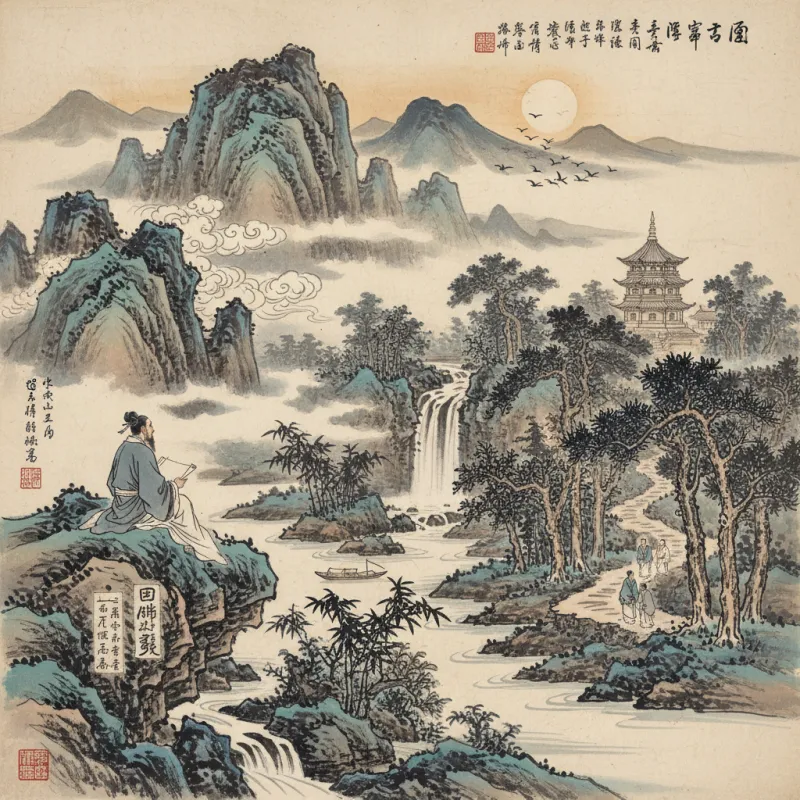
When Li Bai (李白, Lǐ Bái) drunkenly composed "Drinking Alone Under the Moon" in 744 CE, he wasn't just writing poetry—he was crystallizing a thousand-year tradition that would define how East Asia understood beauty, loss, and the human condition. The verse forms perfected during the Tang, Song, and Yuan dynasties weren't mere literary exercises; they were sophisticated technologies for encoding emotion, each with rules as precise as musical notation and effects as powerful as any modern art form.
The Architecture of Emotion: Understanding Classical Forms
Chinese classical poetry operates on principles fundamentally different from Western verse. Where English poetry often relies on stress patterns and rhyme, Chinese poetry exploits the tonal nature of the language itself. The lüshi (律詩, lǜshī, "regulated verse") perfected during the Tang dynasty demands not just rhyme but tonal parallelism—each character must balance its counterpart in pitch contour, creating a musical architecture that's impossible to fully translate.
Consider the jueju (絕句, juéjù, "cut-short verse"): twenty characters arranged in four lines of five or seven characters each. Within this microscopic space, poets like Du Fu (杜甫, Dù Fǔ) could capture entire landscapes, philosophical systems, and emotional universes. The form's brevity wasn't a limitation but a compression chamber, forcing language to its highest density. When Du Fu wrote "Spring View" in 757 while Chang'an lay in ruins, those twenty characters contained the collapse of an empire.
The Song dynasty introduced the ci (詞, cí, "lyric meters"), which broke free from the rigid line lengths of Tang poetry. These poems followed the melodic patterns of popular songs—some with lines as short as one character, others stretching to eleven. This flexibility allowed poets like Li Qingzhao (李清照, Lǐ Qīngzhào) to mirror the rhythms of speech and thought more naturally, creating what feels like overheard conversation rather than formal declaration.
The Tang Aesthetic: Clarity Through Restraint
Tang poetry achieves its power through what it doesn't say. The technique of bixing (比興, bǐxīng), inherited from the ancient Book of Songs, uses natural imagery not as decoration but as emotional shorthand. When Wang Wei (王維, Wáng Wéi) writes of empty mountains and autumn rain, he's not describing scenery—he's constructing a psychological state that readers complete with their own loneliness.
This restraint extended to the poets' relationship with their own emotions. Tang poets rarely named feelings directly; instead, they created objective correlatives centuries before T.S. Eliot coined the term. Li Bai's famous "Quiet Night Thought" never mentions homesickness, yet its image of moonlight resembling frost on the floor has become synonymous with exile's ache across East Asia. The poem works because it trusts readers to supply the emotion, making them collaborators rather than passive recipients.
The Tang court examination system, which required candidates to compose poetry on demand, created a shared vocabulary of allusions and techniques. Every educated person knew the same corpus of earlier poetry, the same historical references, the same symbolic associations. This common ground allowed poets to work with extraordinary compression—a single reference to the Chu Ci (楚辭, Chǔ Cí, "Songs of Chu") could invoke entire mythological systems. Modern readers often need footnotes to catch these resonances, but for Tang audiences, they created layers of meaning as natural as breathing.
Song Interiority: The Turn Inward
Where Tang poetry looked outward at landscapes and social bonds, Song poetry turned its gaze inward. The ci form's flexibility suited this introspection perfectly. Su Shi (蘇軾, Sū Shì), perhaps the Song's greatest poet, used the form to explore consciousness itself—how memory works, how perception shifts, how the self fragments and reforms. His "Prelude to Water Melody" written in 1076 moves between cosmic speculation and intimate family feeling within a single poem, a tonal range the stricter Tang forms couldn't easily accommodate.
Song poets also developed what we might call psychological realism. Li Qingzhao's poems about her marriage and widowhood don't idealize or universalize—they capture specific moments with almost uncomfortable precision. When she writes about weighing herself against a flower and finding herself lighter, she's documenting depression with clinical accuracy wrapped in elegant metaphor. This specificity was new; Tang poets tended toward archetypal situations, but Song poets insisted on the irreducible particularity of individual experience.
The Song dynasty's economic prosperity and urban culture also changed poetry's social function. Where Tang poetry circulated primarily among officials and scholars, Song poetry reached merchant classes and educated women. This broader audience demanded and received poetry that addressed everyday concerns—not just exile and war, but domestic life, romantic love, and the small disappointments of ordinary existence. The form evolved to meet these needs, becoming more conversational and less dependent on classical allusions.
Yuan Synthesis: Mongol Rule and Cultural Fusion
The Yuan dynasty presents a paradox: foreign conquest that somehow enriched Chinese poetry rather than suppressing it. Mongol rule closed many traditional career paths for Chinese scholars, pushing them toward artistic pursuits. The sanqu (散曲, sǎnqǔ, "free songs") that flourished during this period combined the ci form's flexibility with colloquial language and even foreign loan words, creating a hybrid aesthetic that reflected the dynasty's multicultural reality.
Yuan poets like Ma Zhiyuan (馬致遠, Mǎ Zhìyuǎn) wrote with a directness that would have seemed crude to Tang sensibilities. His "Autumn Thoughts" uses plain speech and repetition to create an almost hypnotic effect, abandoning classical allusions for immediate emotional impact. This wasn't a decline in sophistication but a deliberate choice—Yuan poets recognized that different historical moments required different aesthetic strategies.
The Yuan period also saw the rise of qu (曲, qǔ) poetry designed for theatrical performance, blurring the line between literary and popular culture. These poems incorporated dramatic dialogue, regional dialects, and contemporary slang, expanding poetry's expressive range. While literati sometimes dismissed these forms as vulgar, they influenced even "serious" poetry, loosening the grip of classical precedent and opening new possibilities for future generations.
Technical Mastery: The Craft Behind the Art
Understanding Chinese classical poetry requires grasping its technical foundations. The tonal system divides characters into ping (平, píng, level tones) and ze (仄, zè, deflected tones), and regulated verse demands specific patterns of alternation. The second and fourth couplets of an eight-line lüshi must exhibit strict parallelism—not just grammatical but semantic, with corresponding words matching in category (noun to noun, verb to verb, color to color).
This parallelism creates effects impossible in non-tonal languages. When Du Fu writes parallel lines about flowers and birds, the tonal patterns create a musical counterpoint that reinforces the semantic meaning. The form itself becomes expressive, with tonal patterns suggesting harmony or discord, stability or disruption. Skilled poets could make the technical requirements seem effortless, but achieving this naturalness required years of practice and deep linguistic intuition.
Rhyme schemes also differed significantly from Western poetry. Chinese classical poetry typically rhymes only even-numbered lines, and the rhymes must match not just in sound but in tone category. The ci form complicated this further, with each tune pattern prescribing its own rhyme scheme, line lengths, and tonal requirements. Mastering these forms was like learning to compose fugues—the constraints were severe, but they channeled creativity rather than stifling it.
Reading Across Time: Translation and Interpretation
Every translation of Chinese classical poetry is a beautiful lie. The tonal music disappears, the visual impact of characters dissolves, and the allusive density thins to transparency. Yet translation remains essential for non-Chinese readers, and the best translators find creative compensations. Some, like Arthur Waley, prioritize readability and emotional equivalence. Others, like David Hinton, attempt to preserve the original's compression and strangeness, even at the cost of smoothness.
The challenge goes beyond linguistic difference. Chinese classical poetry assumes a worldview—Confucian ethics, Daoist philosophy, Buddhist metaphysics—that modern readers may not share. When Wang Wei writes about mountains and streams, he's not just describing nature but invoking a complex philosophy about the relationship between human consciousness and the natural world, influenced by Chan Buddhism's emphasis on direct perception. Missing this context, we might read the poems as simple nature poetry, beautiful but shallow.
Yet something essential does survive translation. The emotional core of these poems—loneliness, joy, grief, wonder—remains recognizable across centuries and cultures. Li Bai's drunken moon-gazing speaks to anyone who's ever felt simultaneously connected to and alienated from the cosmos. Du Fu's war poems capture the specific texture of suffering that transcends their historical moment. The forms may be untranslatable, but the humanity they contain is universal.
The Living Tradition: Classical Forms in Modern Context
Chinese classical poetry didn't die with the dynasties that produced it. Throughout the twentieth century, even as vernacular poetry dominated, poets continued writing in classical forms. Mao Zedong composed ci poems; contemporary poets still practice lüshi. These aren't mere exercises in nostalgia but living engagements with a tradition that continues to offer unique expressive possibilities.
The classical forms also influenced modern Chinese poetry in subtle ways. Even free verse poets trained in classical techniques bring that sensibility to their work—the compression, the imagistic thinking, the tonal awareness. The relationship between classical and modern Chinese poetry resembles that between Latin and Romance languages: the old form persists within the new, shaping it from within.
For non-Chinese readers, engaging with Tang, Song, and Yuan poetry offers more than historical interest. These poems present alternative ways of thinking about what poetry can do—how it can compress meaning, how it can use form expressively, how it can balance personal feeling with cultural tradition. In an era when much Western poetry has abandoned formal constraints, Chinese classical poetry reminds us that restrictions can liberate rather than confine, that working within tradition can produce radical innovation.
The techniques developed across these three dynasties—the Tang's restraint, the Song's interiority, the Yuan's synthesis—represent centuries of collective experimentation in how language can capture consciousness. They're not museum pieces but active resources, tools for making meaning that remain as sharp as when Li Bai first picked up his brush. Understanding these techniques doesn't just illuminate the past; it expands what we think poetry can be in the present.
Related Reading
- Delving into the Techniques of Chinese Classical Poetry: Insights from Tang, Song, and Yuan Poets
- The Complete Guide to Chinese Classical Poetry: From Tang Poems to Song Ci
- Su Shi in Exile: How Banishment Produced China's Greatest Prose
- Discovering the Rich Legacy of Tang, Song, and Yuan Poetry
Explore Chinese Culture
- Explore the Tang dynasty's golden age
- Explore Daoist themes in classical poetry
- Explore Chinese literary traditions