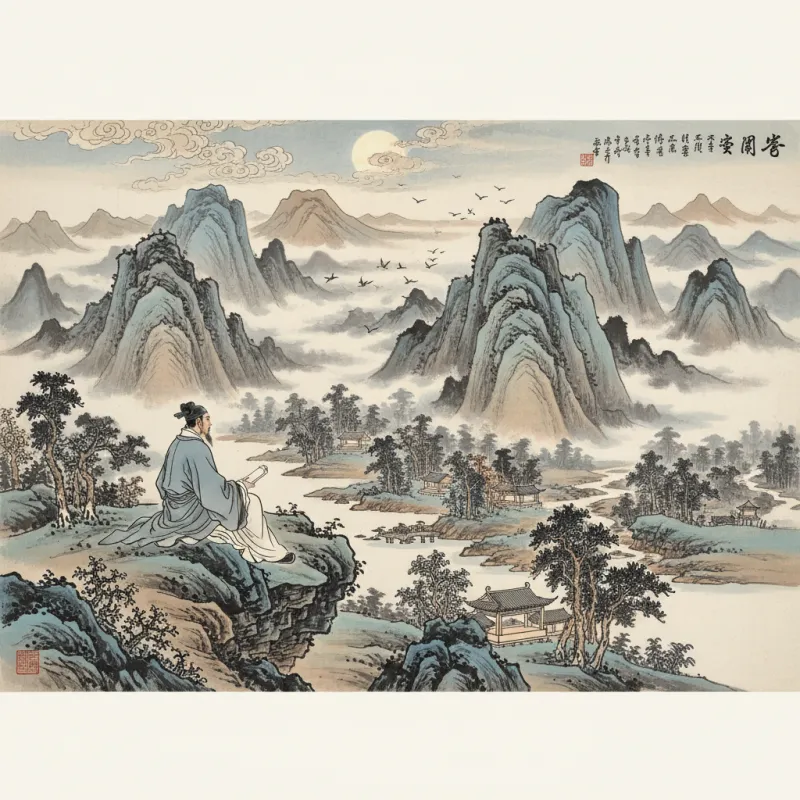
When Li Bai (李白, Lǐ Bái) dashed off "Drinking Alone Under the Moon," he wasn't just describing a solitary evening—he was demonstrating duì'ǒu (對偶), the art of parallelism that would define Chinese poetry for centuries. His paired lines about the moon, his shadow, and himself weren't accidents of inspiration but deliberate deployments of techniques refined over generations. The greatest Chinese poets didn't simply feel deeply; they mastered an arsenal of formal devices that transformed emotion into architecture, spontaneity into craft.
The Foundation: Parallelism and Structural Balance
Duì'ǒu (對偶) stands as perhaps the most distinctive feature separating Chinese classical poetry from its Western counterparts. This technique demands that corresponding lines mirror each other in grammatical structure, tonal pattern, and semantic category. In Du Fu's (杜甫, Dù Fǔ) "Spring View," the couplet "Country broken, mountains and rivers remain / City in spring, grass and trees grow deep" exemplifies perfect parallelism: noun answers noun, verb answers verb, and the cosmic scope of "mountains and rivers" balances against the intimate detail of "grass and trees."
But parallelism operates on multiple levels simultaneously. Tang poets distinguished between gōngduì (工對, "skilled parallelism") and kuānduì (寬對, "loose parallelism"). The former required exact categorical matching—if one line mentioned a color, its partner must too. The latter permitted semantic flexibility while maintaining structural symmetry. Song dynasty poets like Su Shi (蘇軾, Sū Shì) often favored kuānduì, finding in its looseness room for philosophical complexity that strict parallelism couldn't accommodate. His famous line "The great river flows east, its waves washing away / The romantic figures of ages past" pairs a natural image with historical reflection—a bold move that earlier Tang formalists might have questioned.
Tonal Orchestration: The Music of Regulated Verse
The lǜshī (律詩, "regulated verse") form elevated tonal patterning to a science. Chinese, being a tonal language, offered poets an acoustic dimension unavailable to their English or Arabic counterparts. The four tones of Middle Chinese divided into píng (平, level) and zè (仄, deflected) categories, and regulated verse demanded specific alternation patterns across eight lines.
Consider Wang Wei's (王維, Wáng Wéi) "Deer Park": each line's second, fourth, and sixth characters follow prescribed tonal sequences, creating a sonic architecture as deliberate as a musical composition. When a Tang poet violated these rules, readers noticed immediately—not as mere pedantry, but because the disruption jarred the ear like a wrong note in a symphony. This explains why understanding classical Chinese prosody remains essential for appreciating these works; without tonal awareness, you're reading sheet music without hearing the melody.
Yuan dynasty poets, writing under Mongol rule, sometimes deliberately loosened these constraints. The sǎnqǔ (散曲, "free songs") form that flourished during this period retained tonal consciousness but permitted more flexibility, reflecting perhaps the cultural hybridity of the era. Ma Zhiyuan's (馬致遠, Mǎ Zhìyuǎn) "Autumn Thoughts" demonstrates this evolution—tonally sophisticated yet less rigid than Tang lǜshī, as if the form itself acknowledged that different times demanded different music.
Allusion and Intertextuality: Poetry as Conversation
Chinese classical poets wrote in constant dialogue with their predecessors, and yòngdiǎn (用典, "using allusions") served as their primary conversational mode. A single reference could invoke entire narratives, philosophical positions, or emotional landscapes. When Li Shangyin (李商隱, Lǐ Shāngyǐn) mentions "the blue sea and azure sky" in "Chang'e," he's not merely describing scenery—he's summoning the myth of the moon goddess, her isolation, her regret, and centuries of poetic commentary on loneliness and transcendence.
Song poets took allusion to new extremes. Su Shi's works bristle with references to earlier texts, sometimes layering three or four allusions in a single couplet. His "Red Cliff Rhapsody" weaves together historical events, earlier poems about those events, philosophical texts, and his own previous writings into a tapestry so dense that traditional commentaries often exceed the poem's length. This wasn't showing off—it was assuming an educated readership that would catch these references and appreciate their interplay.
The technique required extraordinary memorization. Educated Tang and Song readers had internalized the Shijing (詩經, "Classic of Poetry"), the Chuci (楚辭, "Songs of Chu"), and hundreds of subsequent poems. When Du Fu alluded to a line from Qu Yuan (屈原, Qū Yuán), his audience recognized it instantly, understanding how the new context transformed the old meaning. Modern readers often miss this dimension entirely, which is why exploring the role of allusion in Tang poetry opens up interpretive possibilities that surface readings cannot access.
Imagery and Objective Correlative: Emotion Through Object
Long before T.S. Eliot coined the term "objective correlative," Chinese poets had perfected the technique of embodying emotion in external objects. The yìxiàng (意象, "meaning-image") tradition held that certain images carried inherent emotional valences: falling flowers suggested transience, autumn wind evoked melancholy, the moon prompted thoughts of separation.
But the greatest poets transcended these conventions. Wang Changling's (王昌齡, Wáng Chānglíng) "Frontier Poem" uses "the bright moon of Qin times, the frontier pass of Han times" not as stock imagery but as a meditation on historical continuity and individual insignificance. The moon and pass become philosophical arguments, not decorative elements. Similarly, Li Qingzhao (李清照, Lǐ Qīngzhào), the Song dynasty's preeminent female poet, transformed conventional flower imagery into vehicles for exploring widowhood, displacement, and female agency in ways that challenged her era's gender assumptions.
Yuan poets, influenced by both Chinese tradition and the dramatic arts that flourished under Mongol patronage, often employed more concrete, less conventionally "poetic" imagery. Guan Hanqing's (關漢卿, Guān Hànqīng) works include marketplace scenes, colloquial speech, and everyday objects that Tang poets might have considered too vulgar for classical verse. This democratization of imagery reflected broader social changes—poetry was no longer exclusively the domain of scholar-officials but increasingly engaged with popular culture.
Compression and Ellipsis: The Art of What's Unsaid
Chinese grammar's flexibility enabled a compression impossible in inflected languages. A four-character line could function as a complete sentence, with subject, verb, and object all implied rather than stated. This shěnglüè (省略, "ellipsis") technique forced readers into active interpretation, making them collaborators in meaning-making.
Wang Wei's "Deer Park" exemplifies this: "Empty mountain, no one seen / But human voices heard." The Chinese original uses just ten characters for these two lines, with no explicit grammatical markers for tense, number, or person. The ambiguity is intentional—is the speaker alone or with others? Is this a single moment or a recurring experience? The poem's power lies partly in what it refuses to specify.
Song dynasty cí (詞, "lyric songs") pushed compression further by working within extremely short forms. Some xiǎolìng (小令, "short songs") contained fewer than thirty characters total, yet conveyed complete emotional narratives. Li Qingzhao's "Like a Dream" uses just thirty-three characters to evoke an entire evening of drinking, a boat trip, startled waterfowl, and the speaker's intoxicated confusion—a miniature story told through fragments and implications.
Closing the Circle: Structural Completion
The best Chinese classical poems don't simply end—they complete. The final couplet often circles back to the opening, creating what critics call shǒuwěi hūyìng (首尾呼應, "head and tail correspondence"). This technique gives poems architectural integrity, transforming them from linear progressions into self-contained worlds.
Du Fu's "Gazing at Mount Tai" demonstrates this perfectly. The poem opens with a question about the mountain's nature and closes with the speaker's aspiration to climb it and survey all other peaks—the initial wonder resolved into determined action. The structure mirrors the mountain itself: broad base, ascending movement, culminating vista. Form and content achieve perfect unity.
These techniques—parallelism, tonal patterning, allusion, imagery, compression, and structural completion—weren't mere ornaments but the very substance of classical Chinese poetry. They represent centuries of collective refinement, each generation of poets inheriting, mastering, and subtly transforming the tools their predecessors developed. When we read Li Bai or Su Shi today, we're not just encountering individual genius but witnessing the culmination of a tradition that understood poetry as both spontaneous expression and rigorous craft, both personal voice and cultural conversation. The techniques themselves became a language, and the greatest poets spoke it with a fluency that still astonishes across the centuries.
Related Reading
- Unveiling the Rich Tapestry of Chinese Classical Poetry: Insights from Tang, Song, and Yuan Dynasties
- Xin Qiji: The Warrior Poet Who Never Got His War
- The Four Seasons in Chinese Poetry: Spring Sorrow, Summer Heat, Autumn Grief, Winter Silence
- Exploring Chinese Classical Poetry: Tang, Song, and Yuan Poets’ Literary Legacy
Explore Chinese Culture
- Explore the Tang dynasty's golden age
- Explore Daoist themes in classical poetry
- Explore Chinese literary traditions