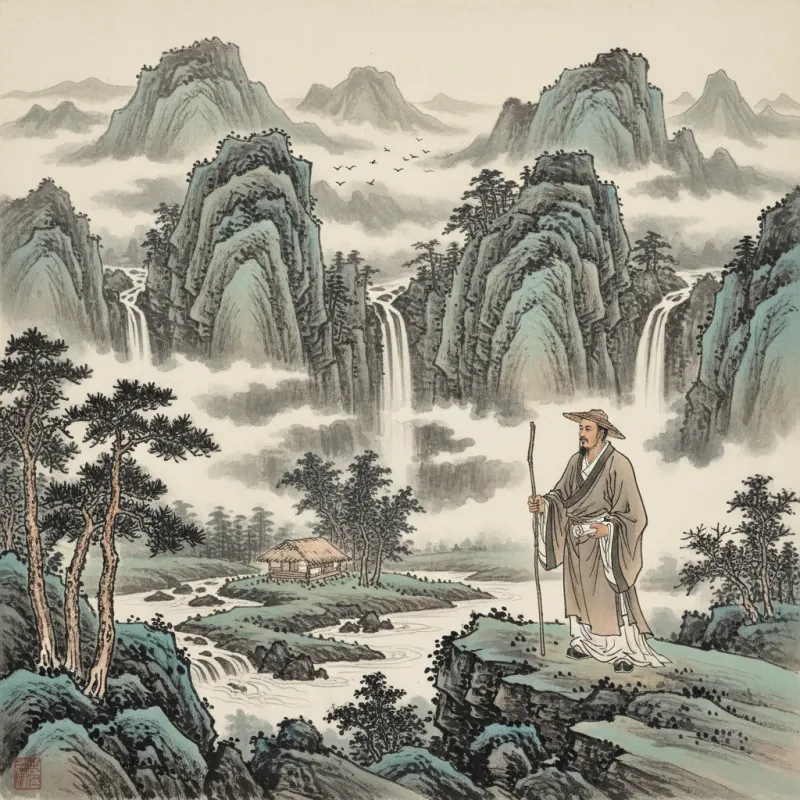
Su Shi stood on the banks of the Yangtze River in 1082, watching the moon rise over Red Cliff, and wrote what would become the most celebrated prose-poem in Chinese literature. He was 47 years old, politically disgraced, living in a borrowed house in Huangzhou, and somehow at the peak of his creative powers. This wasn't supposed to happen. Exile was meant to break scholars, not make them immortal.
The Wutai Poetry Case: When Metaphors Became Evidence
The disaster began in 1079 with what historians call the Wutai Poetry Case (乌台诗案 Wūtái Shī'àn). Su Shi's political enemies — and he had many — combed through his poetry looking for seditious content. They found it, or claimed they did. A line about "old roots rotting" became evidence of criticizing the emperor. A reference to "withered trees" was read as an attack on reform policies. The censors at the Wutai (the imperial censorate, literally "Crow Terrace") built an entire case from metaphors.
Su Shi spent 103 days in prison. He wrote two poems to his brother, expecting execution. The emperor, to his credit, commuted the sentence to demotion and exile. Su Shi was sent to Huangzhou (modern Huanggang, Hubei province) as deputy militia commander — a meaningless title that kept him far from court and stripped of real authority.
It was the best thing that ever happened to Chinese literature.
Huangzhou: The Alchemy of Humiliation
Huangzhou was a backwater. Su Shi arrived broke, disgraced, and dependent on the charity of local officials. He cleared a plot of land on the eastern slope outside town and started farming. He called himself Dongpo Jushi (东坡居士 Dōngpō Jūshì) — the Layman of the Eastern Slope. The name stuck. Today, most Chinese know him as Su Dongpo.
The physical labor changed something in his writing. Before exile, Su Shi was brilliant but conventional — a court official writing court official poetry. In Huangzhou, he started writing about radishes. About brewing wine. About the texture of pork belly braised in his own style (Dongpo pork is still a famous dish). The grand abstractions of court poetry gave way to immediate, sensory detail.
Then came the Red Cliff rhapsodies (赤壁赋 Chìbì Fù). Su Shi wrote two prose-poems about visiting the site where the famous Three Kingdoms battle supposedly took place. The first "Rhapsody on Red Cliff" is a meditation on impermanence that manages to be both devastating and consoling. He describes drinking wine with friends, reciting poetry, watching the moon's reflection on the water. Then he pivots to the battle that happened 900 years earlier — all those heroes and their ambitions now dust. But the moon is still there. The river is still there. And Su Shi, disgraced and exiled, is still there too, finding joy in the moment.
The prose style is unlike anything written before in Chinese. It moves between philosophical reflection and vivid description, between classical allusion and immediate experience. It's conversational but elevated, personal but universal. Scholars have been trying to categorize it for a thousand years.
The Pattern: Exile as Creative Liberation
What happened in Huangzhou kept happening. In 1094, Su Shi was exiled again, this time to Huizhou in Guangdong — even further south, even more remote. He was 59 years old. He wrote about lychees. He wrote about the local Hakka people. He wrote a series of poems about Chaoyun, his concubine who followed him into exile and died there. The grief is raw but the writing is controlled, precise.
Then came Danzhou (儋州 Dānzhōu) on Hainan Island in 1097. This was the end of the world by Song Dynasty standards — a malarial island inhabited by people the court considered barbarians. Su Shi was 62. He lived in a thatched hut. He taught local students. He wrote about tropical fruits nobody at court had ever heard of. He experimented with Buddhist meditation and Daoist breathing exercises.
And he kept producing masterpieces. His late poetry has a clarity and directness that makes his earlier work look cluttered. The exile that was meant to silence him instead stripped away everything inessential.
Why Exile Worked: The Paradox of Constraint
There's a theory in creativity research about how constraints can enhance rather than limit creative output. Su Shi's exile proves it. Removed from court politics, he couldn't write the expected occasional verse for imperial ceremonies. Removed from literary circles, he couldn't perform for an audience of fellow scholars. He was writing for himself, for his brother (who was also exiled), for the handful of friends who still corresponded with him.
The result was a kind of freedom. Su Shi started mixing registers that were supposed to stay separate — classical allusions with colloquial language, Buddhist philosophy with Confucian ethics, high literary forms with descriptions of peasant life. He wrote ci poetry (词 cí), a form associated with entertainment quarters, about philosophical themes. He wrote prose that read like poetry and poetry that read like prose.
His contemporaries didn't always know what to make of it. But later generations recognized what he'd done: he'd expanded what Chinese literature could be.
The Prose Style: Conversational Profundity
Su Shi's exile prose has a quality that's hard to translate but impossible to miss in Chinese. It sounds like someone talking to you — not lecturing, not performing, just talking. But the person talking happens to have read everything, thought about everything, and can quote from memory any text in the classical canon.
Take his essay "Record of the Pavilion of Drunken Old Man" written about Ouyang Xiu, his mentor. Or his "Record of Stone Bell Mountain" where he investigates why a mountain has that name and turns it into a meditation on the importance of direct observation over received wisdom. The prose moves easily between anecdote and argument, between description and reflection. It feels modern in a way that most Song Dynasty prose doesn't.
This style came from exile. When you're writing from Huangzhou or Danzhou, you can't rely on shared cultural references with your audience. You have to explain things. You have to make your case from the ground up. The result is prose that's more accessible, more direct, more human.
The Buddhist Turn: Finding Peace in Impermanence
Su Shi had always been interested in Buddhism, but exile made it personal. In Huangzhou, he became close friends with several Chan (Zen) monks. He started writing about Buddhist concepts not as intellectual exercises but as lived experience. His late poetry is full of Buddhist imagery — empty boats, reflected moons, dreams within dreams.
But Su Shi never became a monk. He remained engaged with the world, with politics (when allowed), with his family, with food and wine and friendship. His Buddhism was practical, not ascetic. He used Buddhist ideas about impermanence and non-attachment to cope with exile, but he never stopped caring about things. The tension between engagement and detachment runs through all his late work.
There's a famous anecdote about Su Shi and his friend the monk Foyin. They're sitting in meditation and Su Shi asks Foyin what he sees. "I see a Buddha," Foyin says. Su Shi smiles and says, "I see a pile of shit." Foyin doesn't react. Later, Su Shi tells his sister about the exchange, proud of his clever insult. She laughs at him: "You see what's in your own heart. He saw Buddha because he has Buddha-nature. You saw shit because that's what you're full of."
The story is probably apocryphal, but it captures something true about Su Shi's relationship with Buddhism. He understood the teachings intellectually but struggled to embody them. His writing is honest about that struggle.
The Legacy: How Exile Shaped Chinese Literature
Su Shi's exile writings created a template that later writers followed. The idea that banishment could be productive, that distance from the capital could clarify rather than obscure vision, that personal hardship could deepen rather than diminish art — these became commonplaces in Chinese literary culture.
You can trace a line from Su Shi to later exile poets like Huang Tingjian and Yang Wanli in the Song Dynasty, to the Ming Dynasty scholar-officials who wrote their best work in provincial postings, to the Qing Dynasty poets who found inspiration in frontier regions. The exile narrative became a genre.
But nobody matched Su Shi's range. He wrote poetry, prose, essays, letters, calligraphy, painting theory, Buddhist commentary, Confucian philosophy, and recipes. He wrote about everything from statecraft to mushrooms. And almost all of his best work came from the twenty years he spent being shuffled from one exile posting to another.
The Final Return That Never Happened
In 1100, the emperor who had exiled Su Shi died. The new emperor recalled him to court. Su Shi was 65 years old. He made it as far as Changzhou in Jiangsu province before dying in 1101. He never saw the capital again.
His last poem, written on his deathbed, is about rain. Not metaphorical rain — actual rain falling on the roof of the house where he was dying. It's specific, immediate, sensory. It sounds like all his exile poetry: present in the moment, aware of impermanence, finding beauty in what's actually there rather than what should be there.
That's the lesson of Su Shi's exile writings. You can't control where you end up or what happens to you. But you can control how you pay attention. You can notice the rain. You can taste the pork. You can watch the moon rise over Red Cliff and write something that people will read a thousand years later, trying to understand how someone turned disaster into art.
Related Reading
- Political Poetry: When Poets Challenged Emperors
- Su Shi in Exile: Making the Best of Banishment
- Qu Yuan: The First Named Poet in Chinese History
- The Melancholy of Exile: A Journey Through Tang, Song, and Yuan Poetry
- Exile Poetry: When Banishment Produced China's Greatest Literature
- Xin Qiji: The Warrior Poet
- The Harmony of Nature in Chinese Classical Poetry: Tang, Song, and Yuan Dynasties
- Xin Qiji: The Warrior Poet Who Never Got His War
Explore Chinese Culture
- Explore the Tang dynasty's golden age
- Explore Daoist themes in classical poetry
- Explore Chinese literary traditions