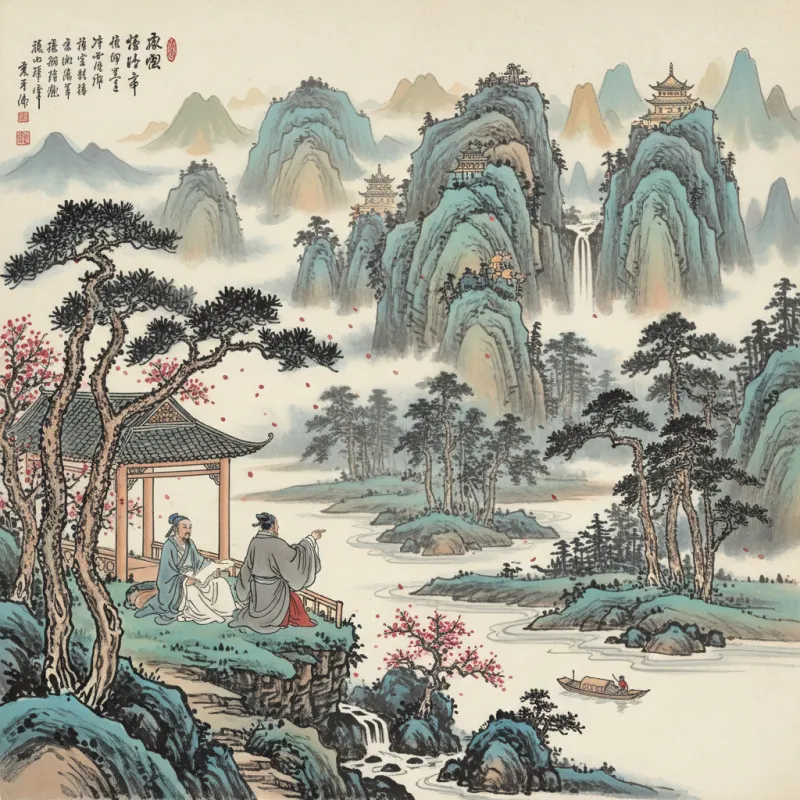
Picture this: it's 742 CE, and you're sitting for the imperial examination in Chang'an. You've memorized thousands of classical texts, mastered calligraphy, and studied philosophy for years. But none of that matters if you can't compose a regulated verse poem on the spot. The examiner gives you a topic — "Autumn Moon Over the Palace" — and you have hours to craft eight lines with perfect tonal patterns, matching rhymes, and parallel couplets. Fail at poetry, and your political career is over before it begins.
This wasn't some quirky cultural footnote. For over a millennium, poetry was the gateway to power in China. It was how you got a job, impressed your friends, courted a lover, mourned the dead, and made sense of exile. The result? The largest, most continuous poetic tradition in human history — over 50,000 Tang poems alone survive, and that's just one dynasty.
The Architecture of Chinese Poetry
Chinese poetry works differently than English poetry at a fundamental level. The language itself is the reason why.
Each Chinese character is a single syllable. No conjugations, no tenses, no articles. This creates a compression that's impossible in English. The famous opening of Li Bai's (李白, Lǐ Bái) "Quiet Night Thought" is just twenty characters: "床前明月光,疑是地上霜" (chuáng qián míng yuè guāng, yí shì dì shàng shuāng). Literally: "bed front bright moon light, suspect is ground top frost." In English we need more words: "Before my bed, the bright moonlight / I thought was frost upon the ground."
But it's not just compression. Classical Chinese is also tonal. Each syllable has a pitch pattern — in Middle Chinese, there were four tones: level, rising, departing, and entering. Poets used these tones structurally, creating patterns of sound that have no equivalent in English. The regulated verse forms (lǜshī, 律诗) required specific tonal patterns in specific positions. Get one tone wrong, and the whole poem was technically flawed.
Then there's parallelism. Chinese poetry loves symmetry. In a couplet, the two lines often mirror each other grammatically and semantically. Du Fu (杜甫, Dù Fǔ) was the master of this. His line "星垂平野阔,月涌大江流" (xīng chuí píng yě kuò, yuè yǒng dà jiāng liú) — "Stars hang over the broad plain / Moon surges in the great river's flow" — matches noun to noun, verb to verb, adjective to adjective. It's architectural.
The Golden Age: Tang Dynasty Poetry
When people say "Chinese poetry," they usually mean Tang poetry (唐诗, Tángshī). The Tang Dynasty (618-907 CE) was to Chinese poetry what Elizabethan England was to English drama — the moment when everything came together.
The Tang produced the three giants: Li Bai, Du Fu, and Wang Wei (王维, Wáng Wéi). Each represents a different approach to the art.
Li Bai was the romantic drunk, the wanderer who wrote with wild spontaneity. His poems feel effortless, as if he's just talking to you over wine. "Drinking Alone Under the Moon" captures his spirit perfectly — he's so lonely he invites the moon and his shadow to drink with him, making a party of three. His genius was making the impossible seem natural. How do you "raise a cup to invite the bright moon"? Li Bai does it, and it feels inevitable.
Du Fu was the opposite: meticulous, socially conscious, technically perfect. If Li Bai was Mozart, Du Fu was Beethoven. His poems document the An Lushan Rebellion (755-763 CE), one of the deadliest wars in human history. "Spring View" describes returning to the capital after it was sacked: "The nation shattered, mountains and rivers remain / Spring in the city, grass and trees grow deep." That opening couplet — nation destroyed, nature indifferent — became the template for war poetry in Chinese for the next thousand years.
Wang Wei brought Buddhism into poetry. He was also a painter, and his poems have a visual stillness to them. "Deer Park" is just twenty characters, but it creates a complete scene: empty mountain, no one visible, but you hear echoes of human voices, and evening sunlight slants into the deep forest, shining on the green moss. It's a painting in words, and it's about absence as much as presence.
The Tang also perfected the major poetic forms. The jueju (绝句, juéjù) or "cut-short verse" was four lines, either five or seven characters per line. The lüshi (律诗, lǜshī) or "regulated verse" was eight lines with strict tonal and parallelism rules. These forms became the standard, like the sonnet in English. Every educated person could write them, but only the masters made them sing.
Song Dynasty: The Rise of Ci Poetry
After the Tang fell, poetry didn't die — it evolved. The Song Dynasty (960-1279 CE) produced ci (词, cí), a form that's often translated as "lyric poetry" but that's misleading. Ci were originally song lyrics, written to fit existing melodies. Each melody had a name — "Tune: Butterflies Love Flowers," "Tune: The River Is Red" — and a fixed pattern of line lengths and rhymes.
This freed poets from the rigid line lengths of Tang poetry. A ci could have lines of three characters, seven characters, eleven characters, whatever the melody required. The result was more flexible, more colloquial, more emotionally direct.
Li Qingzhao (李清照, Lǐ Qīngzhào) was the greatest ci poet, and one of the few women whose work survived in large quantities. Her early poems are playful, even flirtatious. But after the Jin invasion forced her to flee south and her husband died, her work turned devastating. "Slow Slow Tune" begins with seven repeated characters expressing desolation: "寻寻觅觅,冷冷清清,凄凄惨惨戚戚" (xún xún mì mì, lěng lěng qīng qīng, qī qī cǎn cǎn qī qī). The repetition itself is the meaning — searching, searching, seeking, seeking, cold, cold, clear, clear, sorrowful, sorrowful, miserable, miserable, grieved, grieved. You can't translate that. You can only gesture at it.
Su Shi (苏轼, Sū Shì), also known as Su Dongpo, brought a philosophical depth to ci. He was a government official repeatedly exiled for political reasons, and his poems reflect on impermanence, nature, and the consolations of art. "Prelude to Water Melody" was written during the Mid-Autumn Festival while separated from his brother: "People have sorrow and joy, parting and reunion / The moon has darkness and light, waxing and waning / This matter has never been perfect since ancient times." It's Buddhist acceptance without being preachy.
The Song poets also wrote in the Tang forms, and some argue that Song regulated verse is technically superior to Tang. But it lacks the Tang's spontaneity. Song poetry is more self-conscious, more aware of its own tradition. That's not necessarily worse — just different.
Earlier Traditions: The Roots
Tang and Song poetry didn't appear from nowhere. They built on centuries of earlier work.
The oldest Chinese poems are in the Shijing (诗经, Shījīng), the "Classic of Poetry," compiled around 600 BCE. These are folk songs, court hymns, and ritual texts. They're simple, direct, and often use repetition and refrain. "Guan guan cry the ospreys / On the river's islet / A modest, retiring, virtuous young lady / For our prince a good mate she." This became the model for using nature imagery to express human emotions — a technique that dominates all later Chinese poetry.
The Chuci (楚辞, Chǔcí), or "Songs of Chu," from around 300 BCE, are wilder and more shamanic. The poet Qu Yuan (屈原, Qū Yuán) wrote long, visionary poems full of gods, spirits, and mythical journeys. His "Li Sao" ("Encountering Sorrow") is 373 lines of exile, frustration, and cosmic wandering. It's the opposite of the Shijing's restraint — emotional, excessive, strange. Qu Yuan supposedly drowned himself in a river, and the Dragon Boat Festival commemorates him. His influence is everywhere in later poetry about political exile and frustrated ambition.
The Han Dynasty (206 BCE - 220 CE) produced the fu (赋, fù), elaborate prose-poems that described palaces, hunts, and cities in exhaustive detail. They're more rhetorical exercises than emotional expressions, but they showed what Chinese could do when it wanted to be ornate.
Then came the Six Dynasties period (220-589 CE), a time of political chaos but poetic innovation. Poets like Tao Yuanming (陶渊明, Táo Yuānmíng) developed the "fields and gardens" style — poems about rural retirement, drinking wine, and escaping politics. Tao's "Drinking Wine" series established the persona of the recluse poet that would influence everyone from Wang Wei to the Song literati. His famous line "I pluck chrysanthemums under the eastern hedge / And gaze afar toward the southern mountains" became shorthand for the contemplative life.
Recurring Themes and Obsessions
Chinese poetry returns to certain themes again and again. Understanding these helps you see the tradition as a conversation across centuries.
Exile and separation: More than half of major Chinese poets spent time in political exile. The pattern is consistent: you criticize the emperor or back the wrong faction, you get sent to some remote province, you write poems about longing for home and friends. Li Bai, Du Fu, Su Shi, Liu Zongyuan — all exiled. This created a whole subgenre of "frontier poems" about the hardships of military service and the beauty of desolate landscapes.
Nature as mirror: Chinese poets don't describe nature for its own sake. Nature reflects human emotions. Falling flowers = the passage of time. The moon = longing for absent friends. Autumn = melancholy. Spring = renewal but also the pain of beauty's transience. These associations are so ingrained that a poet can just mention "autumn wind" and the reader feels the sadness.
Wine and friendship: Chinese poetry is full of drinking. Not because Chinese poets were all alcoholics (though some were), but because wine represented freedom from social constraints. When you're drunk, you can say what you really think. Li Bai supposedly drowned while drunk, trying to embrace the moon's reflection in a river. It's probably not true, but it should be.
Impermanence: Buddhist and Daoist ideas about the transience of all things permeate Chinese poetry. Dynasties fall, friends die, youth fades, even the mountains erode. But this isn't depressing — it's liberating. If nothing lasts, then you might as well enjoy the moment. Su Shi's "Red Cliff" poems are the classic statement: "The great river flows east / Its waves washing away / The heroes of ages past."
The past as ideal: Chinese poets constantly look backward. The ancient sage kings, the golden age of the Zhou Dynasty, the simplicity of rural life — these are always better than the corrupt present. This isn't nostalgia exactly. It's a way of criticizing the current regime without getting executed. If you praise the ancient kings, you're implicitly criticizing the current emperor.
The Translation Problem
Here's the uncomfortable truth: Chinese poetry is largely untranslatable. Not "difficult to translate" — untranslatable.
The reasons are structural. Chinese is monosyllabic and tonal. English is polysyllabic and stress-based. Chinese has no grammar in the Western sense — no tenses, no articles, no conjugations. English requires all of these. Chinese poetry uses the visual form of characters as part of the meaning. English uses an alphabet.
Take Li Bai's "Quiet Night Thought" again. The original is twenty characters. Every English translation I've seen is at least twice as long. You can't preserve the compression. You can't preserve the tonal patterns. You can't preserve the ambiguity — is the poet looking at moonlight or frost? The Chinese doesn't specify.
The best translations don't try to be literal. They try to create an equivalent effect in English. Arthur Waley, Burton Watson, David Hinton — they're not translating words, they're translating the experience of reading the poem. Sometimes that means adding things that aren't in the original. Sometimes it means leaving things out.
But even the best translations are shadows. Reading Chinese poetry in translation is like looking at a black-and-white photograph of a painting. You get the composition, maybe some of the mood, but you miss the color, the brushwork, the texture.
Does that mean non-Chinese readers should ignore Chinese poetry? No. It means you should read it with humility, knowing you're getting an approximation. And if you're serious about it, you should learn some Chinese. Even a little helps. Knowing that "mountain" is 山 (shān) and "water" is 水 (shuǐ) and that together they mean "landscape" (山水, shānshuǐ) opens up layers of meaning.
Why This Tradition Endures
Chinese poetry survived the fall of dynasties, foreign invasions, the Cultural Revolution's attempt to destroy traditional culture, and the modern world's indifference to poetry in general. Why?
Partly because it's embedded in the language itself. Chinese children still memorize Tang poems in school. The phrases and images have become part of everyday speech. When Chinese people see a full moon, they think of Li Bai. When they feel homesick, they think of Du Fu.
But it's also because Chinese poetry offers something rare: a way of being in the world that values observation, restraint, and the precise naming of emotions. In an age of social media and constant noise, there's something radical about a four-line poem that says everything by saying almost nothing.
The tradition also matters because it's a reminder that poetry was once central to civilization. Not a hobby, not a niche interest, but the way educated people communicated. Imagine if today's politicians had to write sonnets to get elected. Imagine if job interviews required you to compose a villanelle. That was China for a thousand years.
Reading Chinese poetry now — even in translation, even imperfectly — connects you to that world. You're reading the same poems that scholars read in the Song Dynasty, that emperors memorized, that exiled officials whispered to themselves in remote provinces. The words have changed, the language has evolved, but the moon Li Bai wrote about is the same moon you see tonight.
For more on specific poets and their techniques, see Understanding Li Bai's Romantic Style and Du Fu's Social Realism. And if you're interested in how these forms influenced later literature, check out The Evolution of Chinese Poetic Forms.
Related Reading
- Bai Juyi: The People's Poet
- Li Bai's Moonlight Poems: Drinking Alone Under the Moon
- Tang Poetry: Why the Tang Dynasty Was Poetry's Golden Age
- What Is Tang Poetry? A Complete Introduction for English Readers
- Li Bai's Drinking Poems: Wine, Moon, and the Soul of Chinese Poetry
- Ci (词): The Song Lyrics That Became High Art
- Wine Poetry: The Chinese Tradition of Drinking and Writing
- Unveiling the Essence of Chinese Classical Poetry: Insights from Tang, Song, and Yuan Poets
Explore Chinese Culture
- Explore the Tang dynasty's golden age
- Explore Daoist themes in classical poetry
- Explore Chinese literary traditions