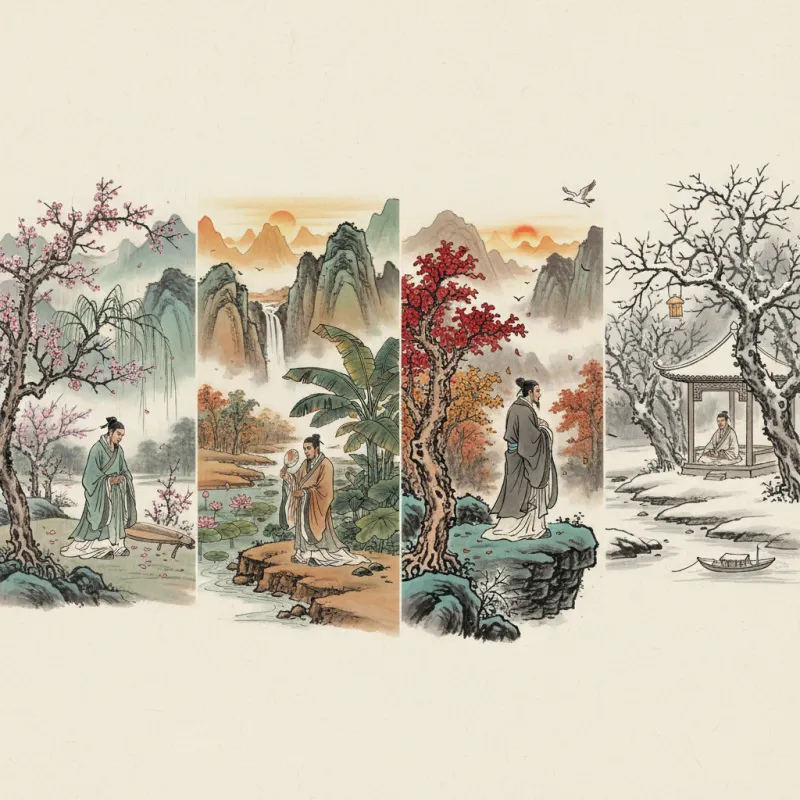
The plum blossoms are blooming, and the poet is miserable. This is not a contradiction — it's the entire point. In Chinese poetry, spring doesn't arrive with joy and renewal. It arrives with chunchou (春愁), "spring sorrow," a melancholy so fundamental to the season that poets barely need to explain it. The flowers bloom, yes, but they'll fall. The lover might return, but probably won't. Spring in classical Chinese poetry is beautiful precisely because it's temporary, and that temporariness hurts.
This is how seasons work in the Chinese poetic tradition: not as neutral backdrops but as emotional arguments. Each season carries a cluster of associations so consistent across centuries that they function almost like musical keys. A Tang dynasty reader encountering autumn leaves in a poem would immediately prepare for themes of separation, aging, and loss — not because the poet stated these themes, but because autumn means these things. The system is so efficient that it can convey complex emotional states in a handful of images, no explanation required.
Spring: Desire and Its Discontents
Spring should be the happy season. New growth, warming weather, the return of life after winter's death. But in Chinese poetry, spring is complicated. It's the season of chunchou, that peculiar spring melancholy that shows up everywhere from the Shijing (詩經, Book of Songs) to late Qing dynasty verse.
Why is spring sad? Because it makes you want things. The warming weather stirs desire — for absent lovers, for lost youth, for political advancement that never came. Du Fu (杜甫) writes about spring in the ruined capital, where "the nation broken, mountains and rivers remain; / city in spring, grass and trees grow deep" (國破山河在,城春草木深). The spring growth is almost offensive in its indifference to human suffering. Nature renews itself; the poet's fortunes do not.
Spring is also the season of female longing in the guiyuan (閨怨, "boudoir lament") tradition. The wife waits for her husband, away on military service or official duty. Spring arrives, flowers bloom, and she's still alone. Li Bai (李白) captures this in "Spring Thoughts" (春思): "The spring wind knows not parting's bitterness, / it stirs the silk curtains to the jade tower" (春風不解離別苦,吹動羅帳上玉樓). The wind is cheerful; the woman is not. The contrast is the poem.
The falling flowers of late spring carry their own weight. They're beautiful, but they're falling — a reminder that beauty doesn't last, that youth passes, that everything good ends. Cui Hu (崔護) writes about returning to a place where he once met a woman, finding only "peach blossoms still smile in the spring wind" (桃花依舊笑春風) while the woman is gone. The flowers mock him with their indifferent renewal.
Summer: Abundance and Excess
Summer gets less attention in classical Chinese poetry than the other seasons, but when it appears, it tends toward two extremes: lush abundance or oppressive heat. Unlike spring's delicate melancholy or autumn's refined grief, summer is physical, almost aggressive in its presence.
The positive summer is the summer of growth and plenty. Rice paddies green and thick, lotus flowers opening on ponds, the natural world at its most productive. This is the summer of pastoral poetry, where farmers work in the fields and the poet observes from a comfortable distance. Wang Wei (王維) excels at this mode: his summer landscapes are serene, abundant, slightly drowsy in the heat.
But summer can also be the season of discomfort and excess. The heat is oppressive, especially for officials stuck in the capital or scholars preparing for examinations. Bai Juyi (白居易) writes about summer heat with the irritation of someone who can't escape it: "The heat comes, I can't sleep, / I open the door and stand in the moonlight" (熱來不可眠,開門立月明). Summer here is an obstacle, something to be endured rather than enjoyed.
The summer storm is its own category — sudden, violent, transformative. It breaks the heat but also destroys the careful order of gardens and fields. In poetry, summer storms often mark turning points, moments when the established order breaks down. They're dramatic in a way that spring rain (gentle, nurturing) and autumn rain (melancholy, persistent) are not.
Autumn: The Season of Separation
If spring is complicated and summer is underutilized, autumn is the undisputed champion of Chinese poetic seasons. Autumn is when Chinese poetry does its best work. The associations are so rich and so consistent that autumn imagery becomes a kind of shorthand for an entire emotional universe: separation, aging, decline, clarity, wisdom, loss.
The falling leaves are the central image. They appear in poem after poem, dynasty after dynasty, always meaning roughly the same thing: time passes, things end, we age and die. The image is so powerful that it barely needs context. Du Fu writes "Endless falling leaves rustle down" (無邊落木蕭蕭下) and the reader immediately understands: this is about mortality, about the poet's awareness of his own decline, about the passage of time that can't be stopped.
Autumn is also the season of separation, particularly in the songbie (送別, "seeing off") tradition. Friends part ways, often at the beginning of autumn, and the season's imagery reinforces the emotional content of the farewell. The wild geese flying south become messengers of separation — they're leaving too, heading away, emphasizing distance. Wang Bo (王勃) writes "The wild geese fly long, light and shadow sink together" (落霞與孤鶩齊飛,秋水共長天一色), creating a landscape of departure and distance.
The autumn moon is clearer than the moon in other seasons — the air is crisp, the sky is high, the light is sharp. This clarity is both aesthetic and philosophical. Autumn strips away summer's lush excess and reveals the underlying structure of things. It's the season of seeing clearly, even when what you see is loss. Li Bai's "Quiet Night Thoughts" (靜夜思) uses the autumn moon to trigger homesickness: "Lifting my head, I gaze at the bright moon; / lowering my head, I think of my hometown" (舉頭望明月,低頭思故鄉).
The autumn wind is cold, cutting, carrying the first hints of winter. It strips the leaves from trees and reminds everyone that the comfortable season is ending. In exile poetry, the autumn wind often marks the moment when the exiled official realizes he won't be recalled before winter, that he'll have to endure the cold season away from home and court.
Winter: Endurance and Emptiness
Winter in Chinese poetry is the season of reduction. Everything that can fall has fallen. The leaves are gone, the flowers are dead, the birds have flown south. What remains is structure: bare branches, frozen rivers, mountains stripped of their green cover. Winter reveals what's essential by removing everything else.
The snow is winter's primary image, and it works in multiple registers. Fresh snow is beautiful, transformative, covering the world in white and making everything clean and new. But snow is also cold, isolating, dangerous. It blocks roads and traps travelers. In poetry, snow often appears in scenes of isolation — the poet alone in a mountain hut, cut off from the world, forced into a kind of involuntary meditation.
The plum blossom blooming in snow is winter's great paradox and its most celebrated image. The plum blooms in late winter, often while snow is still on the ground, and this early blooming makes it a symbol of resilience, integrity, and the refusal to compromise. The plum doesn't wait for spring like the other flowers. It blooms in the cold, alone, beautiful precisely because it's willing to endure what others won't. Wang Anshi (王安石) writes "In the corner, several plum branches, / alone they bloom in the cold" (牆角數枝梅,凌寒獨自開), making the plum's solitary blooming a statement of principle.
Winter is also the season of waiting. The farmer waits for spring planting. The official waits for the roads to clear so he can travel. The exile waits for recall. This waiting can be patient and philosophical, or it can be desperate and bitter. The season doesn't determine the tone — the poet's circumstances do. But winter provides the imagery of endurance, of making it through to the other side.
The frozen river is another key winter image. Water, normally flowing and changing, becomes solid and still. This can represent stagnation and death, or it can represent a kind of crystalline perfection, water at its most pure and clear. The ice will melt in spring, but for now, everything is suspended, held in place.
The Seasonal Cycle as Narrative Structure
Individual seasonal images are powerful, but the real sophistication of the Chinese poetic seasonal system emerges when poets use the cycle of seasons as a narrative structure. A poem that moves through seasons is also moving through emotional states, through stages of life, through the rise and fall of dynasties.
The yuefu (樂府, "Music Bureau") tradition includes many poems structured around the seasonal cycle, often focusing on the life of a woman waiting for her husband. Spring brings hope of his return, summer brings the fullness of her longing, autumn brings the realization that he won't return this year, winter brings resignation and endurance. The cycle repeats, year after year, and the repetition itself becomes part of the poem's meaning.
In longer narrative poems, seasonal transitions often mark turning points in the story. The Peacock Flies Southeast (孔雀東南飛), one of the longest narrative poems in Chinese literature, uses seasonal imagery to track the deteriorating relationship between the protagonist and her mother-in-law. The poem begins in spring and ends in winter, with the seasonal decline mirroring the narrative decline toward tragedy.
Poets also use seasonal imagery to comment on political cycles. The spring of a new dynasty, the autumn of decline, the winter of collapse — these aren't just metaphors, they're ways of understanding historical change through natural patterns. When Du Fu writes about autumn in the ruined capital, he's not just describing a season, he's describing the Tang dynasty's decline, using seasonal imagery to make a political argument.
Regional Variations and Exceptions
The seasonal system I've described is most consistent in poetry from the Yellow River valley and the regions around the Tang and Song capitals. But China is a large country with diverse climates, and poets from different regions sometimes push against the standard seasonal associations.
Southern poets, writing from regions where winter is mild and spring arrives early, sometimes treat seasons differently. The Jiangnan (江南, "south of the river") tradition includes poems about winter that are less harsh, more gentle, than northern winter poems. The plum blossoms bloom earlier, the snow is lighter, the cold is less bitter.
Poets in exile, particularly those sent to the far south or the far north, often write about seasons that don't match the standard cycle. Su Shi (蘇軾), exiled to Hainan Island, writes about a place where the seasons barely change, where the tropical climate makes the traditional seasonal imagery almost meaningless. His poetry from this period has to find new ways to mark time and emotional change.
Some poets deliberately violate seasonal expectations for effect. Writing about spring joy or winter celebration becomes interesting precisely because it goes against the grain of the tradition. These violations work because the tradition is so strong — the reader notices when a poet treats spring as genuinely happy or winter as genuinely festive, and that noticing is part of the poem's meaning.
Why the System Persists
The seasonal imagery system in Chinese poetry has remained remarkably stable for over two thousand years. Poets in the Qing dynasty used autumn leaves to signify loss in much the same way that poets in the Han dynasty did. This stability is unusual — most literary conventions evolve or get discarded over time. Why has this one persisted?
Part of the answer is efficiency. The seasonal system allows poets to convey complex emotional content in very few words, which matters in a tradition that values compression and implication over explicit statement. A Tang dynasty jueju (絕句, "cut-short verse") has only twenty or twenty-eight characters to work with. Using "falling leaves" to mean "aging and loss" saves space for other things.
But the deeper answer is that the seasonal system connects poetry to lived experience in a way that feels natural and inevitable. Everyone experiences seasons. Everyone has noticed that spring makes you restless, that autumn makes you melancholy, that winter makes you want to stay inside. The poetic tradition takes these common experiences and refines them, makes them more precise and more resonant, but it doesn't invent them from nothing.
The system also creates a sense of continuity across time. When a contemporary Chinese poet uses autumn imagery, they're participating in a conversation that stretches back millennia. They're writing in a tradition, connecting their individual experience to a collective cultural memory. This continuity is valuable in itself — it's a way of asserting that human experience, despite all the changes in technology and politics and social structure, remains fundamentally similar across centuries.
The seasonal imagery system is one of the great achievements of Chinese poetry. It's a shared language that allows poets to communicate complex ideas efficiently, a connection between human emotion and natural cycles, and a tradition that has proven flexible enough to accommodate individual variation while maintaining its core associations. When you read Chinese poetry with an awareness of these seasonal patterns, you're not just reading individual poems — you're reading a conversation that has been going on for two thousand years, and that shows no signs of stopping.
Related Reading
- Unraveling Themes in Chinese Classical Poetry: Insights from Tang, Song, and Yuan Dynasties
- Moonlight in Chinese Poetry: Why the Moon Means Everything
- War and Exile in Chinese Poetry: The Literature of Survival
- Friendship and Farewell: Poems of Parting
- Nature in Chinese Poetry: Mountains, Rivers, and the Mirror of the Soul
- Best English Translations of Tang Poetry: A Comparative Guide
- Su Shi: The Renaissance Man of Chinese Literature
- Bai Juyi: The Song of Everlasting Sorrow
Explore Chinese Culture
- Explore the Tang dynasty's golden age
- Explore Daoist themes in classical poetry
- Explore Chinese literary traditions