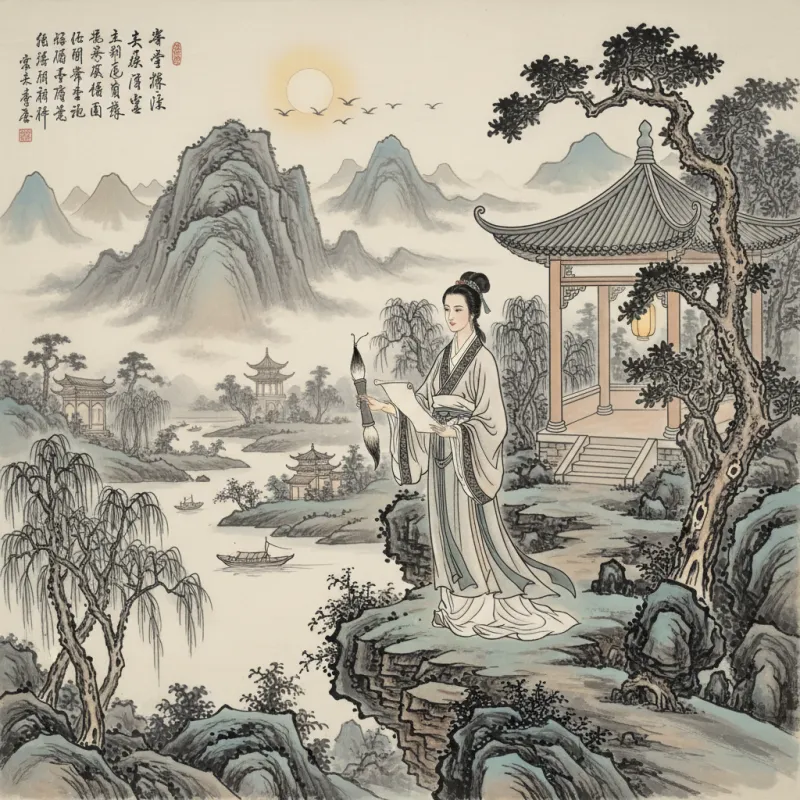
She was drinking wine and writing poetry while most women of her era were confined to embroidery and silence. Li Qingzhao (李清照, Lǐ Qīngzhào, 1084-1155) didn't just break the rules of Song dynasty society—she rewrote them entirely, becoming the most celebrated female poet in Chinese literary history. Her life reads like a novel: a brilliant youth surrounded by art and scholarship, a passionate marriage to a fellow antiquarian, then devastating loss as war tore through China and took everything she loved. What emerged from that crucible was a body of work so emotionally raw and technically masterful that scholars still debate whether any poet, male or female, has matched her command of the ci (词, cí) form.
A Childhood Among Books and Scholars
Li Qingzhao was born into extraordinary privilege—not of wealth alone, but of intellect. Her father, Li Gefei, was a renowned scholar and essayist, a member of the literary circle surrounding the great Su Shi. Her mother was also educated and from a prominent family. This wasn't typical. Most Song dynasty families educated their sons and married off their daughters young. But Li Qingzhao grew up in Jinan, Shandong province, in a household where books lined the walls and literary debates filled the air.
She started writing poetry as a teenager, and her talent was immediately recognized. One famous anecdote tells of her writing a ci poem that so impressed the established poets of the capital that they assumed it was written by a man. When they discovered the author was a seventeen-year-old girl, the literary world took notice. She wasn't just competent—she was revolutionary, bringing a female perspective to a form that had been dominated by male voices writing about courtesans and palace ladies.
Marriage as Intellectual Partnership
At eighteen, Li Qingzhao married Zhao Mingcheng (趙明誠, Zhào Míngchéng), a student at the Imperial Academy whose passion for antiquities and epigraphy matched her love of poetry. Their marriage became legendary—not for romance alone, but for genuine intellectual companionship. They were both collectors, spending whatever money they had on ancient rubbings, bronze vessels, and rare books. Zhao would bring home a new acquisition, and they'd stay up late examining it, debating its authenticity, composing poems about it.
Her early ci poems from this period overflow with playful sensuality and domestic happiness. In "Like a Dream" (如夢令, Rú Mèng Lìng), she describes getting drunk on a summer evening and accidentally rowing her boat into a lotus pond, startling the waterfowl. The poem captures pure joy—the kind that comes from being young, in love, and free to be yourself. This was the ci form at its most intimate, transforming everyday moments into art.
The Turning Point: War and Loss
Everything changed in 1127 when the Jurchen Jin dynasty invaded northern China, forcing the Song court to flee south in what historians call the Jingkang Incident. Li Qingzhao and Zhao Mingcheng were caught in the chaos. They had to abandon most of their precious collection—fifteen cartloads of books and antiquities left behind as they fled. Zhao took a government position in the south, but died suddenly in 1129, leaving Li Qingzhao a widow at forty-five.
The poetry that followed is almost unbearable in its grief. Her later ci poems strip away all the playfulness of youth and confront loss directly. "Slow Slow Song" (聲聲慢, Shēng Shēng Màn) opens with seven repeated characters—"searching, seeking, cold, lonely, miserable, sorrowful, distressed"—that create a rhythm of desolation. She writes about autumn wind, empty rooms, and wine that can't numb the pain. This wasn't the decorative sadness that male poets often affected. This was real grief, and it changed Chinese poetry forever.
Technical Mastery of the Ci Form
What made Li Qingzhao more than just an emotional poet was her technical brilliance. She understood that ci poems, originally written to be sung to specific melodies, required perfect attention to tonal patterns and rhythm. She wrote an essay, "On Ci Poetry" (詞論, Cí Lùn), that criticized even famous poets like Su Shi for treating ci too casually, for writing them like shi (詩, shī) poems—the more formal classical verse form.
Her argument was that ci demanded its own rules. The tones had to match the musical requirements. The language had to be both colloquial and refined. She practiced what she preached. Her poems use everyday words—"yellow flowers," "thin wine," "cold rain"—but arrange them with such precision that every syllable carries weight. Modern scholars analyzing her work find layers of meaning in her tonal choices, her use of reduplication, her strategic placement of empty words that create breathing space in the line.
A Woman's Voice in a Man's World
Li Qingzhao wrote from an explicitly female perspective, and this was radical. Male poets of the Song dynasty often wrote ci poems in female voices, but these were performances, fantasies about courtesans or palace ladies. Li Qingzhao wrote about her own experience—waiting for her husband to return, managing a household, feeling desire, experiencing widowhood. She didn't apologize for it or disguise it.
In one famous poem, she describes being too lazy to get up and fix her hair, letting her makeup fade. In another, she writes about her jealousy when her husband pays attention to his books instead of her. These weren't acceptable topics for women to write about publicly. But Li Qingzhao had the talent and confidence to claim space in the literary tradition. She influenced later female poets throughout Chinese history, proving that women's experiences were worthy subjects for serious art, much like how Song dynasty poetry expanded the boundaries of acceptable poetic subjects.
Legacy and Rediscovery
Only about fifty of Li Qingzhao's ci poems survive today, along with a handful of shi poems and prose works. Much of her writing was lost during the chaos of war and her difficult later years. She spent her final decades in poverty, moving from place to place in southern China, trying to preserve what remained of her collection. She died around 1155, largely forgotten.
But her work survived, copied and preserved by admirers who recognized its value. By the Ming and Qing dynasties, she was being celebrated as the greatest female poet in Chinese history. Modern scholars have only deepened that appreciation, recognizing how she transformed the ci form and brought psychological depth to Chinese poetry. Her influence extends beyond literature—she's become a symbol of female intellectual achievement, a reminder that genius doesn't respect gender boundaries.
Reading Li Qingzhao Today
What strikes contemporary readers about Li Qingzhao is how modern she feels. Her poems don't require extensive historical footnotes to understand emotionally. When she writes about missing someone, about feeling displaced in a world that's changed beyond recognition, about finding small moments of beauty amid loss—these experiences translate across centuries. The specifics are Song dynasty, but the feelings are universal.
Her technical mastery means her poems reward close reading. In Chinese, they're musical, full of internal rhymes and tonal patterns that create emotional effects. In translation, much of that music is lost, but the imagery and emotional honesty remain. She writes about yellow chrysanthemums, cold wine, geese flying south, rain on banana leaves—images that accumulate into a complete emotional landscape.
For anyone interested in classical Chinese poetry, Li Qingzhao is essential reading. She represents the ci form at its absolute peak, the moment when a genre originally associated with entertainment became high art. She proved that women could be not just poets, but masters of the craft. And she left behind a body of work that continues to move readers nearly a thousand years after her death—which is, ultimately, what great poetry is supposed to do.
Related Reading
- Xin Qiji: The Warrior Poet
- Su Shi's Red Cliff Odes: Philosophy in Poetry
- Drinking Poetry: Why Chinese Poets Wrote Their Best Work Drunk
- The Timeless Art of Song Poets: A Deep Dive into Classical Chinese Poetry
- Love Poetry in Classical Chinese: The Art of Saying Everything by Saying Almost Nothing
Explore Chinese Culture
- Explore the Tang dynasty's golden age
- Explore Daoist themes in classical poetry
- Explore Chinese literary traditions