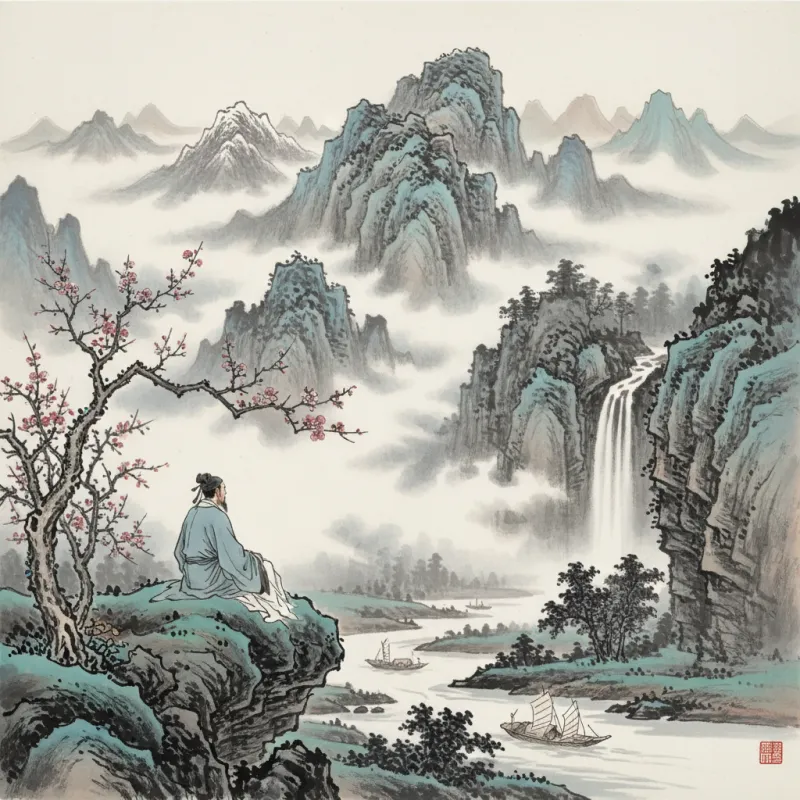
The poet sits alone in a room. Outside, rain falls on the lotus pond. He writes nothing about longing, nothing about the person he misses. He writes only: "The autumn pond rises with the night rain." Yet every reader for the past thousand years has felt the ache in those words. This is the genius of classical Chinese love poetry — it says everything by refusing to say anything at all.
The Problem with Saying "I Love You"
Western poetry, from the Elizabethan sonnets to modern love songs, operates on a principle of declaration. The speaker announces their feelings, catalogs the beloved's virtues, makes promises, issues complaints. "How do I love thee? Let me count the ways," Elizabeth Barrett Browning writes, and then literally counts them.
Classical Chinese poets considered this approach crude. To name an emotion is to limit it. The word "love" (愛, ài) appears surprisingly rarely in Tang and Song dynasty poetry. When it does appear, it often feels flat, almost bureaucratic. The poems that endure — the ones copied and memorized for centuries — are the ones that never mention love at all.
Instead, they describe scenes. A woman stands by a window. Moonlight falls on an empty bed. A letter arrives from a distant province. The reader supplies the emotion, and because the reader supplies it, the emotion feels more real than any declaration could make it.
Li Shangyin and the Art of Beautiful Confusion
Li Shangyin (李商隱, Lǐ Shāngyǐn, 813-858) perfected this technique to the point where his poems became almost impossible to interpret with certainty. His most famous poem, "Untitled" (無題, wútí) — and he wrote many poems with this non-title — begins: "It's hard to meet, and hard to part" (相見時難別亦難, xiāng jiàn shí nán bié yì nán). The next lines describe spring wind, dying silkworms, candle tears, morning mirror worries. Scholars have debated for over a millennium: Is this about a forbidden love affair? A courtesan? A political allegory? A memory of someone dead?
The answer is: it doesn't matter. Or rather, the ambiguity is the point. Li Shangyin's poems work like dreams — vivid, emotionally coherent, but resistant to logical paraphrase. You feel them before you understand them, and the feeling is what matters.
His contemporary critics hated this. They wanted clarity, moral instruction, political relevance. But readers loved it, because Li Shangyin's poems felt true to the actual experience of longing — confused, contradictory, impossible to explain to someone who hasn't felt it.
The Language of Objects
Classical Chinese poetry developed an elaborate vocabulary of objects that carried emotional weight. These weren't symbols in the Western sense — fixed, allegorical, requiring a key to decode. They were more like emotional triggers, objects that accumulated associations through repeated use in poetry.
The willow (柳, liǔ) appears in parting scenes because its name sounds like "to stay" (留, liú). Lotus flowers (蓮, lián) suggest purity but also homesickness, because lián sounds like "to long for" (戀, liàn). The autumn moon (秋月, qiūyuè) carries centuries of associations with separation, clarity, coldness, and beauty. A poet could write "autumn moon" and trust readers to feel the entire complex of emotions those two characters evoked.
This system allowed for extraordinary compression. Du Mu (杜牧, Dù Mù, 803-852) wrote a four-line poem about visiting a courtesan that contains only the words: "Ten years, Yangzhou dream, won the name of brothel's fickle heart." Twenty characters in Chinese. An entire affair, its aftermath, and the poet's rueful self-awareness, compressed into a handful of images.
What Gets Lost in Translation
English translations of Chinese love poetry often add what the original deliberately omits. Translators insert "I" and "you" into poems that have no pronouns. They specify genders that Chinese grammar leaves ambiguous. They name emotions that the original only implies.
This isn't the translators' fault. English demands subjects for its verbs. It requires gender markers. It feels incomplete without emotional labels. But something essential disappears in the process. The Chinese poem "月明" (yuè míng, "moon bright") becomes "I see the bright moon and think of you," and suddenly the reader's imaginative participation — the work of feeling the longing that moonlight implies — is done for them.
The best translations preserve some of this openness. Arthur Waley's versions often feel more like English poems inspired by Chinese originals than literal translations, but they capture the indirection, the sense of emotion hovering just outside the frame of the poem.
The Erotic Restraint of Song Ci
Song dynasty ci poetry (詞, cí) — lyrics written to existing melodies — pushed indirection even further. These poems were often performed by courtesans, which created a complex situation: a woman singing words written by a man, expressing emotions that might be the man's, the woman's, or a fictional character's.
Liu Yong (柳永, Liǔ Yǒng, 987-1053) wrote ci that were wildly popular in his time and scandalized the court. His poems describe intimate scenes — a woman's hair unpinned, clothes loosened, the morning after — but always through indirection. He writes about "clouds and rain" (雲雨, yúnyǔ), a euphemism so well-established it had lost its shock value. He describes a woman's embarrassment, her reluctance, her eventual yielding, but never the act itself. The eroticism comes from what's not shown.
This restraint wasn't prudishness. It was aesthetic sophistication. The Song poets understood that desire is more powerful when it remains partially unfulfilled, that the imagination is more erotic than any explicit description. For more on the musical forms that shaped these poems, see The Ci Form and Musical Poetry.
Why Indirection Works
Modern readers sometimes find classical Chinese love poetry frustrating. Where's the passion? Where's the declaration? Why won't the poet just say what they mean?
But the indirection serves a purpose beyond aesthetic preference. It acknowledges a truth about emotional experience: we rarely know exactly what we feel, and when we try to name our feelings, we often get them wrong. The poet who writes "I am devastated by your absence" has already simplified and falsified the emotion. The poet who writes "Rain falls on the empty courtyard" has left room for the full complexity — the longing, yes, but also the peace of solitude, the beauty of the rain, the way grief and aesthetic pleasure can coexist.
This approach also respects the reader's intelligence and emotional sophistication. The poet trusts you to understand what the rain means, what the empty courtyard implies. You become a collaborator in creating the poem's emotional meaning, not a passive recipient of the poet's declarations.
The Modern Inheritance
Contemporary Chinese poets still work in this tradition of indirection, though they've absorbed Western influences as well. Bei Dao (北島, Běi Dǎo) writes love poems that feel both ancient and modern: "I don't believe the sky is blue / I don't believe in thunder's echoes / I don't believe that dreams are false / I don't believe that death has no revenge." The beloved is never mentioned, but the poem's emotional intensity comes from that absence.
The tradition also influenced Western modernism. Ezra Pound's imagist poems — "The apparition of these faces in the crowd / Petals on a wet, black bough" — owe everything to classical Chinese poetry's technique of presenting an image and trusting the reader to feel its emotional weight. For more on how Tang poetry influenced Western literature, see Tang Poetry's Global Influence.
The lesson of classical Chinese love poetry isn't that directness is bad or that Western poetry is inferior. It's that there are multiple ways to tell the truth about emotion, and sometimes the most accurate way is to describe the world the emotion inhabits rather than the emotion itself. The rain falls. The courtyard is empty. The moon is bright. And in those simple observations, an entire universe of longing becomes present without ever being named.
Related Reading
- Poems of Separation: The Chinese Art of Saying Goodbye
- Love and Longing in Chinese Classical Poetry: Tang, Song, and Yuan Dynasties Explored
- Li Qingzhao: China's Greatest Female Poet
- The 10 Greatest Chinese Love Poems of All Time
- Love Poetry in Chinese Literature: The Art of Saying Everything by Saying Nothing
- Nature Poetry in the Tang Dynasty: Mountains, Rivers, and the Art of Seeing
- The Banana Garden Poetry Club: When Women Took Over Chinese Poetry
- Su Shi: The Renaissance Man of Chinese Literature
Explore Chinese Culture
- Explore the Tang dynasty's golden age
- Explore Daoist themes in classical poetry
- Explore Chinese literary traditions