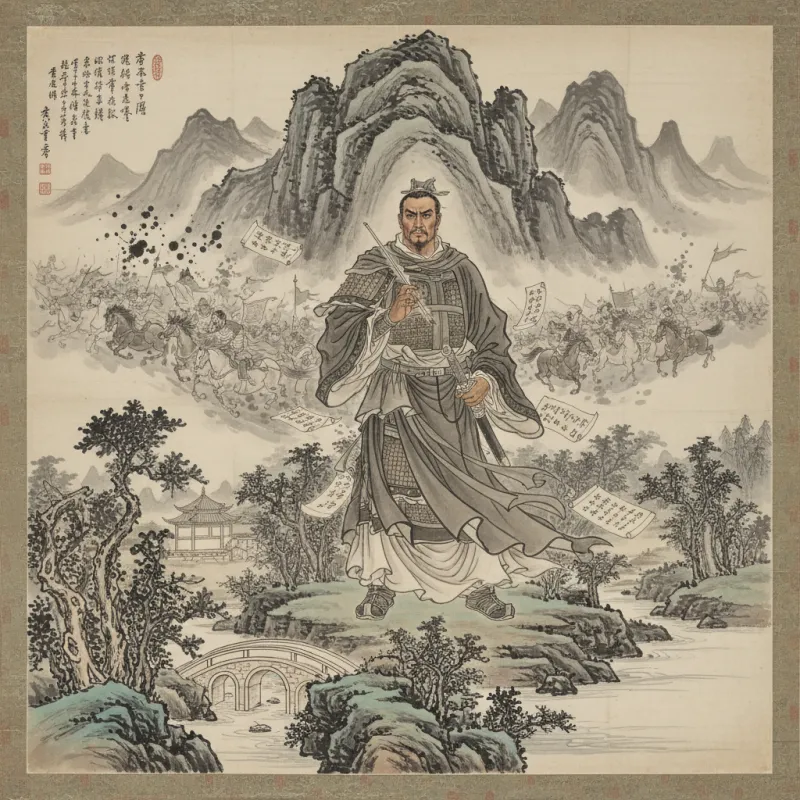
Picture this: A battle-hardened general in his fifties, stripped of military command and exiled to a remote provincial post, sits alone with brush and ink. Outside, the Jurchen armies occupy half of China. Inside, he writes poetry so fierce it could rally armies—except no one in power wants to listen. This was Xin Qiji (辛弃疾, Xīn Qìjí, 1140-1207), and his story reveals something the textbooks often miss: sometimes the most dangerous weapon isn't a sword, but words that refuse to let people forget what they've lost.
The Making of a Warrior
Xin Qiji grew up in occupied territory. Born in Jinan, Shandong Province, he spent his childhood under Jurchen Jin Dynasty rule after the catastrophic loss of northern China in 1127. Most children in his position learned to accept the new order. Xin did the opposite. At twenty-two, he led a daring raid with fifty horsemen into an enemy camp of fifty thousand soldiers, captured a traitor who had murdered his resistance leader, and dragged him south to Song territory for execution. This wasn't poetry—this was the kind of audacity that makes you wonder if the historical records exaggerated. They didn't.
The young warrior arrived in Southern Song China expecting to be celebrated as a hero. Instead, he encountered a court that had made peace with permanent division. The officials who mattered had comfortable positions in Hangzhou, the new capital. They wrote elegant poetry about West Lake and philosophical treatises about accepting what heaven ordains. The last thing they wanted was a northern hothead reminding everyone that half the empire was still under foreign occupation.
The Ci Form as Battlefield
When the military establishment sidelined him, Xin Qiji turned to ci (词, cí)—lyric poetry set to musical patterns. But he didn't write ci the way it was supposed to be written. The form had evolved in the entertainment quarters, designed for singing about romance, nature, and refined melancholy. Poets like Liu Yong had already expanded its emotional range, but Xin Qiji essentially weaponized it.
Take his most famous piece, "Broken Array" (破阵子, Pòzhènzǐ). The title itself refers to a military formation. He writes about "watching the sword while drunk, dreaming of horns and barracks" (醉里挑灯看剑,梦回吹角连营). This isn't metaphor—it's a middle-aged man obsessing over the military career that was stolen from him. The poem ends with devastating directness: "Pitiful white-haired man" (可怜白发生). No elegant resolution, no philosophical acceptance. Just rage at wasted potential.
His ci poems read like someone smuggling military dispatches inside love songs. He describes landscapes, but they're always northern landscapes—the lost territories. He writes about historical heroes, but they're always generals who recovered lost ground. When he mentions growing old, it's never the gentle autumn-of-life imagery you find in Su Shi's contemplative works. It's fury at dying before the reconquest.
The Vocabulary of Resistance
What made Xin Qiji's poetry genuinely revolutionary was his language. Traditional ci used refined, often euphemistic vocabulary. Xin imported the rough diction of military camps and northern folk speech. He wrote about "swallowing ten thousand miles like a tiger" (气吞万里如虎) and "shooting the Sirius star" (射天狼)—the latter being a metaphor for defeating northern invaders that he practically trademarked.
Critics at the time called his style "heroic and unrestrained" (háofàng, 豪放), which sounds like a compliment but was often meant as criticism. Refined literati thought he was vulgar. They had a point—he was vulgar, deliberately so. He wanted his poetry to sound like someone who'd actually been in battle, not someone who'd read about it in classical texts.
But here's what makes him fascinating: he could also write with devastating subtlety when he chose. His poem "Ugly Slave" (丑奴儿, Chǒunú'ér) contains the lines: "Now I know the taste of sorrow / But want to speak yet stop / Want to speak yet stop / Instead I say: what cool autumn weather!" (而今识尽愁滋味,欲说还休,欲说还休,却道天凉好个秋). That repetition of "want to speak yet stop"—that's a man who's learned that some truths are too dangerous to voice directly.
The Political Exile
Xin Qiji spent most of his adult life in forced retirement or minor provincial posts. He wrote policy proposals that were ignored. He trained militia that were disbanded. He watched younger, less capable men receive the military appointments he deserved. The court kept him at arm's length because his very presence was an accusation: Why aren't we fighting to recover the north?
During one of his rare periods of employment, he served as magistrate in Jiangxi Province, where he created the "Flying Tiger Army" (飞虎军, Fēihǔjūn), a militia force of 25,000 men. It was disbanded almost immediately after he left office. The pattern repeated throughout his career: brief appointments, impressive results, sudden dismissal. The problem wasn't his competence—it was his refusal to pretend that the status quo was acceptable.
His poetry from these exile periods carries a particular weight. He writes about farmers and village life, but always with an undercurrent of what these people have lost. In "Partridge Sky" (鹧鸪天, Zhègūtiān), he describes rural scenes but can't help noting that these were once prosperous northern territories. Even his pastoral poetry is political.
Legacy and Influence
Xin Qiji died in 1207, still in exile, never having seen the reconquest he spent his life advocating for. The Southern Song would limp along for another seventy years before falling to the Mongols—proving, in a sense, that his warnings about military weakness were correct all along.
His poetry survived because it was too good to suppress. Later dynasties, particularly the Ming, embraced him as a patriotic hero. Modern Chinese nationalism has claimed him enthusiastically, sometimes too enthusiastically, turning a complex figure into a simple symbol. But read his actual poems, and you find someone more interesting than any propaganda poster: a man who refused to accept defeat, who channeled his frustration into art, and who proved that poetry could be as uncompromising as any military campaign.
The ci form itself was permanently changed by his intervention. After Xin Qiji, it was impossible to claim that lyric poetry had to be delicate or refined. He showed that the same musical patterns used for love songs could carry the weight of political rage, military ambition, and historical grief. Later Song Dynasty poets had to reckon with his example, whether they embraced or rejected his approach.
Reading Xin Qiji Today
What strikes me most about Xin Qiji is how modern his frustration feels. He's the talented person blocked by bureaucracy, the expert ignored by decision-makers, the idealist watching mediocrity triumph. His poetry doesn't offer comfort or resolution—it offers the cold satisfaction of seeing your anger articulated perfectly.
His best poems work on multiple levels. Surface level: beautiful imagery and masterful technique. One level down: political allegory and historical reference. Deepest level: raw emotional honesty about what it feels like to fail at the thing you were born to do. You can read him for the craft, for the history, or for the feeling. All three readings are valid.
If you want to understand why Chinese poetry matters beyond academic study, read Xin Qiji. He proves that formal constraints don't limit expression—they intensify it. Every word had to fight for its place in the strict ci patterns, which means every word carries maximum force. His poetry is what happens when someone with something urgent to say masters a difficult form completely.
The warrior never got his war. But the poet won a different kind of victory: eight hundred years later, we're still reading his words, still feeling his anger, still understanding exactly what he meant. That's not a bad legacy for someone the establishment tried to silence.
Related Reading
- Su Shi's Red Cliff Odes: Philosophy in Poetry
- Li Qingzhao: China's Greatest Female Poet
- Ezra Pound and Chinese Poetry: Beautiful Mistakes
- The Art of Nature in Tang, Song, and Yuan Dynasty Poetry: A Literary Exploration
- The Enchantment of Song Dynasty Poets: A Deep Dive into Their Timeless Verses
Explore Chinese Culture
- Explore the Tang dynasty's golden age
- Explore Daoist themes in classical poetry
- Explore Chinese literary traditions