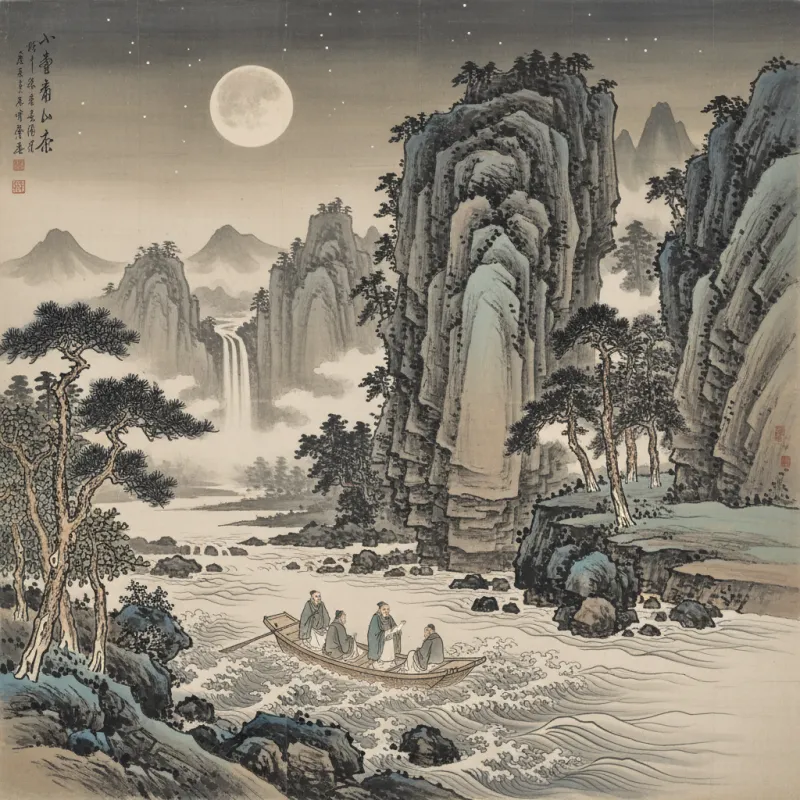
Picture this: a disgraced official stands on a moonlit cliff above the Yangtze River, wine cup in hand, contemplating the same waters where Cao Cao's million-man army met catastrophic defeat nine centuries earlier. This is Su Shi (苏轼, Sū Shì) in 1082, exiled to the cultural backwater of Huangzhou, transforming personal disaster into two of Chinese literature's most philosophically rich poems—the "Red Cliff Odes" (赤壁赋, Chìbì Fù).
The Man Behind the Masterpiece
Su Shi wasn't just any Song Dynasty poet—he was a political heavyweight who'd served as a high-ranking official before his enemies at court accused him of slandering the emperor through his poetry. The "Crow Terrace Poetry Trial" of 1079 nearly cost him his life. Instead, he got exile to Huangzhou, a provincial town in modern-day Hubei. Most officials would have sulked. Su Shi wrote two of the greatest fu (赋, fù)—a poetic prose form—in Chinese literary history.
The timing matters. At forty-five, Su Shi had lost everything: position, influence, the ear of power. What he gained was perspective. The Red Cliff site near Huangzhou became his philosophical laboratory, a place where he could wrestle with questions that court life had kept at bay. The result was the "Former Red Cliff Ode" (前赤壁赋, Qián Chìbì Fù) written in the seventh month of 1082, followed by the "Latter Red Cliff Ode" (后赤壁赋, Hòu Chìbì Fù) three months later.
When History Becomes Philosophy
Here's where Su Shi pulls off something brilliant: he deliberately confuses his Red Cliff with the famous Red Cliff of the Battle of Chibi (208 CE), where Zhou Yu and Zhuge Liang's allied forces destroyed Cao Cao's fleet during the Three Kingdoms period. Scholars have long known these are different places—the actual battle site lies downstream. But Su Shi doesn't care about geographical accuracy. He's after something deeper.
By invoking Cao Cao's defeat, Su Shi sets up a meditation on impermanence that would make any Buddhist monk nod in approval. Cao Cao commanded hundreds of thousands of troops, held the emperor hostage, and seemed unstoppable. Then fire ships turned the Yangtze into an inferno, and his dreams of unifying China went up in smoke. The mighty chancellor became a footnote, his "ten thousand boats" reduced to ash and memory.
The Former Ode opens with Su Shi and friends boating under an autumn moon, drinking wine and reciting poetry. One guest plays a flute so mournfully that "the hidden dragon in the sunken boat weeps, and the widow in her lonely vessel sobs." When Su Shi asks why such sadness, the guest launches into a lament about Cao Cao's vanished glory: "Where is he now? And where are we, you and I?"
The Philosophy of Water and Moon
Su Shi's response to his guest's despair contains some of the most quoted lines in Chinese philosophy. He points to the river and moon, arguing that from one perspective, everything changes constantly—the water flows endlessly, never the same twice. From another perspective, nothing truly changes—the river remains a river, the moon remains the moon. "If we view things from the perspective of change," Su Shi writes, "heaven and earth cannot remain the same for even a blink. If we view them from the perspective of changelessness, both things and I are inexhaustible."
This isn't just pretty wordplay. Su Shi is synthesizing Daoist, Buddhist, and Confucian thought into a coherent response to suffering. The Daoist influence shows in his acceptance of natural cycles and transformation. The Buddhist element appears in his recognition of impermanence and attachment as sources of suffering. But unlike a pure Buddhist who might renounce the world, Su Shi maintains a Confucian engagement with life—he's still drinking wine, enjoying friendship, appreciating beauty.
The moon becomes his central metaphor. It waxes and wanes but never truly grows or shrinks. Cao Cao's glory has faded, but the moon that shone on his defeat still shines on Su Shi's exile. "The Yangtze's endless flow and the moon's eternal brightness—these we may enjoy without limit, use without exhaustion." This is Su Shi's answer to loss: find joy in what cannot be taken away.
The Latter Ode: Deepening the Mystery
Three months later, Su Shi returned to Red Cliff and wrote a second ode that's stranger, more dreamlike, and arguably more profound. This time he goes alone, climbing the cliff at night when frost covers the ground and leaves have fallen. The landscape is harsh, almost hostile. He hears a crane's cry—"like a Daoist priest in black robes and yellow cap"—flying from the east across the river.
That night, Su Shi dreams of two Daoist priests passing his door, asking if he enjoyed the evening. When he tries to see their faces, he can't. He wakes to find a crane outside. The boundary between dream and reality, human and nature, has dissolved.
Where the Former Ode resolved philosophical questions through argument, the Latter Ode abandons argument entirely. Su Shi doesn't explain the crane or the dream. He simply presents the experience and lets it speak for itself. This is closer to Chan (Zen) Buddhism's approach—direct pointing at reality beyond words. The crane might be the Daoist priests, or the priests might be the crane, or both might be projections of Su Shi's own transformed consciousness.
Literary Innovation in the Fu Form
Su Shi's Red Cliff Odes revolutionized the fu form, which had become stale and formulaic by the Song Dynasty. Traditional fu were elaborate, ornate compositions full of obscure allusions and parallel constructions—impressive but often emotionally distant. Su Shi stripped away the artifice. His language is relatively plain, his allusions accessible, his emotional honesty striking.
He also broke the fu's typical structure. Classical fu often featured a host-guest dialogue where the guest expresses wrong views and the host corrects them. Su Shi uses this framework but subverts it—the guest's despair is genuine, and Su Shi's response doesn't dismiss it but transforms it. Both perspectives have validity. This reflects Su Shi's broader philosophical stance: reality contains contradictions, and wisdom lies in holding multiple truths simultaneously.
The influence on later literature was enormous. Song Dynasty poets after Su Shi felt liberated to write more personally, to blend philosophical reflection with immediate experience. The Red Cliff Odes showed that profound thought didn't require obscure language or emotional detachment.
Exile as Spiritual Transformation
What makes the Red Cliff Odes so powerful is their authenticity. Su Shi isn't performing philosophical wisdom from a position of comfort—he's working out his own survival strategy in real time. Exile in Song Dynasty China wasn't a vacation. It meant separation from family, loss of income, social humiliation, and real danger. Officials died in exile from disease, depression, or further political persecution.
Su Shi's response was to radically reframe his situation. If he couldn't control external circumstances, he could control his relationship to them. The Red Cliff became his teacher, showing him that loss and gain are perspectives, not absolute realities. Cao Cao lost everything, but the moon and river remain. Su Shi lost his position, but he gained the freedom to write honestly, to drink wine with friends, to experience nature without the burden of ambition.
This wasn't resignation or defeat—it was a kind of victory. By the time Su Shi wrote the Latter Ode, he'd moved beyond needing philosophical arguments. The crane's cry, the frost, the dream—these were enough. He'd achieved what Daoist philosophy calls wuwei (无为, wúwéi), effortless action, being fully present without grasping or resisting.
Legacy and Modern Relevance
The Red Cliff Odes have been memorized by Chinese students for nearly a millennium. They've inspired countless paintings, calligraphies, and musical compositions. The site near Huangzhou became a pilgrimage destination for literati seeking their own transformations. Even today, Chinese readers turn to these poems during personal crises, finding in Su Shi's words a model for maintaining dignity and joy amid loss.
What makes them timeless is their refusal of easy answers. Su Shi doesn't promise that everything happens for a reason or that suffering leads to growth. He simply shows one man's honest reckoning with impermanence, using poetry to transform pain into beauty. The river flows, the moon shines, and we—like Cao Cao, like Su Shi, like everyone who's ever stood on that cliff—are here for a moment, then gone.
But what a moment it can be, if we learn to see it as Su Shi did: not as something to possess or control, but as an inexhaustible gift, free for the taking, impossible to lose.
Related Reading
- Xin Qiji: The Warrior Poet
- Li Qingzhao: China's Greatest Female Poet
- Buddhist Poetry in Chinese Literature: Enlightenment in Twenty Characters
- Nature Poetry in the Tang Dynasty: Mountains, Rivers, and the Art of Seeing
- Women Poets of China: The Voices That Were Almost Lost
Explore Chinese Culture
- Explore the Tang dynasty's golden age
- Explore Daoist themes in classical poetry
- Explore Chinese literary traditions