Li Bai once claimed he could drink a thousand cups without getting drunk. He was lying, of course — the man famously drowned trying to embrace the moon's reflection in a river while completely plastered. But the lie reveals something true: for Chinese poets, drunkenness wasn't about losing control. It was about finding a different kind of control, one that bypassed the rigid social codes of imperial China and accessed what they called zhen (真) — authenticity, the real self beneath the performance.
The Wine That Loosens Tongues and Unlocks Gates
In Tang Dynasty China, every word you spoke in public was a political act. Officials memorized Confucian texts that prescribed exactly how to behave, what to say, when to bow. Poetry itself was a tool of statecraft — you wrote regulated verse (律诗, lǜshī) to pass the imperial examinations, composed occasional poems to flatter your superiors, crafted farewell verses that followed strict tonal patterns. The whole system was designed to produce predictable, harmonious, socially acceptable art.
Wine was the solvent that dissolved these constraints. When Du Fu (杜甫) wrote "in wine, there is no ancient or modern" (酒中无古今, jiǔ zhōng wú gǔ jīn), he meant that drunkenness collapsed the hierarchies of time and status. A drunk poet could address the emperor as an equal, could weep openly about political failures, could admit to desires and doubts that sober Confucian propriety forbade. The drinking poem became a licensed space for dangerous honesty.
This is why so many of the greatest Chinese poems are drinking poems. Not because alcohol made poets write better — it probably made them write worse, technically — but because it gave them permission to write differently. The relationship between wine and creative freedom became so established that even sober poets would invoke drinking as a frame, a signal to readers: what follows is unfiltered truth.
Li Bai's Calculated Wildness
Li Bai (701-762) understood this better than anyone. His drinking persona — the wild immortal who wandered mountains with a wine gourd, who got kicked out of the imperial court for showing up drunk, who wrote his best poems in taverns — was carefully constructed theater. Yes, he drank heavily. But he also knew exactly what that drinking signified in Tang culture: rejection of official careerism, alignment with Daoist spontaneity, access to divine inspiration.
Look at "Drinking Alone Beneath the Moon" (月下独酌, Yuè Xià Dú Zhuó). Li Bai sits in a garden with wine, the moon, and his shadow — three drinking companions, he jokes, though he's completely alone. The poem is playful, melancholy, and deeply weird. He invites the moon to drink, dances with his shadow, then promises to meet them again "beyond the Milky Way." It's the kind of poem you can only write if you've given yourself permission to be absurd, to follow the image wherever it leads without worrying whether it makes Confucian sense.
But notice: the poem is technically flawless. The tonal patterns are perfect, the imagery is controlled, the structure is deliberate. Li Bai wasn't writing while drunk — he was writing about drunkenness, using it as a method to access a particular kind of imaginative freedom while maintaining complete technical mastery. The drunkenness is the subject and the excuse, not the cause.
The Social Architecture of Drinking Poetry
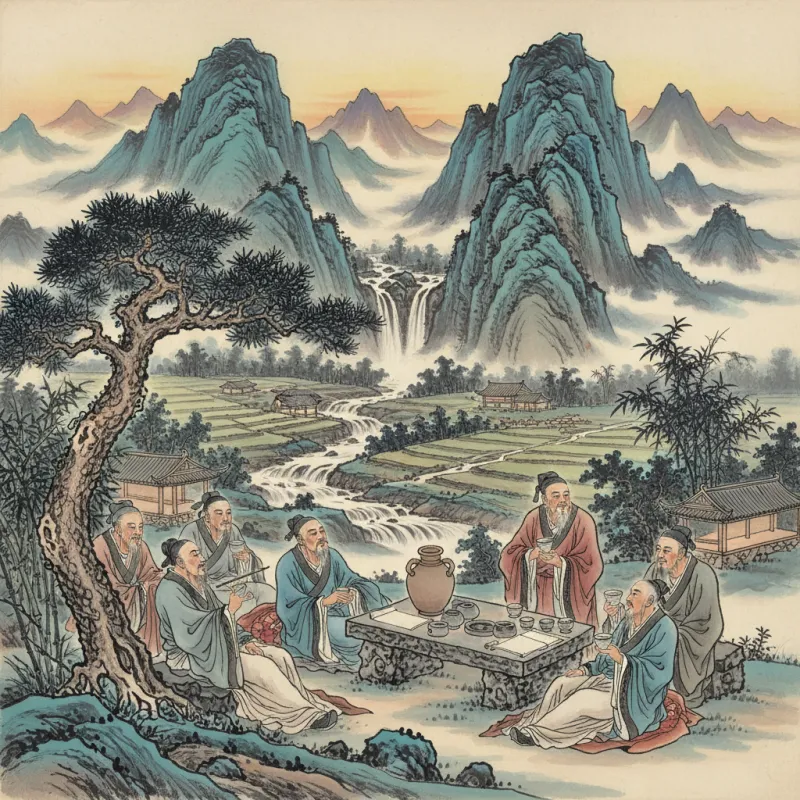
Chinese drinking poetry was rarely solitary. The typical scene: a group of scholar-officials gather at someone's estate, sit by a stream or in a pavilion, and drink while composing poems. Someone suggests a theme — autumn leaves, political exile, the brevity of life. Everyone writes a poem, usually in the same form and rhyme scheme. The poems are read aloud, judged, and the worst poet has to drink more as punishment (which of course makes the next round of poems even worse, which is part of the fun).
This is the context for Wang Wei's (王维) famous "Weicheng Song" (渭城曲, Wèichéng Qǔ), written at a farewell banquet: "Morning rain dampens the dust of Weicheng / By the guesthouse, green willows are fresh again / Drink one more cup of wine, my friend / West of Yang Pass, there will be no old friends." The poem works because everyone at the banquet knows this is the last cup they'll share, that the friend is leaving for a dangerous frontier post, that this moment of drunken warmth is all they have against the vastness of separation.
The drinking isn't incidental to the poetry — it creates the emotional intensity that makes the poem necessary. Sober, you might say "safe travels" and bow politely. Drunk, you can grab your friend's sleeve and say what you really mean: I will miss you. I am afraid you will die out there. This cup of wine is all I can give you.
Tao Yuanming and the Refusal of Sobriety
If Li Bai used drinking as performance, Tao Yuanming (陶渊明, 365-427) used it as philosophy. Tao quit his government job — famously refusing to "bow for five pecks of rice" — and spent the rest of his life farming and drinking in rural obscurity. His drinking poems are manifestos of refusal: refusal of ambition, of social climbing, of the whole Confucian project of self-improvement through public service.
"I built my hut in the world of men / Yet there is no noise of horses and carriages / You ask how this is possible? / When the heart is distant, the place is naturally remote." Then he picks chrysanthemums, drinks wine, and watches the mountains. The drinking here is not about ecstasy or inspiration — it's about wu wei (无为), the Daoist principle of non-action, of letting things be. Sobriety means striving, planning, wanting. Drunkenness means acceptance, presence, enough.
Tao's influence on later drinking poetry is enormous. He established the archetype of the recluse-poet who drinks not to escape the world but to find the right relationship to it. His vision of wine as a path to contentment became a template that poets would return to for the next thousand years, especially when their own political careers collapsed.
The Limits of Drunken Genius
Not everyone celebrated the drinking-poetry connection. Bai Juyi (白居易), the great Tang Dynasty realist, wrote poems about alcoholic officials who neglected their duties, about wine that ruined families, about the gap between the romantic image of the drunk poet and the reality of addiction. His "After Drinking, Facing the Mirror" is brutal: "My face is haggard, my hair is white / I look like a ghost, not a man."
And there's the question of the women poets, who were largely excluded from the drinking-banquet culture that produced so much male poetry. Li Qingzhao (李清照), the greatest female poet of the Song Dynasty, wrote drinking poems, but they're different — more private, more melancholy, more aware of drinking as a response to loss rather than a path to transcendence. "Last night the rain was sparse, the wind sudden / Heavy sleep did not dispel the lingering wine." She's not celebrating drunkenness; she's documenting its aftermath, the hangover both literal and emotional.
The drinking-poetry tradition, for all its brilliance, was also a privilege — available mainly to educated men with enough wealth and leisure to spend days drinking and writing. The poems rarely acknowledge this. They present drinking as universal human experience, when it was actually a specific class performance.
What the Drunk Poets Knew
Still, there's something in these poems that transcends their social context. The best drinking poems aren't really about alcohol — they're about the human need for spaces where we can be unguarded, where we can say what we actually feel instead of what we're supposed to feel. Wine was the technology Tang poets used to create those spaces. We might use different technologies now, but the need remains the same.
Li Bai's moon-drinking, Tao Yuanming's chrysanthemum wine, Du Fu's bitter cups in exile — these poems endure because they capture moments when the performance drops and something true appears. The drunkenness is just the excuse, the frame that makes honesty possible. What matters is what gets said in that frame: I am lonely. I am afraid. I love you. This moment is enough. Nothing is enough. Look at the moon.
The Chinese poets didn't write their best work drunk. They wrote their best work about drunkenness, using it as a method to access and express what sober poetry couldn't reach. The wine was never the point. The wine was the door.
Related Reading
- Unraveling the Essence of Drinking Poetry in Tang, Song, and Yuan Eras
- Li Bai's Drinking Poems: Wine, Moon, and Immortality
- Poetry Drinking Games: When Literature Met Entertainment
- Wine Poetry: The Chinese Tradition of Drinking and Writing
- Drinking Poetry: Wine, Moonlight, and the Art of Getting Drunk with Purpose
- Poetic Forms in Chinese Literature: The Rules That Set Poetry Free
- The Resonance of War in Chinese Classical Poetry: Analyzing Tang, Song, and Yuan Poets
- Song Ci: The Lyrics That Broke Poetry's Rules
Explore Chinese Culture
- Explore the Tang dynasty's golden age
- Explore Daoist themes in classical poetry
- Explore Chinese literary traditions