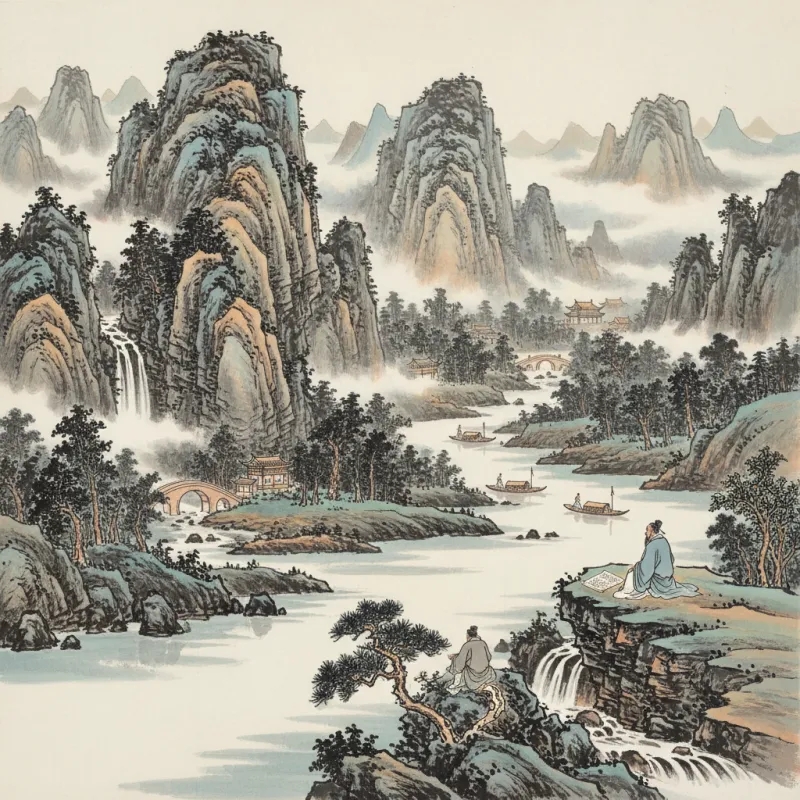
Picture this: you're standing alone in a mountain valley at dusk. The last visitors have left, but their voices still echo faintly between the peaks. Then, as the sun drops below the ridgeline, a shaft of golden light cuts through the forest canopy and illuminates a patch of moss at your feet. In that moment, something shifts. You're not just looking at nature anymore — you're witnessing the precise instant when perception itself becomes visible.
This is what Tang Dynasty nature poetry actually does. And if you came here expecting flowery descriptions of babbling brooks and cherry blossoms, you're in for something far stranger and more profound.
The Radical Emptiness of Wang Wei
Wang Wei (王维, Wáng Wéi, 701-761) didn't write nature poetry. He wrote perception poetry that happened to use mountains and rivers as its medium. A painter as accomplished as he was a poet, Wang Wei understood that the most interesting thing about a landscape isn't what's in it — it's what happens in the space between the observer and the observed.
Take his famous "Deer Enclosure" (鹿柴, Lù Zhài):
空山不见人 / kōng shān bù jiàn rén / Empty mountain, no one to be seen
但闻人语响 / dàn wén rén yǔ xiǎng / Only the echo of voices heard
返景入深林 / fǎn jǐng rù shēn lín / Returning light enters the deep forest
复照青苔上 / fù zhào qīng tái shàng / And shines again on the green moss
Four lines. Twenty characters in Chinese. And somehow it contains an entire epistemology. The mountain is empty, but not silent. The people are gone, but their presence lingers as sound. The light doesn't just shine — it "returns" (返, fǎn), as if coming back from somewhere, and then shines "again" (复, fù), as if repeating an action. Every verb in this poem suggests that perception is not passive reception but active participation.
This is Buddhist-influenced poetry at its most subtle. Wang Wei isn't describing emptiness (空, kōng) as absence. He's describing it as a particular quality of attention — the kind that notices echoes, returning light, and the precise moment when illumination touches moss.
Meng Haoran and the Politics of Withdrawal
While Wang Wei served at court (when he wasn't retreating to his estate in the Zhongnan Mountains), Meng Haoran (孟浩然, Mèng Hàorán, 689-740) made a career out of not having a career. He failed the imperial examinations, refused several official appointments, and spent his life traveling between the estates of friends and patrons, writing poems about the places he stayed.
This wasn't just personal preference — it was a political statement. In the Tang Dynasty, landscape poetry functioned as a coded language for discussing power, ambition, and the choice to opt out of the system entirely. When Meng Haoran writes about sleeping late in spring or watching rain from a mountain temple, he's not just being lazy or contemplative. He's performing a specific kind of educated withdrawal that his readers would have recognized immediately.
His "Spring Dawn" (春晓, Chūn Xiǎo) is probably the most famous poem in Chinese that pretends to be about nothing:
春眠不觉晓 / chūn mián bù jué xiǎo / Spring sleep, unaware of dawn
处处闻啼鸟 / chù chù wén tí niǎo / Everywhere, the sound of birds crying
夜来风雨声 / yè lái fēng yǔ shēng / Last night, the sound of wind and rain
花落知多少 / huā luò zhī duō shǎo / How many flowers have fallen?
On the surface: a guy overslept and missed the sunrise. But read it as a Tang scholar-official would have, and it's a meditation on what you miss when you're not paying attention, on the violence that happens while you sleep (that wind and rain destroyed flowers), and on the impossibility of knowing the full extent of loss. The final line — "How many flowers have fallen?" — isn't really a question about flowers.
Li Bai's Ecstatic Seeing
Then there's Li Bai (李白, Lǐ Bái, 701-762), who approached nature poetry the way he approached everything else: drunk, confident, and convinced that the boundaries between self and world were negotiable.
Where Wang Wei's nature poetry is about stillness and Meng Haoran's is about withdrawal, Li Bai's is about merger. His famous "Drinking Alone Beneath the Moon" (月下独酌, Yuè Xià Dú Zhuó) starts with the poet drinking by himself and ends with him, the moon, and his shadow forming a party of three. This isn't metaphor — Li Bai genuinely seems to believe that if you look at nature with enough intensity (and wine), the distinction between observer and observed collapses entirely.
His "Gazing at the Waterfall at Mount Lu" (望庐山瀑布, Wàng Lú Shān Pùbù) contains one of the most audacious images in Chinese poetry:
日照香炉生紫烟 / rì zhào xiāng lú shēng zǐ yān / Sunlight on Incense-Burner Peak produces purple mist
遥看瀑布挂前川 / yáo kàn pùbù guà qián chuān / From afar, the waterfall hangs like a river in the sky
飞流直下三千尺 / fēi liú zhí xià sān qiān chǐ / The flying stream plunges three thousand feet
疑是银河落九天 / yí shì yín hé luò jiǔ tiān / You'd think the Milky Way was falling from the ninth heaven
Three thousand feet. The Milky Way falling from heaven. This is not careful observation — this is ecstatic hyperbole. Li Bai looks at a waterfall and sees the entire cosmos rearranging itself. His nature poetry doesn't describe the world; it describes what happens to perception when you're so overwhelmed by beauty that measurement becomes meaningless.
Du Fu's Moral Landscape
Du Fu (杜甫, Dù Fǔ, 712-770), Li Bai's friend and temperamental opposite, wrote nature poetry that's inseparable from human suffering. His landscapes are always inhabited, always marked by war, poverty, and political collapse. Where other Tang poets used nature as an escape from social reality, Du Fu used it as a lens to see that reality more clearly.
His "Spring View" (春望, Chūn Wàng), written during the An Lushan Rebellion when Chang'an was occupied by rebel forces, begins:
国破山河在 / guó pò shān hé zài / The nation is broken, but mountains and rivers remain
城春草木深 / chéng chūn cǎo mù shēn / In the city, spring — the grass and trees grow deep
This is nature poetry as political commentary. The mountains and rivers outlast the dynasty. The grass grows thick in an abandoned capital. Du Fu's point is devastating: nature doesn't care about human affairs, and that indifference is both comforting and terrible. The landscape remains beautiful even as the human world collapses.
This is a different kind of seeing than Wang Wei's Buddhist emptiness or Li Bai's ecstatic merger. Du Fu's vision is moral and historical. When he looks at nature, he sees time, change, and the persistence of the physical world beyond human meaning.
The Art of Seeing: What Tang Poets Actually Did
So what were Tang Dynasty nature poets actually doing? They were developing a technology of attention — a set of techniques for training perception itself.
Wang Wei taught readers to notice emptiness, silence, and the quality of light. Meng Haoran showed how withdrawal could be a form of seeing more clearly. Li Bai demonstrated that intensity of vision could dissolve boundaries. Du Fu proved that landscape and history were inseparable.
Together, they created what we might call a phenomenology of the natural world — not a description of nature, but a description of what happens in consciousness when it encounters nature. This is why Tang Dynasty poetry still feels contemporary. They weren't writing about mountains and rivers. They were writing about the structure of experience itself.
Why This Matters Now
We live in an age of constant distraction, where attention is fragmented and perception is mediated by screens. The Tang nature poets offer something radical: a model of seeing that's slow, deliberate, and transformative.
When Wang Wei writes about returning light on moss, he's not just describing a pretty scene. He's demonstrating that if you pay close enough attention to a single moment, that moment opens up and reveals depths you didn't know were there. When Du Fu writes about grass growing in an abandoned city, he's showing that the act of seeing can be an ethical practice — a way of bearing witness to what persists beyond human intention.
The Tang poets understood something we're still learning: that how you see determines what you see, and that training your perception is as important as training your mind. Their nature poetry isn't about escaping into the landscape. It's about learning to be present to what's actually there — the echoes, the returning light, the fallen flowers you didn't notice, the waterfall that looks like the Milky Way, the grass that grows whether empires rise or fall.
That's the art of seeing. And it's not about nature at all.
Related Reading
- The Harmony of Nature in Chinese Classical Poetry: Tang, Song, and Yuan Dynasties
- Nature Poetry in Chinese Literature: Seeing the World as the Poets Saw It
- Mountain and Water Poetry (山水诗): When Landscape Becomes Literature
- The Moon in Chinese Poetry: 50 Ways to Say 'I Miss You'
- The Art of Nature in Tang, Song, and Yuan Dynasty Poetry: A Literary Exploration
- Unveiling the Rich Tapestry of Chinese Classical Poetry: Insights from Tang, Song, and Yuan Dynasties
- Wine Poetry: The Chinese Tradition of Drinking and Writing
- Zhuo Wenjun: The Woman Who Wrote Her Own Love Story
Explore Chinese Culture
- Explore the Tang dynasty's golden age
- Explore Daoist themes in classical poetry
- Explore Chinese literary traditions