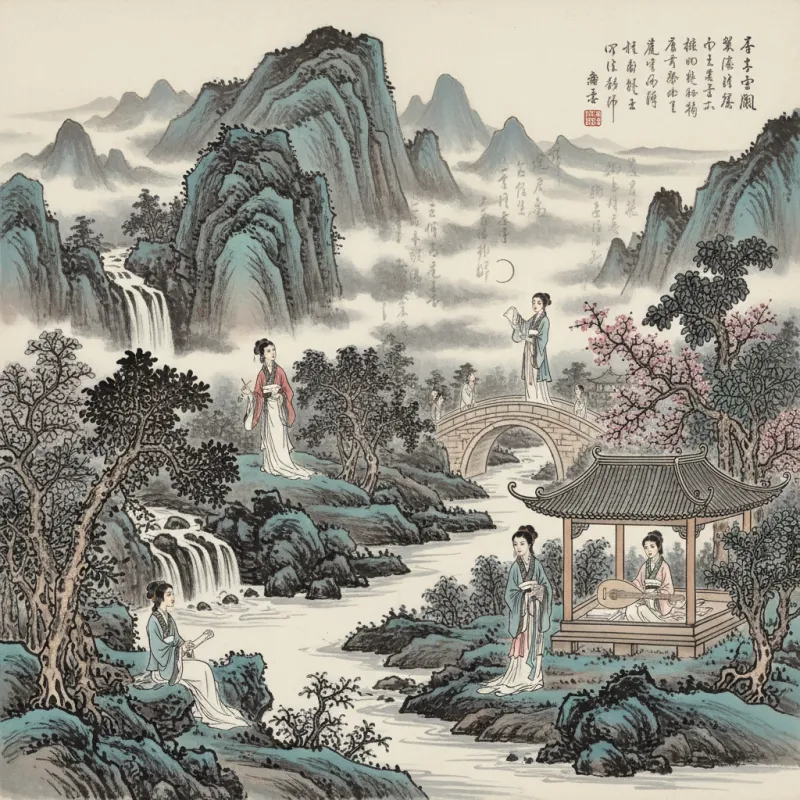
When Li Qingzhao's husband left for an official posting in 1103, she wrote a poem so achingly specific about loneliness that it still makes readers uncomfortable nine centuries later. She described the exact weight of her jade hairpin, too heavy for her thinning hair. She counted the petals falling from her courtyard flowers. She didn't write about "missing her beloved" in elegant abstractions — she wrote about the physical sensation of waiting, the way time moves differently when you're alone. This is what makes women's poetry from imperial China so devastating to read: when these voices survived, they survived because they refused to be polite.
The Arithmetic of Erasure
Here's the number that should make you angry: of the roughly 2,200 poets included in the authoritative Quan Tang Shi (全唐詩, Complete Tang Poems) anthology, fewer than 130 are women. The Tang Dynasty lasted 289 years and had a population in the tens of millions. You're telling me that in three centuries, only 130 women wrote poetry worth preserving? The math doesn't work. The truth is simpler and uglier: women's writing wasn't systematically collected, wasn't copied by official scribes, wasn't taught to the next generation of scholars. It survived through accidents — a sympathetic brother who kept his sister's manuscripts, a courtesan whose patron happened to be an anthologist, a poem so technically perfect that even dismissive male editors couldn't ignore it.
The loss wasn't passive. It was structural. Women's poetry circulated in private spaces — inner chambers, family gatherings, exchanges between friends. When a woman died, her poems died with her unless someone with access to the official literary world decided they mattered. Most of the time, no one decided that. We're reading the exceptions, and we should remember that every surviving poem represents dozens that didn't make it.
Li Qingzhao: Technical Perfection as Survival Strategy
Li Qingzhao (李清照, Lǐ Qīngzhào, 1084-1155) is the exception that proves every rule about women's poetry. She's universally acknowledged as the greatest female poet in Chinese history — and here's the crucial part — one of the greatest poets of any gender. Not "great for a woman." Just great. Her ci (詞, cí) lyrics combine technical mastery so undeniable that even Song Dynasty literary gatekeepers had to include her in their anthologies.
Her early poems, written during her marriage to the scholar Zhao Mingcheng, do something radical: they make happiness interesting. Anyone can write about longing or loss, but Li Qingzhao wrote about contentment with the same specificity she'd later bring to grief. When she describes getting drunk with her husband and arguing about which classical text contained a particular reference, you can hear the laughter in the lines. When she writes about lotus flowers and summer wine, you can feel the weight of humid air.
Then the Jin Dynasty invaded. Her husband died. She fled south with whatever manuscripts she could carry, watching the rest burn. Her later poems are different — sharper, more bitter, technically even more accomplished. In her most famous late poem, she writes: "Searching, searching, seeking, seeking / Cold, cold, clear, clear / Sad, sad, painful, painful" (尋尋覓覓,冷冷清清,淒淒慘慘戚戚). Fourteen characters, seven pairs of repeated words, building a rhythm that mimics obsessive searching. It's a technical tour de force that happens to contain genuine grief. This is how she survived in the literary record: by being so good that erasure became impossible.
The Courtesan Poets: Writing from the Margins
If you want to find women's voices in Chinese poetry, look at the courtesan registers. This is uncomfortable for modern readers who want to celebrate women's literary achievement without acknowledging the conditions that made it possible. But courtesans — educated entertainers who were not quite sex workers, not quite artists, but something in between — had access to literacy, classical education, and the literary networks that most women didn't. They also had motivation: a brilliant poem could attract a wealthy patron, change your social position, or at least ensure you were remembered as more than a commodity.
Yu Xuanji (魚玄機, Yú Xuánjī, 844-868) is the most famous example. She became a Daoist priestess after a failed relationship, which gave her even more freedom to write and socialize with male poets. Her poems are technically accomplished and emotionally direct in ways that made Confucian scholars nervous. She wrote about desire — not metaphorical desire for enlightenment, but actual physical wanting. She wrote about ambition, about wanting recognition as a poet, not just as a beautiful woman who happened to write. She was executed at 24 for allegedly murdering a maid, and you have to wonder how much of that charge was about the murder and how much was about a woman who refused to stay in her assigned category.
The courtesan poets understood something that respectable women couldn't afford to acknowledge: poetry was a form of power. A well-placed poem could humiliate a stingy patron, could create alliances, could preserve your version of events. These women wrote knowing their words might be their only legacy, and that urgency shows in every line.
Xue Tao: The Woman Who Invented Her Own Paper
Xue Tao (薛濤, Xuē Tāo, 768-831) was a courtesan in Chengdu who became so famous that military governors competed for her company. She wrote poems for generals and governors, and they wrote back — treating her as a literary equal, which was almost unheard of. But here's what I find most interesting: she invented her own paper. Literally. She created a smaller format of colored paper specifically for writing jueju (絕句, juéjù) quatrains, and it became so popular that it was called "Xue Tao paper" for centuries after her death.
Think about what that means. She didn't just write poems; she changed the physical format of poetry. She made an aesthetic choice that influenced how other poets — male and female — thought about the relationship between form and content. That's not just surviving in the literary record; that's shaping it. Her poems are sharp and political, full of coded references to contemporary events. She wrote about military campaigns, about corruption, about the gap between Confucian ideals and actual governance. She did this while maintaining the persona of a charming entertainer, which was probably the only way she could get away with it.
The Ones We Almost Lost
For every Li Qingzhao, there are poets like Zhu Shuzhen (朱淑真, Zhū Shūzhēn, 1135-1180), whose work survived only because her family didn't burn all of it. According to legend, her parents destroyed most of her poems after her death because they were too emotionally revealing, too critical of her unhappy marriage. What survived suggests we lost something extraordinary. Her poems about marital disappointment are devastating precisely because they're so specific — she doesn't write about "loneliness" in the abstract; she writes about hearing her husband's footsteps pass her door without stopping.
Or consider the anonymous women poets whose work appears in collections with attributions like "by a palace lady" or "by a courtesan of Yangzhou." We have the poems but not the names. We have the voices but not the lives. Reading these poems is like overhearing half a conversation through a wall — you can sense the intelligence and craft, but you're missing the context that would make them fully comprehensible.
The women poets of the Tang Dynasty faced different challenges than their Song Dynasty counterparts, but the pattern is consistent: exceptional talent, limited preservation, and the nagging question of how many voices we'll never hear.
What Survival Required
The women poets who made it into the historical record had to be better than their male contemporaries — not just as good, but undeniably, technically, obviously better. They had to write in forms that male editors valued, which meant mastering ci lyrics and shi (詩, shī) poetry according to strict tonal and structural rules. They couldn't just be talented; they had to be so talented that exclusion became embarrassing.
They also needed luck: the right family connections, the right patron, the right historical moment. Li Qingzhao had a father who was a respected scholar and encouraged her education. Xue Tao had beauty and charm that gave her access to powerful men who happened to value poetry. Yu Xuanji had the protection of Daoist religious institutions. Remove any of these factors, and their poems might have disappeared like thousands of others.
This is why reading women's poetry from imperial China requires a double vision. You're reading the poems themselves — their technical brilliance, their emotional honesty, their specific observations about lived experience. But you're also reading the absence around them, the silence where other voices should be. Every surviving poem is a small miracle of preservation, and every miracle required someone to decide that this woman's words mattered enough to copy, to preserve, to pass on.
Why These Voices Still Matter
Modern readers sometimes approach classical Chinese women's poetry looking for proto-feminism, for evidence of resistance against patriarchal structures. That's not quite right. These poets weren't writing manifestos; they were writing poems within the constraints available to them. But within those constraints, they created something remarkable: a record of interior life, of emotional specificity, of individual consciousness that the official historical record mostly ignored.
When Li Qingzhao writes about the exact weight of her hairpin, she's not making a political statement. She's making an aesthetic one: that small, domestic, "feminine" observations are worthy of the same technical attention as poems about military campaigns or philosophical concepts. When Xue Tao invents her own paper format, she's claiming the right to shape literary culture, not just participate in it. When Yu Xuanji writes about desire, she's insisting that women's inner lives are complex enough to require complex poetry.
The tragedy isn't just that we lost so many voices. It's that we almost lost the idea that women's voices were worth preserving at all. The poets who survived did so by being exceptional, but their exceptionalism shouldn't have been required. Reading their work now means acknowledging both their brilliance and the system that made brilliance their only path to survival. It means recognizing that for every poem we have, there are dozens we don't — and that absence should make us read what remains with even more attention, even more care.
The classical Chinese poetry tradition is richer because these voices survived, but it's also haunted by the ones that didn't. Every time you read a poem by Li Qingzhao or Xue Tao, you're reading a small victory against erasure — and remembering that victory shouldn't have been necessary in the first place.
Related Reading
- Zhuo Wenjun: The Woman Who Wrote Her Own Love Story
- Rediscovering Women Poets of the Tang, Song, and Yuan Dynasties
- The Banana Garden Poetry Club: When Women Took Over Chinese Poetry
- Women Poets of China: The Voices That History Almost Silenced
- Ban Zhao: Scholar, Historian, Poet — The Woman Who Finished China's Greatest History
- AI vs. Human Translation of Chinese Poetry: A 2024 Comparison
- Exile Poetry: When Banishment Produced China's Greatest Literature
- Poetry Drinking Games: When Literature Met Entertainment
Explore Chinese Culture
- Explore the Tang dynasty's golden age
- Explore Daoist themes in classical poetry
- Explore Chinese literary traditions