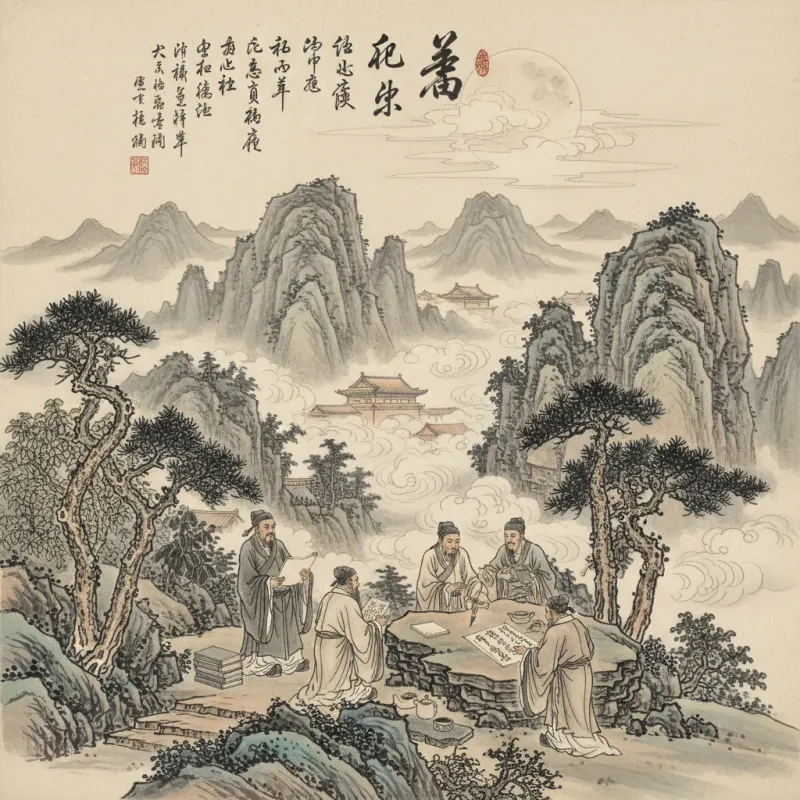
A single cassia blossom falls in the moonlight. No one sees it. No one hears it. Yet Wang Wei writes it down, and thirteen centuries later, we experience that moment of perfect stillness. This is the paradox of Buddhist poetry in Chinese literature: it uses language to point beyond language, employs twenty characters to capture what cannot be captured.
The Poem as Dharma Gate
Buddhist poetry in Chinese literature operates on a principle that would seem contradictory to anyone trained in Western poetics: the best poems say the least. Where European religious poetry tends toward elaboration—think of Dante's Divine Comedy or Milton's Paradise Lost—Chinese Buddhist poetry practices radical compression. A Tang dynasty quatrain gives you twenty-eight characters. A Song dynasty gāthā (偈, jì) might use even fewer.
This compression is not stylistic preference. It is doctrinal necessity. Buddhism teaches that conceptual thinking obscures reality. Language, by its nature, creates distinctions and categories. The Buddhist poet faces an impossible task: use the tool of delusion to point toward enlightenment. The solution is to use language so sparingly, so precisely, that it becomes transparent—a finger pointing at the moon, not the moon itself.
The great Buddhist poems do not describe meditation experiences. They are meditation experiences, compressed into linguistic form and transmitted across centuries. When you read Wang Wei's "Bird-Singing Stream" (鸟鸣涧, Niǎo Míng Jiàn), you are not reading about stillness. You are entering stillness.
Wang Wei and the Poetry of No-Mind
Wang Wei (王维, 699-759) earned the title "Buddha of Poetry" (诗佛, shī fó) not because he wrote about Buddhism, but because his poems function as Buddhist practice. His famous quatrain demonstrates this perfectly:
人闲桂花落
夜静春山空
月出惊山鸟
时鸣春涧中
People at rest, cassia blossoms fall
Night still, spring mountain empty
Moon rises, startles mountain birds
Now and then calling in the spring ravine
Notice what Wang Wei does not do. He does not tell you the falling flowers symbolize impermanence. He does not explain that the empty mountain represents śūnyatā (空, kōng). He simply presents phenomena arising and passing. The Buddhist teaching emerges from the structure of attention itself.
The poem's genius lies in its progression. First line: human stillness. Second line: the stillness expands to encompass the entire mountain. Third line: a disruption—the moon rises, birds startle. Fourth line: the disruption itself becomes part of the stillness. This is the Buddhist teaching of non-duality enacted in twenty characters. There is no separation between stillness and movement, silence and sound. They arise together, pass together, and the mind that observes them without grasping is itself the Buddha-mind.
The Chan Poets: Koans in Verse
The Chan (禅, Chán—Zen in Japanese) school produced a distinct strain of Buddhist poetry that makes Wang Wei look almost conventional. Chan masters used poetry the way they used koans: as devices to short-circuit conceptual thinking and provoke sudden awakening.
Hanshan (寒山, "Cold Mountain," fl. 9th century) wrote poems that read like transcripts of a madman's ravings:
世人何事可吁嗟
苦乐交煎勿底涯
What in the world is worth sighing over?
Suffering and pleasure boil together without bottom or shore
This is not refined court poetry. This is someone yelling at you from a mountaintop. Hanshan's poems deliberately violate aesthetic norms—they are rough, colloquial, sometimes crude. The roughness is the point. Polished poetry invites aesthetic appreciation, which is just another form of attachment. Hanshan's poems are designed to be indigestible, to resist the mind's attempt to categorize and file them away.
The Song dynasty Chan master Wumen Huikai (无门慧开, 1183-1260) took this further. His collection The Gateless Gate (无门关, Wúmén Guān) includes verses that are deliberately nonsensical:
春有百花秋有月
夏有凉风冬有雪
若无闲事挂心头
便是人间好时节
Spring has a hundred flowers, autumn has the moon
Summer has cool breezes, winter has snow
If no idle concerns hang in your mind
Then it's a fine season in the human world
Read superficially, this is greeting-card Buddhism: appreciate the seasons, don't worry, be happy. Read as Chan practice, it is devastating. The poem presents the obvious—seasons change, each has its beauty—and then reveals that the only thing preventing you from experiencing this is your own mental chatter. The poem does not offer consolation. It offers a mirror.
The Poetics of Emptiness
The Buddhist concept of emptiness (空, kōng; Sanskrit: śūnyatā) is perhaps the most misunderstood doctrine in Buddhism. It does not mean nothingness or void. It means that phenomena lack inherent, independent existence—they arise through causes and conditions, exist in relation to other phenomena, and pass away when conditions change.
Buddhist poetry enacts emptiness through its treatment of imagery. Consider this poem by the Tang monk-poet Jiaoran (皎然, 730-799):
万境本闲闲
心闲境自闲
Ten thousand phenomena are originally at rest
When mind is at rest, phenomena are naturally at rest
The poem presents a paradox: phenomena are already at rest, yet we need to rest our minds to perceive this. The paradox dissolves when you understand emptiness. Phenomena and mind are not separate. The agitation we perceive in the world is the agitation of our own minds projected outward. When the mind settles, the world settles—not because the world has changed, but because we see it as it is.
This is radically different from nature poetry in the pastoral tradition, which treats nature as a refuge from human concerns. Buddhist poetry does not seek refuge. It seeks to dissolve the distinction between refuge and threat, between nature and human, between observer and observed.
The Influence on Secular Poetry
By the Song dynasty (960-1279), Buddhist poetics had so thoroughly permeated Chinese literary culture that even poets with no particular religious commitment wrote in Buddhist modes. Su Shi (苏轼, 1037-1101), the great Song polymath, was not a monk, but his poetry is saturated with Buddhist sensibility.
His famous poem "Written on the Wall at West Forest Temple" (题西林壁, Tí Xīlín Bì) is pure Chan:
横看成岭侧成峰
远近高低各不同
不识庐山真面目
只缘身在此山中
Viewed horizontally, it forms ridges; viewed from the side, peaks
From far, near, high, low, each different
I cannot recognize Mount Lu's true face
Only because I am within this mountain
The poem appears to be about perspective and epistemology—how our position determines what we see. But the final line transforms it into a Buddhist teaching about the impossibility of objective knowledge. You cannot see the mountain's "true face" because there is no position outside the mountain from which to view it. You are always already within the system you are trying to observe. This is the Buddhist teaching of non-duality expressed through landscape description.
The Twenty-Character Limit as Spiritual Discipline
The classical Chinese quatrain (jueju, 绝句) consists of four lines of five or seven characters each—twenty or twenty-eight characters total. This is not much space. In English translation, a five-character quatrain might be forty or fifty words. The original Chinese is twenty characters, twenty syllables, twenty semantic units.
This compression forces a kind of linguistic asceticism. Every character must justify its existence. There is no room for elaboration, explanation, or rhetorical flourish. The form itself enforces the Buddhist principle of non-attachment—you cannot become attached to your clever phrases because there is no space for clever phrases.
The great Buddhist poets turned this limitation into a spiritual practice. Writing a poem became an exercise in discernment: which details are essential? Which words point most directly toward the experience? The process of composition mirrors the process of meditation—stripping away the inessential until only the luminous core remains.
The Transmission of Silence
The paradox of Buddhist poetry is that its greatest achievements are its silences. What makes Wang Wei's cassia blossoms fall so perfectly is not what he says but what he does not say. The space between the lines is where the teaching lives.
This is why Buddhist poetry resists analysis. You can explicate the imagery, trace the allusions, map the prosody—but the poem's essential function occurs in the gap between reading and understanding, in the moment when conceptual thinking pauses and direct perception arises.
The Chinese Buddhist poets understood that poetry, like all Buddhist practice, is ultimately a raft to be abandoned once you reach the other shore. The poem is not the destination. It is a device for triggering an experience that transcends the poem itself. When Hanshan writes "苦乐交煎勿底涯" (suffering and pleasure boil together without bottom or shore), he is not making a philosophical statement. He is creating a linguistic event designed to disrupt your habitual patterns of thought.
The best Buddhist poems self-destruct upon reading. They deliver their payload—a moment of clarity, a shift in perception—and then dissolve, leaving no residue. You cannot possess them because there is nothing to possess. Like the cassia blossom falling in moonlight, they appear, they are perceived, they vanish. And in that vanishing, they accomplish what volumes of scripture cannot: they show you your own Buddha-nature, right here, in these twenty characters, in this moment, now.
Related Reading
- The Spiritual Depth of Chinese Classical Poetry: Insights from Tang, Song, and Yuan Poets
- Wang Wei's Buddhist Nature Poems: Silence as Spiritual Practice
- Cold Mountain Poems of Hanshan: The Hermit Who Wrote on Rocks
- Zen Koans in Poetry Form: When Chinese Verse Became a Riddle
- Buddhist Impermanence in Tang Poetry: Everything You Love Will Disappear
- AI vs. Human Translation of Chinese Poetry: A 2024 Comparison
- The Enchantment of Song Dynasty Poets: A Deep Dive into Their Timeless Verses
- War Poetry of the Tang Dynasty: When Soldiers Became Poets
Explore Chinese Culture
- Explore the Tang dynasty's golden age
- Explore Daoist themes in classical poetry
- Explore Chinese literary traditions