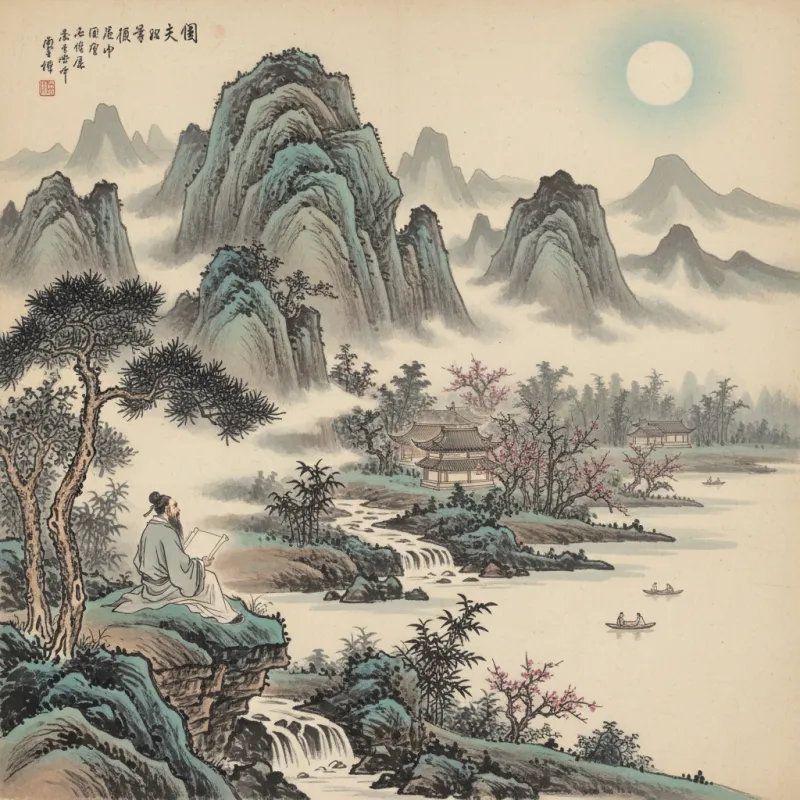
When Wang Wei (王維) wrote "Empty mountains see no one" in the 8th century, he wasn't just describing an absence of people—he was capturing a philosophical stance that would define Chinese nature poetry for the next six centuries. The silence he evoked wasn't emptiness but fullness, a paradox that Tang, Song, and Yuan poets would explore through bamboo groves, misty rivers, and solitary cranes until nature itself became a language more precise than words.
The Tang Foundation: When Mountains Became Mirrors
The Tang dynasty poets didn't invent nature poetry, but they perfected its emotional range. Li Bai (李白, 701-762) treated mountains like drinking companions, addressing them with the same casual intimacy he showed his wine cup. In "Drinking Alone Beneath the Moon," he invites the moon and his shadow to join him, transforming a solitary moment into a cosmic party. This wasn't metaphor for its own sake—Li Bai genuinely seemed to prefer mountains to people, and his poetry makes you understand why.
Du Fu (杜甫, 712-770) took a different approach. Where Li Bai saw nature as escape, Du Fu saw it as witness. His "Spring View" opens with "The nation shattered, mountains and rivers remain"—a line that acknowledges nature's indifference to human suffering while finding strange comfort in its permanence. The mountains don't care about the An Lushan Rebellion, and somehow that matters. Du Fu's nature poetry carries political weight without ever becoming didactic, a balance that later poets would struggle to match.
Wang Wei, the third pillar of Tang nature poetry, brought Buddhist emptiness (空, kōng) into the landscape itself. His "Deer Park" describes hearing voices in an empty mountain, then watching returning sunlight illuminate green moss. The poem works through negation—what you don't see, what isn't there—until absence becomes a form of presence. This technique would influence Song dynasty landscape poetry for centuries, particularly in how poets handled silence and space.
Song Refinement: The Intimate Turn
Song dynasty poets (960-1279) inherited Tang mastery but added something new: self-consciousness. They knew they were writing after the golden age, and this awareness made their nature poetry more introspective, more concerned with the act of observation itself. Su Shi (蘇軾, 1037-1101), the dynasty's most versatile poet, wrote about nature while simultaneously writing about writing about nature—a meta-poetic move that sounds modern but felt natural in Song literary culture.
Su Shi's "Red Cliff Ode" demonstrates this layered approach. He's describing the Yangtze River, yes, but he's also thinking about Cao Cao's naval defeat there eight centuries earlier, and about his own political exile, and about how moonlight makes all of this feel both immediate and distant. The river becomes a meditation on time, memory, and the relationship between historical events and natural permanence. When he writes "The river flows on, never ceasing," he's not making a simple observation—he's wrestling with what it means that nature continues while human ambitions dissolve.
Li Qingzhao (李清照, 1084-1155), one of the few female poets whose work survived in significant quantity, brought domestic intimacy to nature imagery. Her ci (詞) poems often feature flowers, but they're flowers in gardens, flowers in vases, flowers that mark the passage of seasons within a woman's constrained world. In "Like a Dream," she describes lotus flowers after a rain, but the real subject is memory and loss. The flowers aren't symbols—they're the actual texture of lived experience, which makes them more powerful than any metaphor.
The Song poets also developed what we might call "small nature poetry"—not grand mountains and rivers but plum blossoms, bamboo shoots, the way light hits a particular rock. This wasn't a diminishment but an intensification, a recognition that you could find the infinite in the particular. Plum blossom poems became an entire subgenre, with poets competing to find new ways to describe the same winter-blooming tree.
Yuan Innovation: Outsider Perspectives
The Yuan dynasty (1271-1368) brought Mongol rule to China, and this political upheaval transformed nature poetry in unexpected ways. Many Chinese literati refused to serve the new government, retreating to the countryside not as romantic escape but as political statement. Their nature poetry carries an edge of defiance, a refusal to participate in the compromised world of the capital.
Ma Zhiyuan (馬致遠, 1250-1321) wrote what might be the most famous Yuan nature poem, "Autumn Thoughts"—though calling it a "poem" undersells its innovation. Written in the sanqu (散曲) form, it reads like a list: "Withered vines, old trees, evening crows. / Small bridge, flowing water, someone's home. / Ancient road, west wind, lean horse." Nine images in three lines, no verbs, no explanation. The poem works through accumulation and juxtaposition, trusting readers to feel the loneliness without being told about it. This stripped-down aesthetic influenced Chinese painting as much as poetry, establishing a visual vocabulary that persists today.
Guan Hanqing (關漢卿, 1241-1320), primarily known for his drama, brought theatrical techniques to nature poetry. His poems often feature dialogue, dramatic situations, characters in motion. Nature isn't backdrop but stage, and the natural elements become actors with their own agency. When he writes about wind, it's not atmospheric—it's a force that drives the action, that makes things happen.
The Yuan poets also experimented with vernacular language in ways their Tang and Song predecessors rarely attempted. They mixed classical allusions with colloquial speech, creating a texture that felt both learned and immediate. This wasn't dumbing down—it was expanding poetry's range, making it capable of capturing experiences that classical diction couldn't quite reach.
Philosophical Underpinnings: Daoism, Buddhism, and the Natural Way
You can't understand Chinese nature poetry without grasping its philosophical foundations, but these weren't abstract systems imposed on experience—they were ways of seeing that emerged from sustained attention to the natural world. Daoist concepts like ziran (自然, "self-so" or spontaneity) and wuwei (無為, non-action) weren't theories about nature but descriptions of how nature actually works when you watch closely enough.
The Daoist influence shows most clearly in poems that celebrate uselessness. Zhuangzi's parable of the gnarled tree that survives because it's too twisted for lumber became a recurring motif. Poets praised rocks that served no purpose, plants that couldn't be eaten, mountains too steep to farm. This wasn't romanticizing poverty—it was recognizing that utility isn't the only form of value, that things can matter simply by existing.
Buddhist emptiness added another dimension, particularly the idea that distinctions between observer and observed are ultimately illusory. When Wang Wei writes about mountains, he's not describing something separate from himself—he's exploring the space where "Wang Wei" and "mountain" dissolve into a single moment of perception. This sounds mystical, but the poems themselves are remarkably concrete, grounded in specific sensory details.
Confucian thought contributed less obviously but no less importantly. The idea that natural phenomena could serve as moral examples—bamboo's flexibility, pine's endurance—gave nature poetry an ethical dimension without making it preachy. A poem about bamboo bending in wind could be about political compromise, or it could just be about bamboo. The ambiguity was the point.
Technical Mastery: Form and Craft
The formal constraints of Chinese poetry—tonal patterns, parallelism, regulated verse structures—might seem like obstacles to natural expression, but Tang, Song, and Yuan poets used these rules to create effects impossible in free verse. The regulated verse (律詩, lǜshī) form, with its strict requirements for tonal balance and parallel couplets, forced poets to find unexpected connections between images.
Consider how parallelism works in a couplet like Du Fu's "Stars hang down, the plain is broad / Moon surges up, the great river flows." The grammatical parallel (subject-verb-object in both lines) creates a visual parallel—horizontal vastness answered by vertical movement. The form isn't decorative; it's generating meaning through structure.
The ci form, which Song poets developed to new heights, allowed for irregular line lengths and more flexible tonal patterns. This made it perfect for capturing the rhythms of natural phenomena—the irregular drip of rain, the unpredictable movement of birds. Li Qingzhao's ci poems feel more spontaneous than regulated verse, but they're actually more carefully crafted, with every syllable placed to create specific musical effects.
Yuan sanqu took this even further, incorporating colloquial rhythms and allowing even more metrical freedom. The form could accommodate sudden shifts in tone, mixing elegant classical phrases with street language. This made it ideal for capturing the complexity of actual experience, where profound insights and mundane observations coexist without transition.
Legacy and Influence: Nature Poetry's Continuing Resonance
The nature poetry of these three dynasties didn't just influence later Chinese literature—it shaped how East Asian cultures think about the relationship between humans and the natural world. Japanese haiku, Korean sijo, Vietnamese lục bát all bear traces of Tang and Song aesthetics, though each tradition developed its own distinctive voice.
More surprisingly, these poems influenced Western modernism. Ezra Pound's imagist poetry owes an obvious debt to Chinese nature poetry, particularly its technique of presenting images without explicit interpretation. When Pound writes "In a Station of the Metro"—"The apparition of these faces in the crowd; / Petals on a wet, black bough"—he's working in a mode that Wang Wei would recognize, even if the subway setting would baffle him.
Contemporary Chinese poets still wrestle with this tradition, sometimes embracing it, sometimes rebelling against it. The question of how to write about nature after industrialization, after environmental destruction, after the classical language itself has become archaic—these challenges make the Tang, Song, and Yuan achievements feel both more distant and more urgent. Modern interpretations of classical nature themes continue to evolve, but they can't escape the shadow of these earlier masters.
Reading Nature Poetry Today: What We Can Learn
The practical question remains: what can 21st-century readers gain from poems written 700 to 1,300 years ago about a world that no longer exists? The answer isn't nostalgia or historical curiosity, though both have their place. These poems offer something more fundamental—a way of paying attention that our distracted age desperately needs.
When Li Bai writes about sitting with a mountain until "we never tire of each other," he's describing a quality of attention that has nothing to do with technology or modernity. It's about being present to something other than yourself, about letting the world be itself without immediately converting it into utility or meaning. This isn't mysticism—it's a learnable skill, and poetry is one way to practice it.
The best Tang, Song, and Yuan nature poems don't tell you what to think about nature. They show you how to look, how to listen, how to notice what's actually there rather than what you expect to find. In an era of climate crisis and environmental anxiety, this might be their most valuable gift—not answers about what nature means, but training in how to perceive it clearly enough that meaning can emerge on its own terms.
Related Reading
- Mountain and Water Poetry (山水诗): When Landscape Becomes Literature
- Nature Poetry in Chinese Literature: Seeing the World as the Poets Saw It
- Nature Poetry in the Tang Dynasty: Mountains, Rivers, and the Art of Seeing
- The Harmony of Nature in Chinese Classical Poetry: Tang, Song, and Yuan Dynasties
- The Moon in Chinese Poetry: 50 Ways to Say 'I Miss You'
- Buddhist Poetry in Chinese Literature: Enlightenment in Twenty Characters
- Love Poetry in Chinese Literature: The Art of Saying Everything by Saying Nothing
- Exploring Chinese Classical Poetry: Tang, Song, and Yuan Poets’ Literary Legacy
Explore Chinese Culture
- Explore the Tang dynasty's golden age
- Explore Daoist themes in classical poetry
- Explore Chinese literary traditions