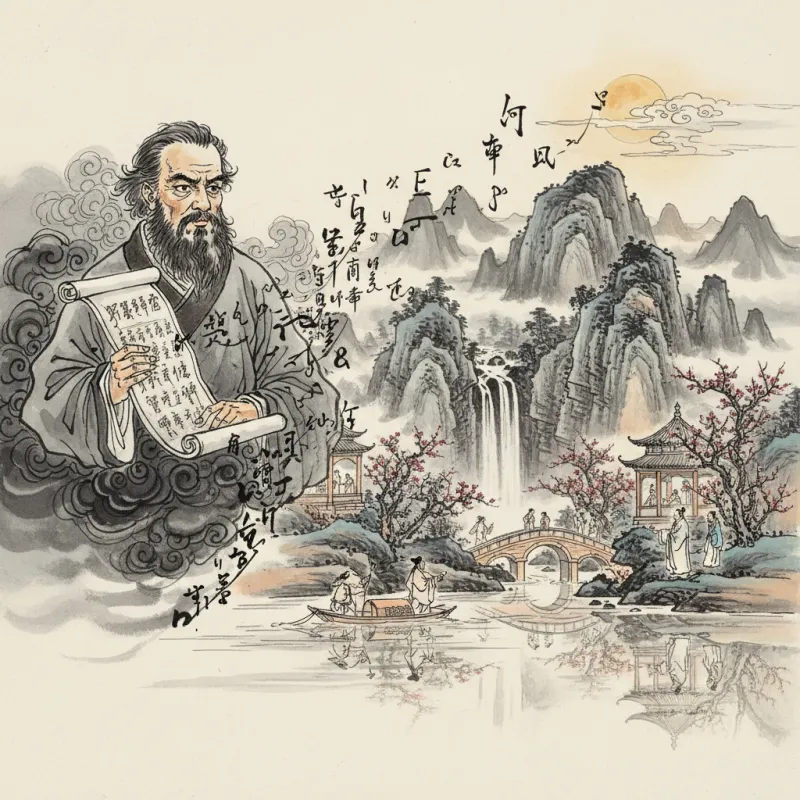
When Ezra Pound sat down with Ernest Fenollosa's notebooks in 1913, he couldn't read a single Chinese character. He didn't know that 李白 (Lǐ Bái) and 王維 (Wáng Wéi) were different poets. He had no idea what a 絕句 (juéjù, regulated quatrain) was supposed to do. And yet, two years later, he published Cathay, a collection that would reshape how the English-speaking world understood Chinese poetry for the next century. The book was full of errors, mistranslations, and wild interpretations. It was also, somehow, brilliant.
This is the paradox at the heart of Pound's engagement with Chinese poetry: his ignorance freed him to create something genuinely new, while simultaneously distorting the tradition he claimed to represent. The question isn't whether Pound got things wrong — he absolutely did. The question is whether those mistakes matter, and what they reveal about translation, poetry, and cultural exchange.
The Fenollosa Notebooks: A Game of Telephone
Ernest Fenollosa never intended his notebooks to become the basis for published translations. They were study materials, rough drafts, personal explorations. Fenollosa had learned about Chinese poetry from Japanese scholars — primarily Mori Kainan and Hirai Kinzō — who were themselves working from Japanese interpretations of Tang dynasty (618–907 CE) texts. So before Pound even entered the picture, we're already playing telephone across languages and centuries.
The notebooks contained character-by-character glosses, often with multiple possible meanings listed. For Li Bai's famous "Rihaku" poems (Pound used the Japanese pronunciation of 李白), Fenollosa might write something like: "blue/green mountain horizontal northern wall." Pound had to decide: Was it blue or green? Was "horizontal" describing the mountain's position or its appearance? Was "northern wall" literal or metaphorical?
Without knowledge of Chinese grammar, poetic convention, or cultural context, Pound made choices based on what sounded good in English. Sometimes this led to inspired interpretations. Often it led to howlers. In "The River-Merchant's Wife: A Letter" (based on Li Bai's 長干行, "Chánggan Xíng"), Pound writes about the speaker's "two small people, without dislike or suspicion" — a charming but completely invented detail about childhood innocence that doesn't appear in the original.
What Pound Got Wrong
Let's be specific about the errors, because they're instructive. In "The Jewel Stairs' Grievance" (玉階怨, "Yù Jiē Yuàn"), Pound translates a five-character line as "The jewelled steps are already quite white with dew." The original is more compressed: 玉階生白露 (yù jiē shēng bái lù) — literally "jade stairs give-birth white dew." Pound's "already quite white" adds temporal and qualitative information that isn't there. He's explaining, interpreting, making explicit what the Chinese leaves implicit.
This is the opposite of how classical Chinese poetry works. The genius of Tang and Song dynasty verse lies in compression, in what's left unsaid. A poem like Wang Wei's 鹿柴 ("Lù Zhài," "Deer Enclosure") creates meaning through juxtaposition and silence. Pound, trained in the verbose tradition of Victorian poetry, couldn't help but fill in the gaps.
He also missed the formal constraints entirely. Chinese regulated verse (律詩, lǜshī) follows strict tonal patterns, with specific rules about which syllables should be level tone (平聲, píngshēng) and which should be oblique (仄聲, zèshēng). These patterns create rhythm and meaning. Pound, unable to hear the tones, translated the poems as free verse. He preserved the line breaks but lost the music.
The cultural references were another problem. When Li Bai writes about 長安 (Cháng'ān, the Tang capital), he's invoking a whole world of associations — imperial power, cultural sophistication, political intrigue. Pound translates it as "the capital" or sometimes just leaves it as "Choan." The resonance disappears.
What Pound Got Right
And yet. And yet Cathay works. It works as poetry, even if it fails as translation. Pound's ignorance of Chinese poetic convention meant he wasn't constrained by it. He could focus on what he did understand: image, rhythm, the weight of individual words.
Take "The River-Merchant's Wife" again. The original poem is formal, restrained, working within the conventions of 樂府 (yuèfǔ, folk song style) poetry. Pound's version is intimate, immediate, almost conversational: "At fourteen I married My Lord you." That direct address — "My Lord you" — doesn't exist in the Chinese, but it creates an emotional immediacy that English readers can feel. Pound understood that translation isn't about word-for-word equivalence; it's about creating equivalent effects in the target language.
His imagist training served him well here. The imagist movement, which Pound helped found, emphasized concrete images over abstract statements, precision over decoration. This aligned surprisingly well with certain aspects of Chinese poetry, even if Pound didn't fully understand the tradition. When he translated 柳 (liǔ, willow) as "willow" rather than explaining that willows symbolize parting and sorrow in Chinese culture, he was accidentally following imagist principles: show, don't tell.
The result was poetry that felt fresh and modern to English readers in 1915. While other translators were producing stilted, Victorian-sounding versions full of "thee" and "thou," Pound wrote: "The leaves fall early this autumn, in wind." Simple. Direct. Imagistic. It sounded nothing like traditional Chinese poetry, but it sounded like something new in English.
The Invention of Chinese Poetry
T.S. Eliot called Cathay "the invention of Chinese poetry for our time," and he meant it as praise. Eliot understood that Pound hadn't discovered Chinese poetry; he'd created a version of it that English-language poets could use. This invented tradition influenced everyone from William Carlos Williams to Gary Snyder, shaping how generations of American poets thought about image, compression, and the relationship between nature and emotion.
The irony is that Pound's "Chinese poetry" had more in common with modernist aesthetics than with actual Tang dynasty verse. His translations emphasized visual imagery and emotional restraint in ways that aligned with early 20th-century poetic values. Real Chinese poetry is more complex, more formally sophisticated, more embedded in literary and cultural tradition than Pound's versions suggest.
But maybe that's okay. Translation always involves transformation. The question is whether the transformation is productive — whether it creates something valuable in the target language, even if it distorts the source. Pound's Cathay did create something valuable. It just wasn't quite what he thought it was.
The Ethics of Beautiful Mistakes
This raises uncomfortable questions about cultural appropriation and authority. Pound presented himself as a translator, implying expertise he didn't possess. He didn't acknowledge the extent of his reliance on Fenollosa's notes, or the fact that those notes were themselves interpretations rather than direct translations. He certainly didn't credit the Japanese scholars who'd taught Fenollosa.
Modern translators of Chinese poetry — scholars like David Hinton, Red Pine, and Burton Watson — have spent decades learning classical Chinese, studying the historical and cultural context, understanding the formal conventions. Their translations are more accurate, more nuanced, more respectful of the original tradition. They're also, sometimes, less exciting as English poetry.
This doesn't mean Pound's approach was right. It means translation involves trade-offs. Accuracy versus readability. Fidelity to form versus fidelity to effect. Scholarly rigor versus poetic inspiration. Pound chose inspiration over accuracy, effect over fidelity. He made beautiful mistakes.
The problem is that his mistakes became canonical. For decades, English-speaking readers thought Pound's versions were what Chinese poetry actually sounded like. They didn't know they were reading inventions, interpretations, creative reimaginings. The line between translation and original composition had blurred beyond recognition.
Legacy and Influence
Cathay influenced more than just poetry. It shaped how Western readers imagined China itself — as a place of refined aestheticism, melancholy beauty, and emotional restraint. This was a fantasy, of course, a projection of modernist values onto an ancient culture. But it was a powerful fantasy, one that persists in Western orientalism to this day.
The book also established a model for translation that prioritized the translator's poetic voice over scholarly accuracy. This approach has its defenders — poets who argue that only a poet can translate poetry, that technical knowledge of the source language matters less than sensitivity to the target language. It also has its critics, who point out that this model often serves to center the translator's creativity at the expense of the original author's vision.
For better or worse, Pound demonstrated that you could create influential translations without deep knowledge of the source culture. This opened doors for creative experimentation in translation. It also opened doors for cultural appropriation and misrepresentation. Both legacies continue to shape translation practice today.
Reading Pound Now
So how should we read Cathay today? Not as accurate translations — we have better options for that. Not as windows into Tang dynasty poetry — they're more like funhouse mirrors. But perhaps as documents of a particular moment in literary history, when modernist poets were searching for alternatives to Victorian poetic conventions and found (or invented) them in Chinese poetry.
The poems in Cathay are best understood as Pound's original compositions, inspired by Chinese sources but fundamentally English-language poems. They're beautiful, innovative, historically important works. They're just not quite what they claim to be.
This doesn't diminish their value as poetry. It does complicate their status as translations. The distinction matters because translation is an ethical practice, not just an aesthetic one. It involves representing another culture, another voice, another way of seeing the world. When we translate, we take on responsibility for that representation.
Pound didn't fully understand that responsibility. He was more interested in what Chinese poetry could do for English poetry than in what Chinese poetry actually was. His beautiful mistakes changed English-language verse forever. They also distorted how generations of readers understood Chinese literary tradition.
Both things can be true. The challenge is holding both truths at once — appreciating Pound's poetic achievement while acknowledging its limitations and distortions. That's harder than simply celebrating or condemning him. But it's more honest, and more useful for anyone trying to understand the complex, fraught, endlessly fascinating work of translation across cultures.
For readers interested in exploring more accurate translations of Tang dynasty poetry, works by Li Bai and Wang Wei offer good starting points. And for those curious about the formal structures Pound missed, understanding regulated verse provides essential context for how classical Chinese poetry actually works.
Related Reading
- Translating Chinese Poetry: Why Every Translation Is Wrong (And Why That Is Fine)
- AI vs. Human Translation of Chinese Poetry: A 2024 Comparison
- Why Some Chinese Poems Are Untranslatable: The Beauty That Gets Lost
- Best English Translations of Tang Poetry: A Comparative Guide
- The Harmony of Nature in Chinese Classical Poetry: Tang, Song, and Yuan Dynasties
- Li Qingzhao: China's Greatest Female Poet
- Song Ci: The Lyrics That Broke Poetry's Rules
Explore Chinese Culture
- Explore the Tang dynasty's golden age
- Explore Daoist themes in classical poetry
- Explore Chinese literary traditions