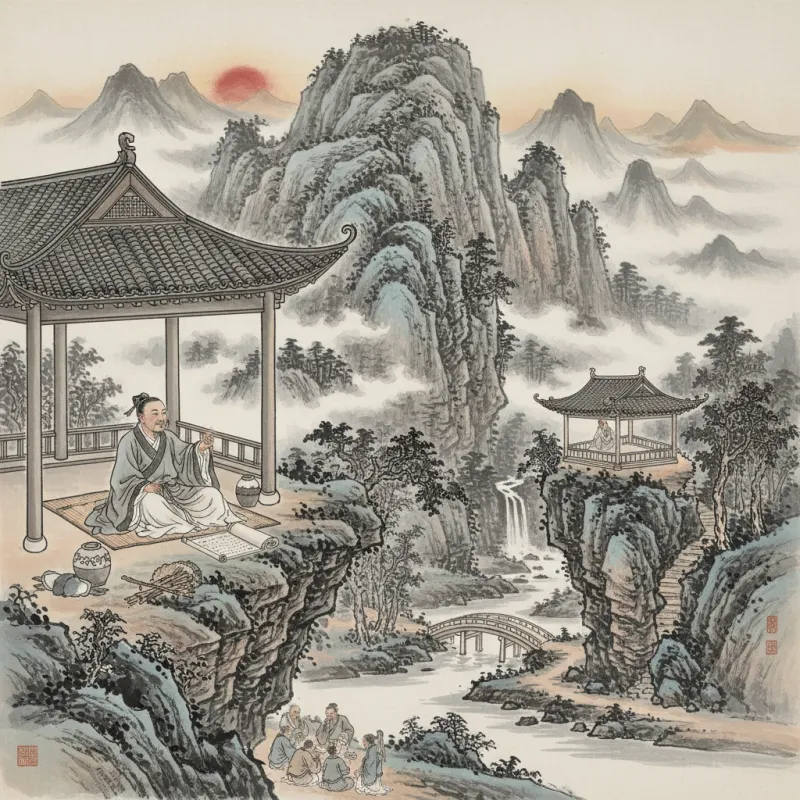
The old drunkard wasn't drunk on wine—he was drunk on mountains. When Ouyang Xiu (欧阳修, Ōuyáng Xiū) sat in his pavilion outside Chuzhou in 1046, watching the sun set over the Langya Mountains, he was performing one of the most sophisticated acts of defiance in Chinese literary history: he was refusing to be miserable. The court had exiled him. His career was in ruins. And his response was to write a 400-character essay so intoxicated with joy that it became one of the most memorized pieces of prose in the Chinese language.
The Art of Getting Demoted Gracefully
Political exile in Song dynasty China was a peculiar institution. You weren't thrown in prison or executed—that would be too honest. Instead, you were promoted to a position of great responsibility in a place no one wanted to go. Ouyang Xiu's crime was loyalty: he'd defended his friend Fan Zhongyan (范仲淹, Fàn Zhòngyan), who had proposed reforms that threatened powerful conservatives at court. The punishment was appointment as prefect of Chuzhou (滁州, Chúzhōu), a minor prefecture in what is now Anhui province, far from the capital at Kaifeng.
For a man who had been at the center of the empire's intellectual life, this was devastating. Ouyang Xiu was 39, the age when a Song official should be ascending to real power. Instead, he was administering a backwater, settling disputes about irrigation ditches and tax collection. The conventional response would have been to write bitter poetry about injustice, to compose thinly veiled allegories about loyal ministers betrayed by corrupt courts. Chinese literature is full of such works—the tradition of exile poetry stretches back to Qu Yuan throwing himself in the Miluo River.
Ouyang Xiu did something different. He got drunk and wrote about how much fun he was having.
The Pavilion That Launched a Thousand Imitations
The Drunkard's Pavilion (醉翁亭, Zuìwēng Tíng) wasn't even Ouyang Xiu's idea. A Buddhist monk named Zhixian (智仙, Zhìxiān) built it in the Langya Mountains (琅琊山, Lángyá Shān) about six miles southwest of Chuzhou. The monk invited Ouyang Xiu to visit, and the prefect became a regular. He named himself the "Old Drunkard" (醉翁, zuìwēng)—he was 39, hardly old, but in the performative self-deprecation that Chinese literati loved, he was playing the role of the carefree elder who had transcended worldly ambition.
The pavilion itself was simple: a wooden structure with a thatched roof, open on all sides to catch the breeze. What made it special was the location. It sat at the point where the mountains opened up to reveal a valley, with a stream running through it and peaks rising on all sides. The view changed with every season, every hour of the day. Ouyang Xiu describes this in prose that moves like the landscape itself, each sentence flowing into the next without pause.
The opening of The Drunkard's Pavilion Record (醉翁亭记, Zuìwēng Tíng Jì) is famous for its rhythm: "The district of Chu is surrounded on all sides by mountains. The peaks and forests of its southwest are especially beautiful. One gazes afar at a place luxuriant, deep, and beautiful—that is Langya." The Chinese is even more hypnotic: 环滁皆山也。其西南诸峰,林壑尤美。望之蔚然而深秀者,琅琊也 (Huán Chú jiē shān yě. Qí xīnán zhū fēng, lín hè yóu měi. Wàng zhī wèirán ér shēn xiù zhě, Lángyá yě). Notice how the sentences build: first the general statement, then the specific location, then the zoom to the particular mountain. This is prose that teaches you how to look at landscape.
The Most Famous Line You've Never Heard
Halfway through the essay, Ouyang Xiu drops the line that every educated Chinese person knows: "The drunkard's intention is not in the wine, but in the mountains and waters" (醉翁之意不在酒,在乎山水之间也, Zuìwēng zhī yì bù zài jiǔ, zài hū shānshuǐ zhī jiān yě). This phrase has become a chengyu (成语, chéngyǔ), a four-character idiom, usually shortened to 醉翁之意不在酒 (zuìwēng zhī yì bù zài jiǔ). It means that someone's real purpose is not what they claim—their true intention lies elsewhere.
The irony is that Ouyang Xiu meant it literally. He really was more interested in the landscape than the alcohol. But the phrase took on a life of its own, becoming a way to talk about hidden motives and ulterior purposes. When a modern Chinese speaker says someone's "drunkard's intention is not in the wine," they're suggesting that person is up to something. The phrase has traveled so far from its origin that most people who use it have never read the essay it comes from.
But in context, the line is not cynical—it's ecstatic. Ouyang Xiu is explaining that the pleasure of drinking in the pavilion comes not from intoxication but from the experience of being present in that landscape, with those friends, at that moment. The wine is just the excuse. The real drug is the mountains.
The Rhythm of Pleasure
What makes The Drunkard's Pavilion Record extraordinary is not just what it says but how it says it. The essay is structured like a day in the mountains, moving from dawn to dusk, from the prefect's arrival to his departure. But the real structure is rhythmic. Ouyang Xiu uses a technique called pianwen (骈文, piánwén), or parallel prose, where phrases balance against each other in length and tone. The effect is almost musical.
Consider this passage describing the changing seasons: "Wild flowers bloom with subtle fragrance; beautiful trees grow lush and provide shade; wind and frost are noble and pure; water recedes and stones emerge—these are the four seasons in the mountains" (野芳发而幽香,佳木秀而繁阴,风霜高洁,水落而石出者,山间之四时也, Yě fāng fā ér yōu xiāng, jiā mù xiù ér fán yīn, fēng shuāng gāo jié, shuǐ luò ér shí chū zhě, shān jiān zhī sì shí yě). Each season gets a parallel phrase, each phrase has the same grammatical structure, and the whole sequence builds to a conclusion that feels inevitable.
This is prose that rewards reading aloud. In fact, it demands it. The rhythm only fully emerges when you hear the tones of the Chinese characters, the way the sounds echo and respond to each other. This is one reason the essay has been memorized for centuries—it's not just literature, it's performance. Students learning classical Chinese still recite it, feeling the rhythm in their mouths before they fully understand the meaning.
The Politics of Joy
Here's what makes Ouyang Xiu's essay radical: it refuses to acknowledge that exile is punishment. There's no complaint, no veiled criticism of the court, no longing for the capital. Instead, there's a detailed, sensuous description of pleasure—the pleasure of landscape, of friendship, of drinking, of being present in a moment. The essay performs contentment so convincingly that it becomes a kind of political statement: I don't need your approval, I don't need your capital, I have everything I need right here.
This was not the standard move in Chinese exile literature. When Su Shi was exiled to Huangzhou, he wrote about it with a mixture of melancholy and defiance. When Han Yu was sent to the far south, he wrote bitter poems about the barbarous landscape and his separation from civilization. The convention was to suffer nobly, to demonstrate that you were being wronged.
Ouyang Xiu's refusal to suffer was more subversive than any direct criticism could have been. By writing about his exile as a time of pure enjoyment, he was implicitly suggesting that the court's punishment had failed. You can't hurt someone who won't admit to being hurt. The essay is a masterclass in what we might call strategic happiness—the use of joy as a form of resistance.
The Drunkard's Legacy
The Drunkard's Pavilion Record made Ouyang Xiu's reputation as a prose stylist. When he was eventually recalled to the capital—because competent administrators were too valuable to leave in exile forever—he became one of the most powerful figures in Song dynasty letters. He led the guwen (古文, gǔwén) or "ancient prose" movement, which advocated for a return to the clear, direct style of Tang dynasty prose writers like Han Yu, rejecting the ornate, artificial style that had become fashionable.
The essay also established a genre. After Ouyang Xiu, every self-respecting literatus who got exiled felt obliged to write about the local landscape and claim to be having a wonderful time. Pavilions sprouted across China, each with its own commemorative essay. The form became so popular that it turned into a cliché—the exile-enjoying-nature essay, complete with philosophical reflections on the relationship between man and landscape.
But none of the imitators quite captured what made Ouyang Xiu's original so powerful. They wrote about nature as an abstraction, a symbol of purity or transcendence. Ouyang Xiu wrote about a specific pavilion, a specific mountain, a specific stream, on a specific day. His essay is grounded in the physical world—the smell of wild flowers, the shade of trees, the sound of water over stones. The philosophy emerges from the details, not the other way around.
Mountains and Waters Between
The Drunkard's Pavilion still exists, though it's been rebuilt many times. It's now a tourist site, with Ouyang Xiu's essay carved on stone tablets and tour groups posing for photos. The mountains are still there, the stream still runs through the valley. Whether the experience of visiting it today has anything to do with what Ouyang Xiu described is an open question.
But the essay itself remains alive in a way that most thousand-year-old texts don't. It's still memorized, still quoted, still used as a model for how to write about landscape and pleasure. The phrase about the drunkard's intention has entered everyday language. And the essay's central insight—that joy can be a form of freedom, that attention to the present moment can be a kind of transcendence—still resonates.
Ouyang Xiu spent less than two years in Chuzhou before being recalled to the capital. He went on to have a distinguished career, serving as a high official and mentoring the next generation of Song dynasty writers, including Su Shi. But he never wrote anything quite like The Drunkard's Pavilion Record again. Maybe he didn't need to. He'd already proven that you could be exiled from the court but not from joy, that you could lose political power but not the power to pay attention, to notice, to celebrate the world as it is.
The old drunkard's real intoxication was with presence itself—the ability to be fully in a place, with friends, watching the light change on the mountains. That's a kind of drunkenness that doesn't wear off.
Related Reading
- Classical Chinese Prose: The Essays That Shaped a Civilization
- The Four Great Classical Novels of Chinese Literature
- Zhuangzi's Butterfly Dream: The Most Famous Thought Experiment in Chinese Philosophy
- Sun Tzu's Art of War: The Complete Guide for Modern Readers
- How to Read Chinese Poetry: A Guide for English Speakers
- Tang Poetry: Why the Tang Dynasty Was Poetry's Golden Age
- Friendship and Farewell: Poems of Parting
Explore Chinese Culture
- Explore the Tang dynasty's golden age
- Explore Daoist themes in classical poetry
- Explore Chinese literary traditions