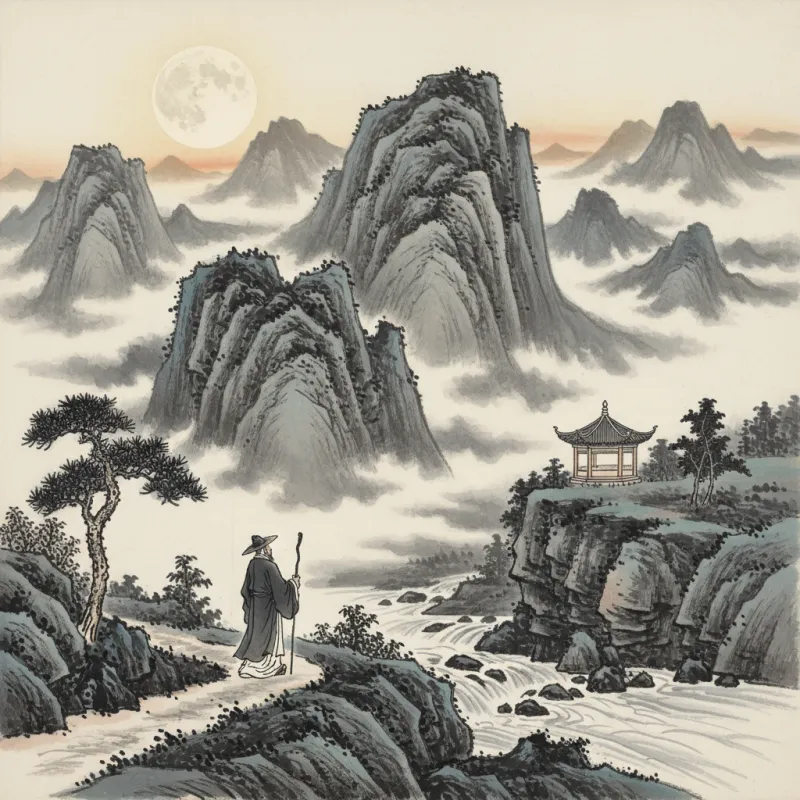
Picture this: It's 752 CE, and in the capital city of Chang'an, more poets are writing verse than there are Starbucks in modern-day Seattle. Except these aren't hobbyists posting on Medium — they're government officials, Buddhist monks, courtesans, and wandering hermits, all competing in a culture where your ability to compose a regulated verse could literally determine whether you got a job. The Tang Dynasty (唐朝 Táng Cháo, 618-907 CE) didn't just produce great poetry. It created a civilization where poetry was the operating system.
The Infrastructure of Genius
Here's what made the Tang different: poetry wasn't decorative. It was structural.
The civil service examination system, expanded dramatically under the Tang, required candidates to compose poetry under time pressure. Imagine taking the SAT, except instead of multiple choice questions, you have to write a perfectly metered eight-line poem in the lüshi (律诗 lǜshī) form, with tonal patterns so precise that a single misplaced syllable disqualifies you. This wasn't testing literary sensitivity — it was testing whether you had internalized the entire cultural operating system.
The result? Every educated person in the empire could write competent verse. The Complete Tang Poems (全唐诗 Quán Tángshī), compiled in 1705, contains 48,900 poems by 2,200 identified poets. But these numbers are fragments. Scholars estimate that perhaps 90% of Tang poetry has been lost to war, fire, and the simple entropy of paper over eleven centuries.
What survived is almost embarrassingly good. Li Bai (李白 Lǐ Bái), Du Fu (杜甫 Dù Fǔ), Wang Wei (王维 Wáng Wéi), Bai Juyi (白居易 Bái Jūyì), Li Shangyin (李商隐 Lǐ Shāngyǐn) — these aren't just the greatest Chinese poets. They're in the conversation for greatest poets in any language. And they're just the first tier. The second tier contains poets like Du Mu (杜牧 Dù Mù) and Wang Changling (王昌龄 Wáng Chānglíng), who would be the defining literary figure of most national traditions.
The Perfect Storm of Conditions
The Tang Dynasty hit a sweet spot that's never been replicated. The empire was wealthy, stable (mostly), and cosmopolitan. Chang'an was the largest city in the world, with a population over one million. The Silk Road brought Persian merchants, Indian monks, and Central Asian musicians. This wasn't a monoculture — it was a remix culture with the confidence to absorb everything.
The writing system itself had matured. By the Tang, classical Chinese had developed into an instrument of extraordinary compression and ambiguity. A five-character line could contain multiple layers of meaning, historical allusions, and tonal music simultaneously. The language was ready for what the poets wanted to do with it.
Printing technology arrived at exactly the right moment. Woodblock printing became widespread during the Tang, which meant poetry could circulate beyond the court. A poem written in Chang'an could be read in Guangzhou within months. This created something like a literary marketplace — poets were writing for an audience that extended across space and time.
And then there's the alcohol. Tang poets drank like it was their job, because in a sense, it was. Wine (酒 jiǔ) appears in Tang poetry more than any other concrete noun except moon and mountain. Li Bai supposedly drowned while drunkenly trying to embrace the moon's reflection in a river — almost certainly a legend, but a legend that tells you what the culture valued. The loosening of Confucian propriety through wine was seen as a path to authentic expression.
The Forms Reached Perfection
The Tang didn't invent Chinese poetic forms, but they perfected them to a degree that made later poets feel like they were working in someone else's shadow.
The jueju (绝句 juéjù), or quatrain, became the haiku of its time — a form so compressed that every word carried weight. Wang Zhihuan's (王之涣 Wáng Zhīhuàn) "Climbing Stork Tower" is twenty characters that contain an entire philosophy of ambition and perspective.
The lüshi (律诗 lǜshī), or regulated verse, was the sonnet — eight lines with strict tonal patterns, required parallelism in the middle couplets, and a turn in the final lines. Du Fu wrote hundreds of these, and somehow made the straitjacket look like freedom. His "Spring View" uses the form's constraints to create a tension between formal control and emotional devastation that still hits hard 1,200 years later.
The gushi (古诗 gǔshī), or ancient-style verse, gave poets room to breathe — irregular line lengths, looser tonal requirements. Li Bai used this form for his wildest flights, like "Drinking Alone Beneath the Moon," where he gets drunk with his shadow and the moon as companions.
What's remarkable is that these forms weren't museum pieces. They were living, evolving technologies that poets pushed in new directions. Li Bai's style was completely different from Du Fu's, yet both were working with the same formal constraints.
The Subjects Expanded
Pre-Tang poetry was largely about court life, ritual occasions, and romantic longing. Tang poets kept those subjects but added everything else.
Du Fu wrote about war, poverty, political corruption, and his own failures with a directness that was almost journalistic. His "Ballad of the Army Carts" describes the human cost of military campaigns with details that feel like war reporting: the sound of families weeping as conscripts march away, the bones of soldiers whitening in the frontier dust.
Wang Wei wrote about Buddhist emptiness and mountain solitude in ways that made metaphysics feel like direct observation. His poems are so visual that later painters used them as blueprints for landscape paintings, creating a genre called "poems in painting, paintings in poems" (诗中有画,画中有诗 shī zhōng yǒu huà, huà zhōng yǒu shī).
Li Shangyin wrote about erotic longing with such indirection and allusion that scholars still argue about whether his poems are about actual affairs or political allegories. The ambiguity isn't a bug — it's the entire point.
Bai Juyi wrote poetry that was deliberately accessible, using simple language to reach a mass audience. His "Song of Everlasting Regret" about Emperor Xuanzong's doomed love affair with Yang Guifei became so popular that people memorized all 840 lines. He was the first Chinese poet to think about poetry as mass media.
The Social Networks
Tang poets weren't isolated geniuses. They were embedded in networks of friendship, rivalry, and mutual influence that look surprisingly modern.
Li Bai and Du Fu met in 744 and became close friends, despite being temperamental opposites. Li Bai was the charismatic drunk who claimed to be descended from royalty; Du Fu was the anxious striver who failed the civil service exams and spent his life in genteel poverty. Du Fu wrote multiple poems about Li Bai; Li Bai wrote one short poem about Du Fu. This asymmetry tells you everything about their personalities.
Poets gathered in literary salons, exchanged poems as letters, and wrote response poems to each other's work. When Wang Changling was demoted to a remote posting, Li Bai wrote him a poem of consolation. When Du Fu heard that Li Bai had been exiled, he wrote poems worrying about his friend's fate. These weren't just personal gestures — they were public performances of friendship that other poets read and responded to.
The culture of poetry competitions and impromptu composition created a hothouse environment. At parties, guests would be challenged to compose poems on assigned topics, sometimes with absurd constraints. This wasn't showing off — it was how educated people socialized.
Why It Couldn't Last
The An Lushan Rebellion (安史之乱 Ān Shǐ zhī Luàn) of 755-763 broke something. The rebellion killed millions, destroyed Chang'an, and shattered the Tang's confidence. Du Fu lived through it and wrote about it with a rawness that earlier Tang poetry rarely showed. The late Tang produced great poets — Li Shangyin, Du Mu, Li He (李贺 Lǐ Hè) — but the mood had changed. The poetry became more private, more melancholic, more aware of endings.
By the time the dynasty fell in 907, the conditions that created the golden age were gone. The Song Dynasty (960-1279) produced great poetry, but it was different — more intellectual, more self-conscious, more aware of the Tang as an impossible standard. Song Dynasty poets wrote in the shadow of the Tang the way modern poets write in the shadow of Shakespeare.
The Afterlife
Tang poetry didn't die with the dynasty. It became the foundation of Chinese literary culture in a way that's hard to overstate. Every educated Chinese person for the next thousand years memorized Tang poems as children. The poems became proverbial — phrases from Li Bai and Du Fu entered the language as idioms.
When Chinese poetry was first translated into English in the early 20th century, it hit modernist poets like a revelation. Ezra Pound's "Cathay" (1915), based on Tang poems, influenced imagism and changed how English-language poets thought about compression and clarity. The influence runs both ways across time.
What makes Tang poetry's golden age unrepeatable isn't just the concentration of talent. It's that the entire civilization was organized around poetry in a way that's never happened before or since. The closest parallel might be Athens in the 5th century BCE, when every citizen was expected to know Homer and participate in dramatic festivals. But even Athens didn't make poetry the entrance exam for government service.
The Tang created a world where poetry mattered more than almost anything else, where your ability to arrange words in patterns could determine your fate, where the most powerful people in the empire spent their evenings composing verses about moonlight and exile. That world is gone. But the poems remain, still sharp, still strange, still capable of cutting through the centuries to remind us what language can do when an entire culture decides it's worth perfecting.
Related Reading
- Du Fu's War Poems: Witnessing the An Lushan Rebellion
- 10 Greatest Tang Poems Every Reader Should Know
- Bai Juyi: The People's Poet
- Li Bai's Moonlight Poems: Drinking Alone Under the Moon
- Wang Wei: The Poet-Painter of Nature
- Su Shi in Exile: Making the Best of Banishment
- Unveiling the Essence of Chinese Classical Poetry: Insights from Tang, Song, and Yuan Poets
- Poetry as Philosophy: How Chinese Poets Think
Explore Chinese Culture
- Explore the Tang dynasty's golden age
- Explore Daoist themes in classical poetry
- Explore Chinese literary traditions