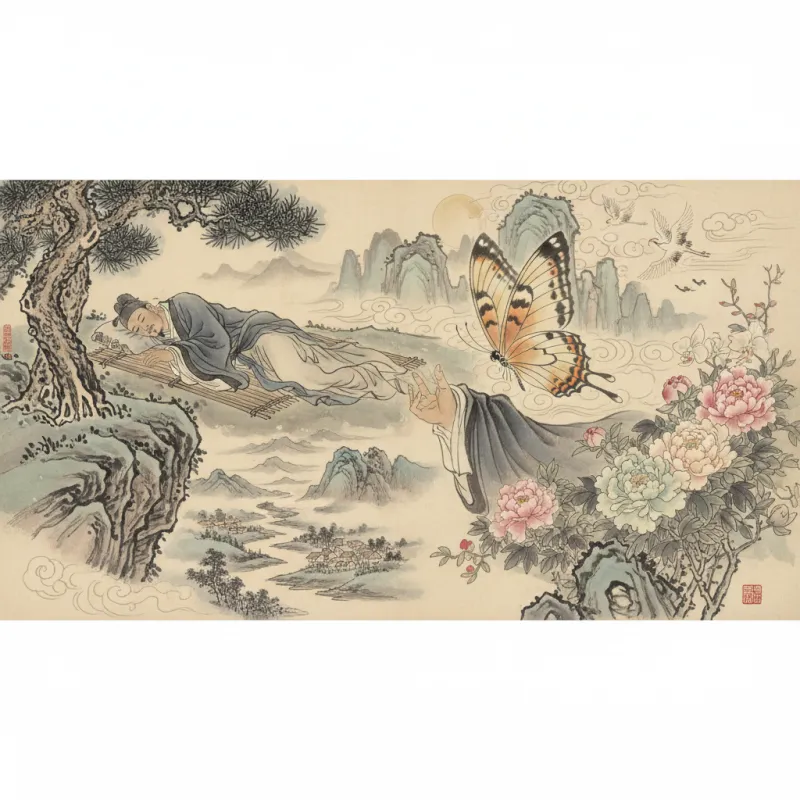
You wake up. The dream fades. But for a moment — just a flicker — you're not sure which side of consciousness you're on. Zhuangzi knew that feeling. Around 300 BCE, he wrote forty-four characters that would haunt Chinese philosophy for the next two millennia, and they begin with the most ordinary experience imaginable: waking up confused.
The Text Itself
Here's what Zhuangzi actually wrote, in the "Discussion on Making All Things Equal" (齐物论 Qíwù Lùn) chapter:
昔者庄周梦为蝴蝶,栩栩然蝴蝶也。自喻适志与!不知周也。俄然觉,则蘧蘧然周也。不知周之梦为蝴蝶与?蝴蝶之梦为周与?周与蝴蝶,则必有分矣。此之谓物化。
"Once Zhuang Zhou dreamed he was a butterfly, a fluttering butterfly, happy and carefree, completely unaware he was Zhuang Zhou. Suddenly he woke up, and there he was — unmistakably Zhuang Zhou. But he didn't know: was he Zhuang Zhou who had dreamed he was a butterfly, or a butterfly now dreaming he was Zhuang Zhou? Between Zhou and the butterfly there must be some distinction. This is called the transformation of things."
Forty-four characters for the dream sequence. Then that final line: 物化 (wùhuà) — the transformation of things. It's Zhuangzi's mic drop, the philosophical punchline that refuses to resolve the paradox it just created.
Why a Butterfly?
Zhuangzi could have chosen any creature. A tiger would have been more dramatic. A crane would have fit the Daoist aesthetic better — cranes appear constantly in Daoist art, symbols of immortality and transcendence. But he chose a butterfly, and that choice matters.
Butterflies in Chinese thought carry a specific weight. They undergo metamorphosis — caterpillar to chrysalis to butterfly — which makes them natural symbols of transformation. The character 化 (huà) in 物化 means exactly this: transformation, metamorphosis, change. A butterfly doesn't just move through the world; it becomes different things.
But there's something else. Butterflies are also profoundly useless. They don't pull plows. You can't eat them. They serve no function in the Confucian social order. And Zhuangzi loved uselessness. His philosophy is full of gnarled trees that survive because they're too twisted for lumber, and useless gourds that become boats. The butterfly is 逍遥 (xiāoyáo) — free and easy wandering — made flesh. Or rather, made wing.
The Question That Isn't a Question
"Was he Zhuang Zhou dreaming he was a butterfly, or a butterfly dreaming he was Zhuang Zhou?"
Every translation treats this as a question. But look at the grammar. Zhuangzi doesn't use a question particle here. He uses 与 (yǔ), which creates an alternative: "this or that?" It's not asking you to solve the puzzle. It's asking you to sit with the impossibility of solving it.
This is where Western readers often stumble. We want the answer. We've been trained by Socratic dialogue to expect that questions lead somewhere, that paradoxes exist to be resolved. But Zhuangzi isn't Socrates. He's not leading you to a predetermined conclusion. He's showing you that the question itself — the need to know which is "real" — is the problem.
The Buddhists who arrived in China centuries later recognized this immediately. The Butterfly Dream became a favorite reference in Chan (Zen) Buddhism, appearing in koans and teaching stories. They understood what Zhuangzi was doing: using logic to demonstrate the limits of logic, using language to point beyond language.
What the Commentators Saw
Guo Xiang (郭象 Guō Xiàng), writing around 300 CE, gave the Butterfly Dream its most influential interpretation. For Guo, the point wasn't skepticism about reality — it was about the self-sufficiency of each moment. When you're the butterfly, you're completely the butterfly. When you're Zhuang Zhou, you're completely Zhuang Zhou. Each state is total, perfect, self-contained. The transformation between them is seamless because there's no persistent "you" carrying memories across the boundary.
This reading shaped how Chinese literati understood the passage for centuries. It wasn't about doubting reality; it was about accepting transformation. Things change. You change. The person who went to sleep isn't quite the person who wakes up. And that's fine. That's 物化 — the natural transformation of things.
But Wang Fuzhi (王夫之 Wáng Fūzhī), writing in the 17th century, pushed back. He argued that Zhuangzi knew perfectly well he was Zhuang Zhou. The confusion was rhetorical, a teaching device. Wang was a Confucian, uncomfortable with too much metaphysical uncertainty. He wanted to preserve the reality of the self, the continuity of identity that makes moral responsibility possible.
The debate continues. Modern scholars like Liu Xiaogan argue that the Butterfly Dream is genuinely skeptical, questioning the foundations of knowledge itself. Others, like Chad Hansen, see it as a critique of language and categories rather than reality. The text is short enough that it can't defend itself against interpretation.
The Dream in Art and Literature
By the Tang Dynasty, the Butterfly Dream had escaped philosophy entirely. It became a standard literary reference, shorthand for any moment of existential uncertainty. Li Bai (李白 Lǐ Bái) references it. So does Du Fu (杜甫 Dù Fǔ). It appears in Tang poetry as a way to express the dreamlike quality of life itself, especially life in exile or separation.
Painters loved it. Song Dynasty artists created countless versions: Zhuangzi sleeping under a tree, butterflies hovering nearby, the boundary between dreamer and dream deliberately ambiguous. The composition itself becomes philosophical argument. Where does Zhuangzi end and the butterfly begin? The paintings refuse to answer.
In opera and drama, the Butterfly Dream became a plot device. The most famous example is "The Peony Pavilion" (牡丹亭 Mǔdān Tíng) by Tang Xianzu (汤显祖 Tāng Xiǎnzǔ), written in 1598. The heroine Du Liniang dies of lovesickness, visits her lover in his dreams, and eventually returns to life. The entire play is structured around the question: which is real, the dream or the waking? Tang Xianzu knew his Zhuangzi.
Why It Still Matters
The Butterfly Dream endures because it captures something we all experience but rarely articulate: the strangeness of consciousness itself. Every morning you wake up and reassemble yourself from scattered dream-fragments. You remember who you are, where you are, what you were doing yesterday. But for a moment — just a moment — it's not obvious. The self has to be reconstructed.
Modern philosophy has caught up. Thomas Metzinger's work on the "ego tunnel" describes consciousness as a simulation, a model the brain creates. When you dream, the simulation continues, just with different inputs. The question "which is real?" becomes meaningless because both are simulations. Zhuangzi would have appreciated that.
But there's something the modern neuroscience version loses. Zhuangzi's butterfly is happy. 栩栩然 (xǔxǔrán) — fluttering joyfully, completely at ease. The dream isn't a malfunction or an illusion to be corrected. It's a state of perfect freedom, unencumbered by self-consciousness. When you're the butterfly, you're not worried about being Zhuang Zhou. You're just flying.
That's the real provocation. Not "how do you know what's real?" but "why do you need to know?" The anxiety about which state is authentic, which self is true — that's the problem Zhuangzi is diagnosing, not solving. The butterfly doesn't have that anxiety. Only Zhuang Zhou does, and only after he wakes up.
The Transformation of Things
物化 (wùhuà) — the transformation of things. This is where the passage ends, and where it really begins. Zhuangzi isn't interested in static categories: real/unreal, self/other, human/butterfly. He's interested in transformation, in the process of becoming something else.
This connects to everything else in the Zhuangzi. The useless tree that survives by being useless. The cook who cuts up oxen by following the spaces between things rather than forcing his blade. The swimmer who survives the waterfall by going with the current rather than against it. All of these are about 化 — transformation, adaptation, flowing with change rather than resisting it.
The Butterfly Dream is the most concentrated expression of this philosophy. You are not a fixed thing. You are a process, a transformation, a series of becomings. The butterfly is one becoming. Zhuang Zhou is another. Neither is more real than the other because "real" is the wrong category. Both are moments in the endless transformation of things.
This is why the passage ends with 物化 rather than with the question about the dream. The question is a trap, an invitation to get stuck in categories and distinctions. The answer is to keep moving, keep transforming, keep becoming. Be the butterfly when you're the butterfly. Be Zhuang Zhou when you're Zhuang Zhou. Don't waste time worrying about which one is really you.
Reading It Now
Two thousand years later, we're still arguing about those forty-four characters. That's either a sign of the passage's profundity or its ambiguity — probably both. Zhuangzi wrote in a style that invites interpretation while resisting conclusion. Every generation finds something new in the Butterfly Dream because every generation brings new questions about consciousness, identity, and reality.
What's remarkable is how little the passage needs updating. The neuroscience is new, but the experience isn't. People in 300 BCE woke up from dreams just as confused as we do. They wondered about the nature of self just as much. Zhuangzi gave them — gave us — not an answer but a way of holding the question lightly, of being comfortable with uncertainty.
The butterfly is still flying. Zhuang Zhou is still waking up. And we're still not sure which is which. That's not a bug in the philosophy. That's the whole point.
Related Reading
- Sun Tzu's Art of War: The Complete Guide for Modern Readers
- Classical Chinese Prose: The Essays That Shaped a Civilization
- The Four Great Classical Novels of Chinese Literature
- Ouyang Xiu and The Drunkard's Pavilion: Getting Drunk on Mountains
- Women Poets of China: The Voices That Were Almost Lost
- Unveiling the Rich Tapestry of Chinese Classical Poetry: Insights from Tang, Song, and Yuan Dynasties
- Qu Yuan: The First Named Poet in Chinese History
Explore Chinese Culture
- Explore the Tang dynasty's golden age
- Explore Daoist themes in classical poetry
- Explore Chinese literary traditions