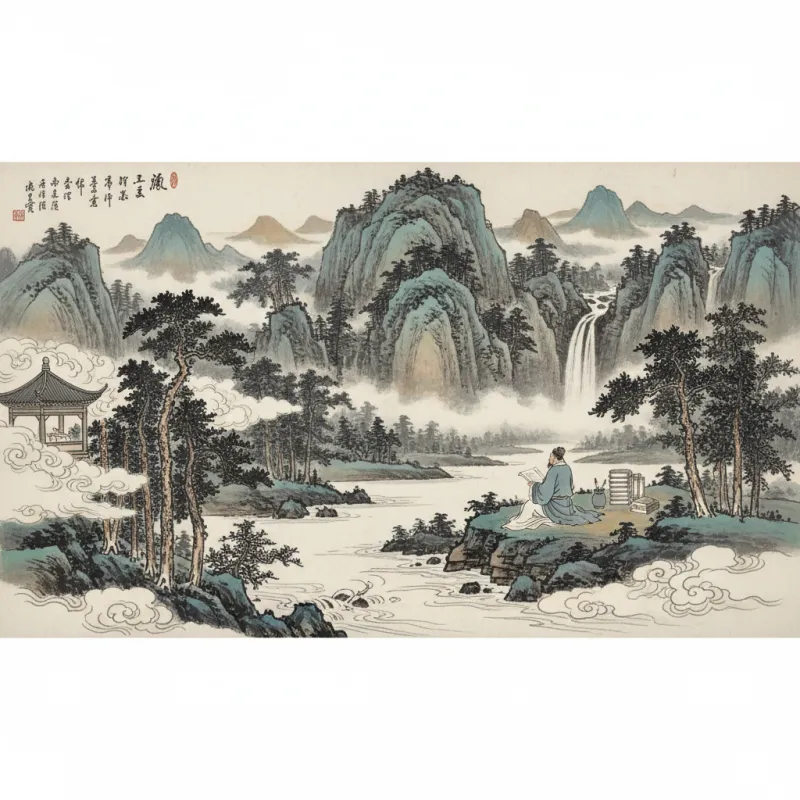
When Han Yu submitted his memorial to Emperor Xianzong in 819 CE arguing against venerating a Buddhist relic, he knew he was risking his life. The essay was so forceful, so uncompromising in its Confucian orthodoxy, that the emperor flew into a rage and nearly had him executed. Han Yu was instead exiled to the remote southern frontier—but his essay survived, and with it, a new vision for Chinese prose that would echo through the next millennium. This wasn't just political dissent; it was a declaration that words themselves needed revolution.
The Ancient Prose Movement: Writing as Rebellion
By the mid-Tang Dynasty, Chinese prose had calcified into an ornamental nightmare. The parallel prose style (骈文, piánwén) that dominated official writing demanded rigid structural symmetry: every sentence had to mirror the next in length, tone, and grammatical structure. It was like forcing every thought into a sonnet's constraints. Beautiful, perhaps, but suffocating.
Han Yu (韩愈, Hán Yù, 768-824) and his contemporary Liu Zongyuan (柳宗元, Liǔ Zōngyuán, 773-819) launched what they called the Ancient Prose Movement (古文运动, gǔwén yùndòng)—a deliberate return to the freer, more direct style of pre-Han writers. They argued that form should serve meaning, not the reverse. Han Yu's prose crackled with urgency and moral conviction. His "Memorial on the Bone of Buddha" wasn't just arguing against Buddhist influence; it was demonstrating that Chinese prose could be a weapon, not merely decoration.
Liu Zongyuan took a different approach. Exiled for his involvement in failed political reforms, he turned to nature writing and philosophical essays that used landscape as a lens for examining human society. His "Eight Records of Yongzhou" (永州八记, Yǒngzhōu bājì) transformed the travel essay into something introspective and melancholic, proving that classical Chinese poetry didn't have a monopoly on capturing the natural world.
The Song Dynasty Masters: Prose Becomes Personal
The Song Dynasty (960-1279) took what Han Yu started and ran with it in six different directions. This is when Chinese prose became not just a vehicle for political argument or moral instruction, but a medium for personal expression, philosophical exploration, and even humor.
Ouyang Xiu (欧阳修, Ōuyáng Xiū, 1007-1072) was the bridge figure. As a powerful official and literary arbiter, he championed the Ancient Prose Movement when it had fallen out of fashion, mentoring the next generation of writers. His "The Old Drunkard's Pavilion" (醉翁亭记, Zuìwēng tíng jì) is deceptively simple—a description of a pavilion and the pleasures of drinking with friends—but its rhythmic prose and layered meanings made it one of the most imitated essays in Chinese literature.
Then came the Su family. Su Xun (苏洵, Sū Xún, 1009-1066) was a late bloomer who didn't pass the civil service examinations until his fifties, but his essays on history and politics showed a penetrating analytical mind. His two sons, however, became legends.
Su Shi (苏轼, Sū Shì, 1037-1101), better known as Su Dongpo, was the Renaissance man of Chinese literature—poet, painter, calligrapher, gastronome, and prose master. His essays range from the philosophical ("Red Cliff Rhapsody") to the playful (his writings on food and drink). What made Su Shi's prose revolutionary was its personality. You can hear his voice in every sentence—witty, self-deprecating, deeply humane. When he writes about being exiled, he doesn't wallow; he describes learning to cook pork belly and finding beauty in provincial landscapes. His prose taught Chinese writers that vulnerability could be a strength.
Su Zhe (苏辙, Sū Zhé, 1039-1112), Su Shi's younger brother, lived in his sibling's shadow but developed his own distinctive style—more restrained, more philosophical, but equally profound. His essays on governance and ethics show a mind grappling seriously with how Confucian principles should apply to real-world politics.
Wang Anshi (王安石, Wáng Ānshí, 1021-1086) was the radical of the group. As chief minister, he attempted sweeping economic and political reforms that split the Song court into bitter factions. His prose reflects his personality: terse, logical, uncompromising. He wrote like a man who believed words could change the world—and for a time, they did. His essays defending his New Policies are masterclasses in argumentation, even if his reforms ultimately failed.
Zeng Gong (曾巩, Zēng Gǒng, 1019-1083) is the least famous of the eight, but his prose exemplifies Song Dynasty ideals: clear, principled, focused on practical ethics. His administrative writings and memorials show how prose could be both beautiful and functional.
What Made Their Prose Revolutionary
The Eight Masters (唐宋八大家, Táng Sòng bā dàjiā) didn't just write well—they fundamentally changed what Chinese prose could do. Before them, prose was primarily a tool for official communication or moral instruction. After them, it became a medium for exploring consciousness itself.
They achieved this through several innovations. First, they varied sentence length and rhythm in ways that parallel prose never allowed. Read Han Yu aloud and you'll hear how he builds momentum through short, punchy sentences, then releases it in longer, flowing passages. Second, they used concrete details and personal anecdotes rather than abstract moralizing. Su Shi doesn't tell you that exile is difficult; he shows you himself trying to make the best of a bad situation, finding small pleasures in unexpected places.
Third, they developed what we might call a "middle style"—neither the ornate formality of parallel prose nor the extreme simplicity of folk writing. This style was sophisticated enough for serious philosophical discussion but accessible enough that educated readers could follow the argument without constantly consulting commentaries. It's similar to what Tang Dynasty poets achieved in verse: a classical language that still felt alive.
The Essays That Defined Genres
Certain essays by these masters became templates that later writers studied and imitated for centuries. Han Yu's "Seeing Off Li Yuan on His Return to Pangu" established the farewell essay as a serious literary form. Ouyang Xiu's pavilion records created a subgenre of architectural writing that was really about human relationships and philosophical reflection.
Su Shi's "Red Cliff Rhapsody" (前后赤壁赋, Qián hòu Chìbì fù) deserves special mention. Written during his exile in Huangzhou, it describes a nighttime boat trip to the site of a famous Three Kingdoms battle. But it's really a meditation on time, mortality, and how we find meaning in a universe that seems indifferent to human concerns. The essay moves between different voices—the narrator, a guest who laments the transience of life, and the narrator's response that change itself is the only constant. It's philosophy disguised as a travel essay, and it influenced every subsequent writer who tried to combine personal experience with metaphysical reflection.
Liu Zongyuan's "The Snake Catcher" (捕蛇者说, Bǔshé zhě shuō) pioneered the social criticism essay. It tells the story of a man who risks his life catching poisonous snakes because the government exempts snake catchers from crushing taxes. The essay doesn't preach; it simply presents the situation and lets the injustice speak for itself. This technique—using a specific case to illuminate systemic problems—became a standard tool for Chinese essayists.
Why They Still Matter
These eight writers created the prose equivalent of what we find in Song Dynasty poetry—a literary language that could handle both public and private concerns, that could be serious without being pompous, personal without being trivial. They proved that prose could be as artistically sophisticated as poetry while remaining grounded in the real world of politics, ethics, and daily life.
Their influence extended far beyond literature. The civil service examinations that determined who would govern China required candidates to write essays in the style of the Eight Masters. For nearly a thousand years, anyone who wanted political power had to master their prose techniques. This meant that Chinese governance was shaped by men who had internalized these writers' values: moral integrity, clear thinking, attention to practical consequences, and the belief that good writing and good government were inseparable.
Modern Chinese prose still bears their fingerprints. When Lu Xun wrote his scathing social criticism in the early twentieth century, he was adapting techniques Liu Zongyuan pioneered. When contemporary essayists try to balance personal voice with serious argument, they're following paths Su Shi mapped out. The Eight Masters didn't just write great essays—they established the fundamental grammar of Chinese non-fiction prose, the basic moves that writers still use when they want to persuade, explain, or explore ideas in Chinese.
Reading them now, what strikes me most is how modern they feel. Strip away the classical Chinese and the historical references, and you're left with writers grappling with timeless questions: How do you maintain integrity in a corrupt system? How do you find meaning when everything you've worked for falls apart? How do you write truthfully about power when power is reading over your shoulder? Their answers, crafted in prose that's been polished by centuries of admiration, still resonate. That's not just good writing—that's literature that shaped a civilization and continues to speak across the centuries.
Related Reading
- The Four Great Classical Novels of Chinese Literature
- Sun Tzu's Art of War: The Complete Guide for Modern Readers
- Ouyang Xiu and The Drunkard's Pavilion: Getting Drunk on Mountains
- Zhuangzi's Butterfly Dream: The Most Famous Thought Experiment in Chinese Philosophy
- Nature Poetry in the Tang Dynasty: Mountains, Rivers, and the Art of Seeing
- Qu Yuan: The First Named Poet in Chinese History
- Discovering the Rich Legacy of Tang, Song, and Yuan Poetry
Explore Chinese Culture
- Explore the Tang dynasty's golden age
- Explore Daoist themes in classical poetry
- Explore Chinese literary traditions