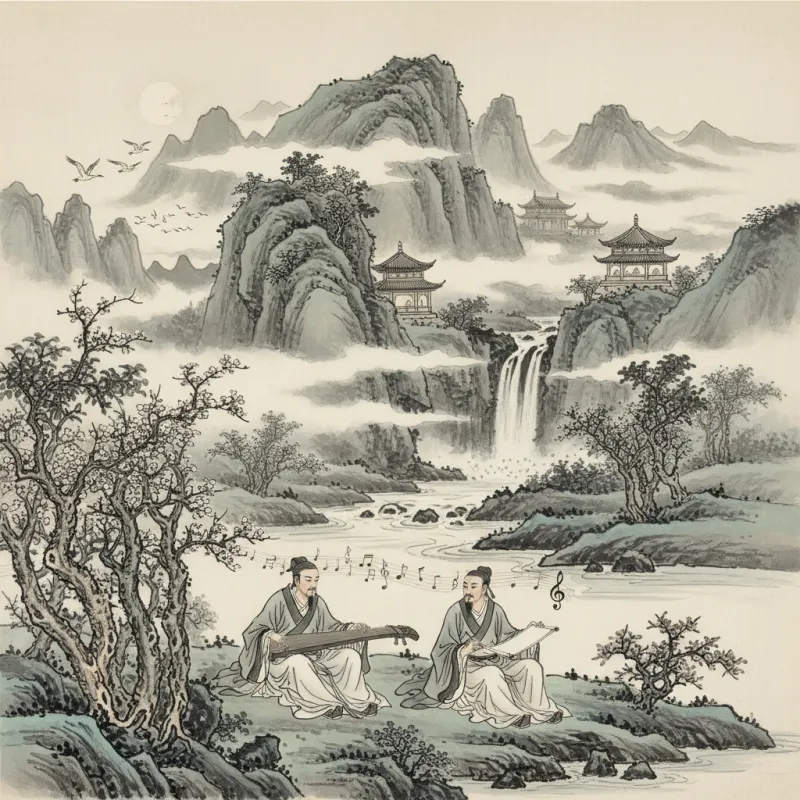
Picture a Song Dynasty banquet hall thick with incense smoke, where a courtesan rises from her silk cushion, lute in hand. As her fingers dance across the strings, she begins to sing—not the stately, measured lines of classical poetry, but something more fluid, more intimate. The words bend and stretch to fit the melody, some lines short as a sigh, others flowing like wine from a tilted cup. This is ci (詞, cí)—poetry that refused to sit still, that demanded to be sung, that turned the rigid rules of classical verse inside out.
When Poetry Broke Free from the Grid
For centuries, Chinese poetry meant shi (詩, shī)—those perfectly balanced lines of five or seven characters, marching in lockstep like soldiers on parade. Every line the same length. Every pause predictable. Beautiful, yes, but constrained by an invisible grid. Then came ci, and suddenly poets could write lines of three characters, or eleven, or whatever the melody demanded. The form didn't dictate the feeling anymore—the feeling dictated the form.
This wasn't just aesthetic rebellion. Ci emerged during the late Tang Dynasty (around the 8th-9th centuries) from the entertainment quarters, the wine houses, the places where professional musicians needed lyrics that actually fit their tunes. These tunes, called cipai (詞牌, cípái) or "ci tune patterns," came from everywhere—Central Asian trade routes, folk songs, military marches, even foreign melodies that had drifted into China along the Silk Road. Each tune had its own rhythm, its own emotional temperature, and poets had to bend their words to match.
The Mechanics of Musical Poetry
Here's what made ci radically different: every poem was written to fit a specific pre-existing tune. Imagine being told "write something profound about autumn, but it has to fit the melody of 'Greensleeves.'" That's essentially what ci poets did, except they had hundreds of tune patterns to choose from, each with its own name—"Butterflies Lingering over Flowers," "The River Is Red," "Immortal at the Magpie Bridge."
Each cipai prescribed everything: how many lines, how many characters per line, where the rhymes fell, even which tones (the rising and falling pitches of Chinese) went where. The tune pattern "Tune of Divination" (卜算子, Bǔ Suàn Zǐ) required forty-four characters arranged in a specific way. "Slow Song of Eternal Longing" (長相思, Cháng Xiāng Sī) needed thirty-six. Poets didn't invent these structures—they inherited them, like a musician inheriting a chord progression.
This constraint paradoxically created freedom. Within the tune's framework, poets could be wildly personal, emotionally raw, even erotic in ways that formal shi poetry rarely allowed. The music gave them permission to feel out loud.
Li Yu: The Emperor Who Sang His Kingdom Away
No one embodied ci's emotional intensity like Li Yu (李煜, Lǐ Yù, 937-978), the last ruler of the Southern Tang kingdom. Before his kingdom fell to the Song Dynasty, Li Yu wrote elegant ci about palace life, beautiful women, spring flowers. Pleasant enough. Then he became a prisoner, and his poetry transformed into something that still makes readers wince with recognition a thousand years later.
His most famous ci, written to the tune "Beautiful Lady Yu" (虞美人, Yú Měi Rén), asks: "When will the spring flowers and autumn moon end? How much of the past do I know?" He's trapped in the Song capital, remembering his lost kingdom, and the poem doesn't philosophize about impermanence—it bleeds. "The carved railings and jade steps must still be there, only the rosy faces have changed." That's not metaphor. That's a man who can't stop picturing the palace he'll never see again.
Li Yu's ci proved that the form could carry unbearable weight. His work influenced everyone who came after, showing that these "song lyrics" could be as serious as any classical poetry. For more on how different poetic forms evolved to express different emotional registers, see Shi Poetry: The Classical Foundation.
The Song Dynasty's Two Approaches
By the Song Dynasty (960-1279), ci had split into two camps, though the division was never absolute. The "delicate and restrained" school (婉約派, wǎnyuē pài) favored intimate subjects—love, longing, the changing seasons, a woman waiting by a window. These poems were often short, using the xiaoling (小令, xiǎolìng) or "short song" format of under sixty characters. Liu Yong (柳永, Liǔ Yǒng) mastered this style, writing ci so popular that people said "wherever there's well water, people sing Liu Yong's lyrics."
Then there was the "bold and unrestrained" school (豪放派, háofàng pài), championed by Su Shi (蘇軾, Sū Shì, 1037-1101), who thought ci should be able to handle anything shi poetry could—history, philosophy, politics, nature on a grand scale. His ci "Remembering the Past at Red Cliff" doesn't sigh over lost love; it conjures the massive naval battle of 208 CE, with "rocks piercing the sky, waves crashing on the shore, rolling up a thousand piles of snow." Su Shi wrote ci about drinking with friends, about Daoist immortals, about the moon—subjects that would have seemed absurd in the delicate style.
The female poet Li Qingzhao (李清照, Lǐ Qīngzhào, 1084-1155) complicated this binary. Her early ci fit the "delicate" category perfectly—playful poems about getting drunk on a boat, losing at chess to her husband. Then the Jin Dynasty invaded, her husband died, and her later ci became something else entirely. "Searching, searching, cold, cold, clear, clear, dismal, dismal, mournful, mournful"—that's how one of her most famous poems begins, seven pairs of repeated characters that sound like someone trying to breathe through grief. Delicate in form, devastating in impact.
The Music We Lost
Here's the tragedy: we have the words, but the melodies are gone. By the Ming Dynasty (1368-1644), people had stopped performing ci as songs. The tunes that gave birth to these poems, that shaped every syllable, vanished. We know the tune patterns, the technical requirements, but not what they actually sounded like. It's like having Shakespeare's lyrics without knowing the Elizabethan melodies they were set to.
Modern scholars have attempted reconstructions based on later musical traditions, but we're essentially reading opera librettos without the opera. The words remain powerful—Li Yu's grief, Su Shi's exuberance, Li Qingzhao's precision—but we're experiencing them as pure text, not as the multimedia art form they originally were. Every ci poem is a ghost of a performance we can never attend.
This loss changed how people read ci. Without the music, readers focused more on the words themselves, on imagery and emotion divorced from melody. Ci became a literary form rather than a performance art. Some argue this elevated it; others say we lost something essential. Both are probably right.
Why Ci Still Matters
Ci poetry proved that constraints breed creativity. Give a poet a rigid tune pattern, and they'll find ways to make it say something no one expected. The form also democratized poetry in a way—because ci came from entertainment culture rather than the scholarly tradition, it felt more accessible, more emotionally direct. You didn't need to know all the classical allusions to understand a ci about missing someone.
The form also preserved something about how poetry actually worked in medieval China. We tend to think of classical Chinese poetry as silent words on a page, but for centuries, poetry was performance. It was sung at parties, chanted at gatherings, set to music and passed around. Ci is the clearest evidence of this performance culture, even if the performances themselves have vanished.
For contemporary readers, ci offers a different entry point into classical Chinese literature. The emotional directness, the personal voice, the way these poems capture specific moments—a woman watching rain, a man remembering a battle, someone drunk and happy and alive—makes them feel immediate in a way that more formal poetry sometimes doesn't. They're songs we can't hear, but we can still feel the rhythm in the words, the places where a voice would have risen or fallen, where the lute would have answered the singer.
The best ci poems do what all great lyrics do: they make the personal universal. Li Yu's grief for his lost kingdom becomes anyone's grief for what they've lost. Li Qingzhao's "searching, searching" becomes the sound of anyone trying to find something—or someone—who isn't there anymore. Su Shi's joy in the natural world becomes an invitation to look up at the moon and feel connected to everyone who's ever looked up at that same moon. The melodies are gone, but the songs remain, waiting for readers to hear them in their own way.
Related Reading
- Poetic Forms in Chinese Literature: The Rules That Set Poetry Free
- Regulated Verse (律诗): The Strictest Form in World Poetry
- Ci (词): The Song Lyrics That Became High Art
- Modern Chinese Poetry: From Classical Forms to Free Verse
- Poetic Forms: The Rules That Made Chinese Poetry Great
- Delving into the Techniques of Chinese Classical Poetry: Insights from Tang, Song, and Yuan Poets
- Tao Yuanming: The Recluse Who Found Paradise
- The Spiritual Depth of Chinese Classical Poetry: Insights from Tang, Song, and Yuan Poets
Explore Chinese Culture
- Explore the Tang dynasty's golden age
- Explore Daoist themes in classical poetry
- Explore Chinese literary traditions