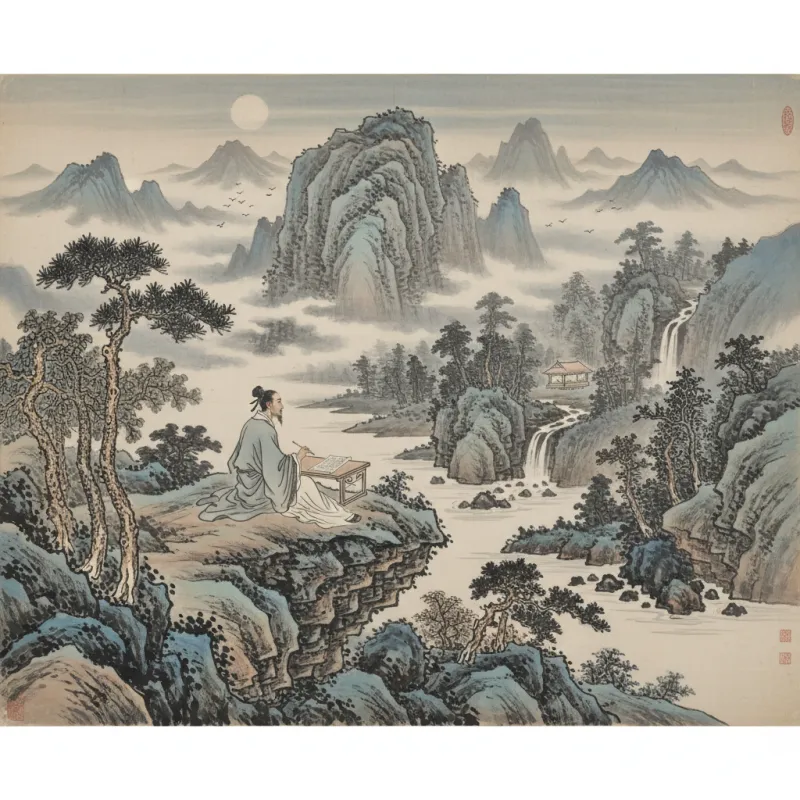
When the Tang poet Wang Wei (王維, Wáng Wéi) wrote "In each grain of dust, a Buddha-land appears," he wasn't being metaphorical—he was documenting a radical shift in how Chinese intellectuals perceived reality itself. By the 8th century, Buddhist philosophy had so thoroughly permeated the literary consciousness that even Confucian scholars found themselves writing poems about emptiness, impermanence, and the illusory nature of worldly attachments. This wasn't cultural appropriation; it was synthesis, and it produced some of the most spiritually sophisticated poetry the world has ever seen.
The Buddhist Revolution in Tang Poetic Consciousness
The transformation didn't happen overnight. When Buddhism first arrived in China during the Han dynasty (206 BCE–220 CE), it was exotic, foreign, and deeply suspicious to the Confucian establishment. But by the time Emperor Taizong consolidated Tang power in the 620s, Buddhist monasteries had become centers of learning, and monks were among the most educated people in the empire. The real breakthrough came with the translation projects—particularly Xuanzang's (玄奘, Xuánzàng) return from India in 645 with 657 Sanskrit texts. Suddenly, Chinese poets had access to concepts that their language had never needed to express: śūnyatā (emptiness), pratītyasamutpāda (dependent origination), and the paradoxical logic of the Madhyamaka school.
Wang Wei absorbed all of this. His estate at Wangchuan became a kind of literary monastery where he and his friend Pei Di (裴迪, Péi Dí) would compose matching poems about the same scenes—a Buddhist practice of seeing multiple perspectives on the same reality. When Wang Wei writes "People at leisure, osmanthus flowers fall / Night quiet, spring mountain empty," he's not just describing a scene. He's enacting the Buddhist concept of wu (無, wú)—the pregnant emptiness that isn't absence but the ground of all presence. The falling flowers happen precisely because no one is grasping at them.
The Chan Aesthetic: Poetry as Sudden Enlightenment
The rise of Chan Buddhism (禪, Chán—later known as Zen in Japan) in the 8th and 9th centuries gave poets a new formal challenge: how do you capture the wordless transmission of enlightenment in words? The Chan masters had their koans and their dramatic gestures—Linji shouting, Deshan hitting students with his staff. Poets needed something equivalent, and they found it in compression, paradox, and the strategic use of silence.
Consider Jia Dao's (賈島, Jiǎ Dǎo) famous poem about visiting a recluse and not finding him home. The entire poem is about absence, but that absence becomes more vivid than any presence could be. Or look at the work of the monk-poet Guanxiu (貫休, Guànxiū), whose "Sixteen Arhats" poems don't describe enlightened beings—they enact the cognitive disruption that encountering such beings would produce. His arhats have eyebrows that "hang down past their knees" and expressions that are simultaneously fierce and compassionate. These aren't realistic portraits; they're visual koans designed to short-circuit conventional perception.
The technique reached its apex in the "gong'an" (公案, gōng'àn) poetry of the late Tang, where poets would take famous Chan encounters and compress them into regulated verse. The result was poetry that demanded the same kind of non-linear insight that Chan practice cultivated. You couldn't understand these poems by analyzing them—you had to let them work on you, the way a koan works on a meditation student.
Song Dynasty Synthesis: Buddhism Meets Neo-Confucianism
By the Song dynasty, Buddhism had been in China for a millennium, and something interesting happened: it started to disappear as a distinct category. Not because it was rejected, but because it had been so thoroughly absorbed that its insights became part of the general intellectual atmosphere. The Neo-Confucian philosophers like Zhu Xi (朱熹, Zhū Xī) were explicitly anti-Buddhist in their rhetoric, but their metaphysics—with its emphasis on li (理, lǐ, principle) and qi (氣, qì, material force)—owed enormous debts to Buddhist ontology.
Song poets navigated this complex terrain with remarkable sophistication. Su Shi (蘇軾, Sū Shì), perhaps the greatest Song poet, was officially a Confucian bureaucrat, but his poetry is saturated with Buddhist sensibility. His famous "Red Cliff" poems use Buddhist impermanence to frame Confucian historical consciousness—the great battles of the Three Kingdoms period become examples of the emptiness of worldly glory, but that emptiness doesn't lead to withdrawal. Instead, it enables a kind of engaged detachment, a way of participating fully in the world while recognizing its dreamlike nature.
The Song ci (詞, cí) form—originally song lyrics, more flexible than the regulated shi (詩, shī) poetry—became a vehicle for exploring Buddhist themes in a more intimate register. Li Qingzhao (李清照, Lǐ Qīngzhào) writes about loss and longing in ways that echo the Buddhist teaching on attachment, but she never preaches. The spiritual insight emerges from the precise observation of emotional states, not from doctrinal assertion. When she writes "Searching, searching, seeking, seeking / Cold, cold, clear, clear / Dismal, dismal, mournful, mournful, mournful," the repetition isn't just rhetorical—it's a meditation technique, a way of staying with difficult feelings until they reveal their empty nature.
The Yuan Transformation: Buddhism in the Vernacular
The Mongol conquest that established the Yuan dynasty (1271–1368) disrupted the traditional examination system and the Confucian bureaucracy that had sustained it. Many educated Chinese found themselves without the official positions that had defined their identity. Some turned to the theater, creating the zaju (雜劇, zájù) drama that became the Yuan dynasty's most distinctive literary achievement. Others deepened their engagement with Buddhism, particularly the Pure Land and Chan schools that had always been more accessible to laypeople.
Yuan poetry reflects this democratization of Buddhist spirituality. The monk-poet Zhongfeng Mingben (中峰明本, Zhōngfēng Míngběn) wrote in a style that combined Chan directness with vernacular accessibility. His poems about meditation practice don't require specialized knowledge—they speak directly to the experience of sitting, of watching thoughts arise and dissolve, of the gradual recognition that the watcher and the watched are not separate.
The sanqu (散曲, sǎnqǔ) form—freer and more colloquial than Song ci—became a vehicle for Buddhist themes that would have seemed too elevated for such informal treatment in earlier periods. Guan Hanqing (關漢卿, Guān Hànqīng) and Ma Zhiyuan (馬致遠, Mǎ Zhìyuǎn) wrote about Buddhist temples, wandering monks, and the vanity of worldly pursuits in language that anyone could understand. This wasn't a dumbing-down of Buddhist philosophy—it was a recognition that enlightenment doesn't require literary sophistication, that the dharma is as available to the illiterate peasant as to the scholar-official.
The Poetics of Impermanence: Technical Innovations
Buddhist philosophy didn't just provide themes for Chinese poets—it transformed their formal techniques. The Buddhist teaching on impermanence (anitya, 無常, wúcháng) led to innovations in how poets handled time and perspective. Traditional Chinese poetry had always been good at capturing moments, but Buddhist-influenced poets developed ways of showing how moments arise and dissolve, how the present contains traces of the past and seeds of the future.
Look at how Du Fu (杜甫, Dù Fǔ) uses verb tenses and aspectual markers in his late poetry. He'll shift from present to past to future within a single couplet, creating a temporal instability that mirrors the Buddhist insight into the constructed nature of time. Or consider the way Song poets use the technique of duizhang (對仗, duìzhàng)—parallel couplets—to create relationships between images that are neither causal nor merely associative. The parallelism suggests connection without asserting it, enacting the Buddhist principle of dependent origination: things arise together without one causing the other.
The treatment of nature imagery also changed under Buddhist influence. Pre-Buddhist Chinese poetry certainly celebrated nature, but it tended to see natural phenomena as symbols or as occasions for human emotion. Buddhist-influenced poets developed a way of presenting nature that respected its otherness, its existence independent of human concerns. When the Song poet Yang Wanli (楊萬里, Yáng Wànlǐ) writes about a lotus flower, he's not using it as a symbol of purity—he's trying to see the flower as it is, before human concepts colonize it. This is harder than it sounds, and the best Buddhist-influenced nature poetry is marked by a kind of epistemological humility, an acknowledgment that language can only point toward what it can never fully capture.
Living Tradition: Buddhist Poetry's Contemporary Resonance
The Buddhist dimension of Chinese classical poetry isn't just historical interest—it offers resources for contemporary readers struggling with many of the same questions that preoccupied Tang, Song, and Yuan poets. How do we find meaning in a world characterized by constant change? How do we love people and things without being destroyed by their inevitable loss? How do we act ethically when we recognize that the self we're trying to perfect is itself a construction?
The poets discussed here didn't answer these questions with doctrinal formulas. They worked through them in specific images, particular moments, concrete situations. Wang Wei's empty mountains, Su Shi's moonlit river, Ma Zhiyuan's autumn evening—these aren't illustrations of Buddhist philosophy. They're experiments in Buddhist seeing, attempts to perceive reality without the distorting lens of ego and attachment.
For readers interested in exploring how Buddhist themes intersect with other aspects of Chinese poetic tradition, the relationship between nature imagery and spiritual cultivation offers particularly rich territory. Similarly, the way Tang poets integrated meditation practices into their creative process reveals how deeply Buddhism shaped not just what poets wrote about, but how they wrote.
The Unfinished Conversation
What makes this tradition so vital is its refusal of closure. Buddhist-influenced Chinese poetry doesn't offer solutions—it offers practices, ways of attending to experience that might, over time, transform how we relate to ourselves and the world. The poems are invitations to a particular kind of seeing, and like all genuine invitations, they leave us free to decline. But for those who accept, who are willing to sit with Wang Wei's empty mountains or Su Shi's impermanent river, the rewards are considerable: not answers, but a deepening of the questions, not certainty, but a more spacious relationship to uncertainty.
The conversation between Buddhism and Chinese poetry continued well beyond the Yuan dynasty, of course, influencing Ming and Qing poets and eventually spreading to Korea, Japan, and Vietnam. But the Tang, Song, and Yuan periods represent the tradition's most creative phase, when Buddhist insights were still fresh enough to generate formal innovations and philosophical surprises. Reading these poets now, we're not just accessing historical documents—we're participating in a living tradition of spiritual inquiry that remains as relevant as ever.
Related Reading
- Cold Mountain Poems of Hanshan: The Hermit Who Wrote on Rocks
- Wang Wei's Buddhist Nature Poems: Silence as Spiritual Practice
- Buddhist Poetry in Chinese Literature: Enlightenment in Twenty Characters
- Buddhist Impermanence in Tang Poetry: Everything You Love Will Disappear
- Zen Koans in Poetry Form: When Chinese Verse Became a Riddle
- Nature Poetry in Chinese Literature: Seeing the World as the Poets Saw It
- Su Shi: The Renaissance Man of Chinese Literature
- Unveiling the Essence of Chinese Classical Poetry: Insights from Tang, Song, and Yuan Poets
Explore Chinese Culture
- Explore the Tang dynasty's golden age
- Explore Daoist themes in classical poetry
- Explore Chinese literary traditions