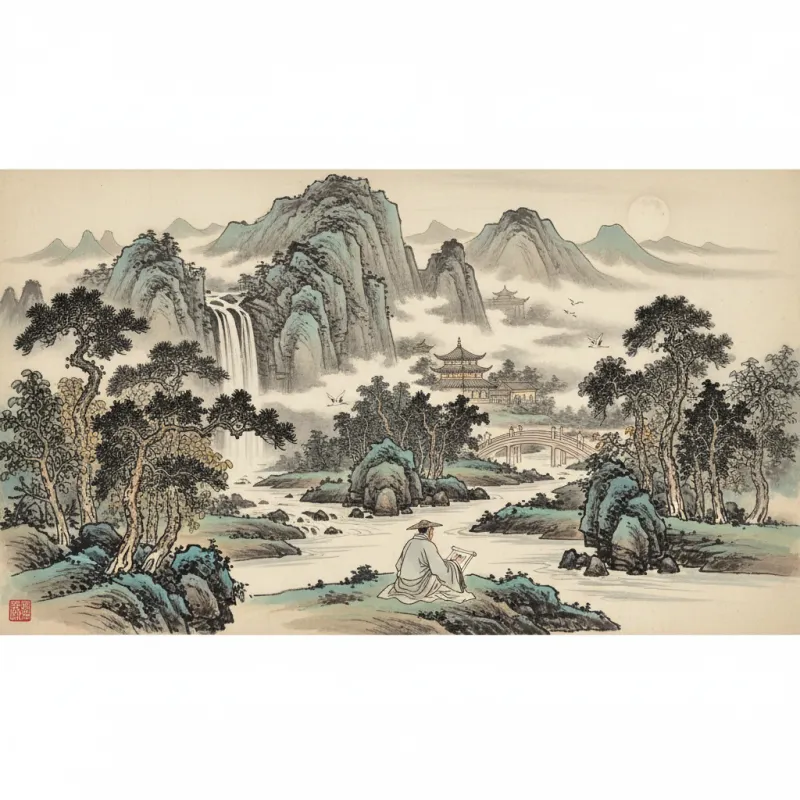
Picture a Tang dynasty poet staring at a blank sheet of paper, knowing he has exactly twenty-eight characters to capture the moonlight on a river, the ache of separation, and the passage of time. Not twenty-nine. Not a vague "around thirty." Twenty-eight. And those characters must follow tonal patterns so precise that a single syllable in the wrong register ruins the entire poem.
This sounds like creative torture. Yet this system — these suffocating rules — produced Du Fu, Li Bai, Wang Wei. It gave us poems that have survived a thousand years while most "free" verse from last decade is already forgotten.
The paradox is real: the strictest formal constraints in world literature created some of its most enduring poetry. Understanding why requires looking at what these rules actually demanded.
The Architecture of Sound: Tonal Patterns
Classical Chinese poetry operates in a tonal language. Every character carries one of four tones (in Middle Chinese: level, rising, departing, entering). This isn't decorative. Tone changes meaning. The character "ma" means "mother," "hemp," "horse," or "scold" depending on tone.
Regulated verse (律詩, lǜshī) exploits this. The rules require alternating patterns of level (平, píng) and oblique (仄, zè) tones. In an eight-line regulated verse, the second and fourth characters of each line must follow specific tonal sequences. The pattern creates a sonic architecture — a rising and falling that English-language poetry can only approximate through stress patterns.
This isn't arbitrary decoration. The tonal patterns prevent monotony in a language where every syllable is one character, one beat. Without tonal variation, Chinese poetry would sound like a drum beating the same rhythm. The rules force musicality into the structure itself.
Wang Wei's "Deer Park" (鹿柴, Lù Zhài) demonstrates this perfectly. Each line balances level and oblique tones so precisely that the poem sounds inevitable, as if these were the only twenty characters that could possibly express this moment. The form doesn't constrain the meaning — it amplifies it.
Parallelism: The Couplet as Mirror
The middle two couplets of an eight-line regulated verse must be parallel (對仗, duìzhàng). Not loosely parallel. Grammatically identical. If line five has a noun in position three, line six must have a noun in position three. If line five uses a color word, line six needs a color word in the same position.
This sounds mechanical. It produces lines like Du Fu's famous couplet: "The state broken, mountains and rivers remain / The city in spring, grass and trees grow deep" (國破山河在 / 城春草木深). The parallelism isn't decorative — it creates meaning through juxtaposition. "State" mirrors "city." "Broken" mirrors "spring." The contrast between human destruction and natural renewal emerges from the grammatical structure itself.
Western poetry occasionally uses parallelism for effect. Chinese regulated verse makes it mandatory. The poet cannot avoid it. This forces a particular kind of thinking: finding two images that mirror each other grammatically while advancing the poem's emotional arc. It's like being required to think in stereo.
The parallel couplets also create a pivot point in the poem's structure. The first couplet establishes the scene. The parallel couplets develop it through mirrored observations. The final couplet resolves or complicates the emotional trajectory. This four-part structure (起承轉合, qǐ-chéng-zhuǎn-hé) becomes so internalized that poets work within it instinctively, the way a sonnet writer feels the turn at line nine.
The Jueju: Compression as Art
The jueju (絕句, juéjù) takes these constraints further by cutting the poem in half. Four lines instead of eight. Twenty or twenty-eight characters total. This is shorter than a haiku when you count syllables.
Yet the jueju must still create a complete emotional arc. Li Bai's "Quiet Night Thought" (靜夜思, Jìng Yè Sī) does this in twenty characters: moonlight, homesickness, resolution. The poem feels complete despite its brevity because the form demands compression. Every character must work. There's no room for throat-clearing or setup.
This compression changes how poets think. In a jueju, you cannot build gradually toward a revelation. You must start in the middle of the experience. The first line must establish scene and mood simultaneously. The final line must resonate without explaining. The form teaches economy.
Compare this to the sprawling freedom of contemporary free verse, where poems can meander for pages, circling their subjects, trying different approaches. The jueju offers no such luxury. You have four lines. Make them count.
Rhyme Schemes: The Sonic Anchor
Regulated verse requires rhyme at the end of even-numbered lines (and optionally the first line). The rhymes must use the same tone category. This is stricter than English rhyme schemes, which only require similar sounds regardless of stress patterns.
The rhyme scheme creates sonic anchors throughout the poem. In an eight-line regulated verse, lines two, four, six, and eight rhyme. This regular pattern gives the poem structural integrity even as the imagery shifts. The ear expects these sonic returns and finds satisfaction in them.
But here's what makes Chinese rhyme schemes particularly demanding: the rhyme words must come from the same rhyme category in the official rhyme dictionaries (韻書, yùnshū). Poets couldn't just find any words that sounded similar. They had to use words from approved rhyme groups, which limited their choices significantly.
This constraint forced poets to think backwards from the rhyme words. If you needed to rhyme with "mountain" (山, shān), you had to use words from the same rhyme category. This might mean restructuring your entire line to accommodate the required rhyme word. The form shapes the content at the most granular level.
Why Constraints Work: The Cognitive Science
Modern research on creativity supports what Tang poets knew intuitively: constraints enhance rather than limit creative output. When faced with infinite possibilities, we freeze. When given specific parameters, we problem-solve.
The rules of regulated verse create a puzzle. The poet must express a specific emotional experience while satisfying tonal patterns, parallelism requirements, rhyme schemes, and line length constraints. This puzzle-solving activates different cognitive processes than pure free association.
The constraints also provide a shared framework. When Du Fu writes a regulated verse, readers know the form. They can appreciate how he works within it, where he bends it, how he makes the mandatory parallel couplets feel inevitable rather than forced. The form creates expectations that the poet can satisfy, subvert, or transcend.
This is why Tang Dynasty poetry remains more widely read than most contemporary Chinese poetry. The forms provide structure that helps poems survive across centuries. Free verse dates quickly because it lacks this architectural foundation.
The Modern Resistance
Contemporary Chinese poets largely abandoned these forms after the May Fourth Movement in 1919. The rules seemed feudal, restrictive, incompatible with modern consciousness. Free verse promised liberation.
Yet something was lost. The formal mastery that made Du Fu great cannot be replicated in free verse. The specific cognitive demands of working within strict constraints — the puzzle-solving, the compression, the sonic architecture — these disappear when all rules become optional.
Some contemporary poets have returned to classical forms, not as nostalgic revival but as recognition that constraints enable certain kinds of excellence. The rules aren't arbitrary traditions. They're technologies for making language do specific things.
Learning from the Forms
You don't need to write regulated verse to learn from it. The principles translate:
Compression matters. Every word should work. If you can cut it without loss, cut it.
Structure creates meaning. The placement of images, the relationship between lines, the sonic patterns — these aren't decoration. They're part of what the poem says.
Constraints force creativity. Give yourself arbitrary rules. Write a poem where every line has exactly seven syllables. Make the third word of each line a color. See what happens when you must problem-solve rather than free-associate.
The Tang poets weren't geniuses despite the rules. They were geniuses because the rules demanded genius. The forms didn't make poetry easy. They made mediocrity impossible.
When you read Li Bai's quatrains or Du Fu's regulated verse, you're seeing what happens when extraordinary talent meets unforgiving constraints. The rules didn't limit these poets. They gave them something to push against, a structure to master and transcend.
That's the lesson: freedom isn't the absence of constraints. It's what you do within them.
Related Reading
- Modern Chinese Poetry: From Classical Forms to Free Verse
- Ci Poetry: When Poems Were Songs
- Ci (词): The Song Lyrics That Became High Art
- Fu: The Grand Rhapsody Form
- Regulated Verse (律诗): The Strictest Form in World Poetry
- Friendship and Farewell: Poems of Parting
- How to Read a Chinese Poem: A Practical Guide for English Speakers
- Zhuo Wenjun: The Woman Who Wrote Her Own Love Story
Explore Chinese Culture
- Explore the Tang dynasty's golden age
- Explore Daoist themes in classical poetry
- Explore Chinese literary traditions