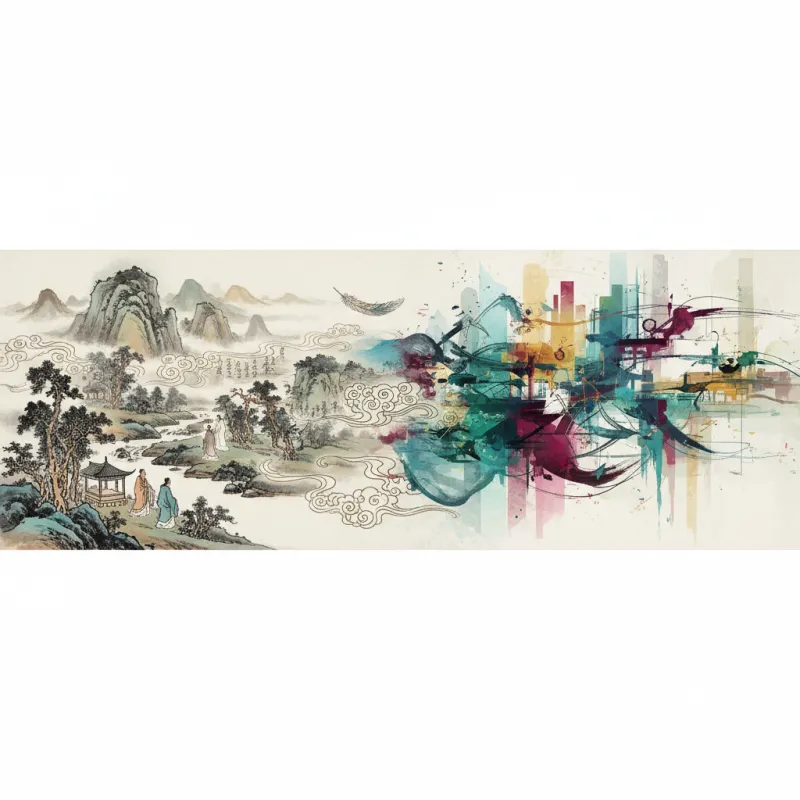
When Xu Zhimo (徐志摩 Xú Zhìmó) boarded a plane in 1931 to visit the poet Lin Huiyin, he carried with him a manuscript of poems that would have baffled his literary ancestors. No tonal patterns. No parallel couplets. No five or seven characters per line. Just three years later, he would die in a plane crash, but his free verse had already helped demolish two thousand years of poetic tradition. The question wasn't whether Chinese poetry could survive without its classical forms — it was whether it could survive with them.
The May Fourth Rupture
The year 1919 marks the true breaking point. The May Fourth Movement — a student-led protest against the Treaty of Versailles and traditional Chinese culture — created the intellectual climate for Hu Shi's (胡适 Hú Shì) vernacular revolution to take root. But here's what most accounts miss: the shift from classical to modern poetry wasn't just about language. It was about epistemology.
Classical regulated verse operated on the assumption that reality could be captured in fixed patterns. The lǜshī (律诗 regulated verse) with its eight lines, the jueju (绝句 juéjù) with its four — these weren't arbitrary constraints. They reflected a Confucian worldview where harmony emerged from structure, where the individual voice found expression through collective forms. When Du Fu (杜甫 Dù Fǔ) wrote about war or poverty, he did so within the tonal patterns (平仄 píngzè) that had governed Chinese poetry since the Tang Dynasty.
New poetry (新诗 xīnshī) rejected this entirely. Influenced by Western free verse — particularly the Imagists and Symbolists — poets like Guo Moruo (郭沫若 Guō Mòruò) and Wen Yiduo (闻一多 Wén Yīduō) argued that modern consciousness required modern forms. The chaos of early twentieth-century China — warlords, foreign occupation, social upheaval — couldn't be contained in the elegant symmetries of Tang poetry.
The Vernacular Question
But switching from classical Chinese (文言文 wényánwén) to vernacular Chinese (白话 báihuà) created unexpected problems. Classical Chinese is monosyllabic and tonal — each character carries meaning, sound, and tone. This density made the five-character line (五言 wǔyán) and seven-character line (七言 qīyán) incredibly efficient vessels for imagery and emotion.
Vernacular Chinese, by contrast, is polysyllabic. The word for "butterfly" isn't just 蝶 (dié) but 蝴蝶 (húdié). "Democracy" requires three characters: 民主主义 (mínzhǔzhǔyì). This expansion meant that free verse in Chinese often felt verbose compared to classical poetry's compression. When Xu Zhimo wrote his famous poem "Saying Goodbye to Cambridge Again" (再别康桥 Zài Bié Kāngqiáo), he needed sixteen lines to capture what Li Bai might have expressed in four.
Some poets tried to split the difference. Wen Yiduo developed what he called "new regulated verse" (新格律诗 xīn gélǜshī) — free verse that retained some structural discipline through stanza patterns and internal rhyme. His poem "Dead Water" (死水 Sǐshuǐ) uses five-line stanzas with a consistent rhythm, creating a bridge between classical constraint and modern freedom.
The Misty Poets and Obscurity
After the Communist Revolution in 1949, poetry became a tool of the state. Revolutionary realism demanded clarity, optimism, and ideological correctness. Poets wrote about steel production and agricultural communes. The classical tradition was denounced as feudal. The May Fourth modernists were criticized as bourgeois.
Then came the Cultural Revolution (1966-1976), and poetry nearly died. But in the late 1970s, a group of young poets began circulating work that was deliberately obscure, personal, and apolitical. They became known as the Misty Poets (朦胧诗派 ménglóng shīpài) — Bei Dao (北岛 Běi Dǎo), Gu Cheng (顾城 Gù Chéng), Shu Ting (舒婷 Shū Tíng), and others.
Bei Dao's poem "The Answer" (回答 Huídá) became an anthem: "I don't believe the sky is blue / I don't believe in thunder's echoes / I don't believe that dreams are false / I don't believe that death has no revenge." This wasn't just rebellion against political orthodoxy. It was a return to the modernist project that had been interrupted by Mao.
But here's the paradox: the Misty Poets, in their rejection of both classical forms and socialist realism, created poetry that was often more difficult than either. Their use of private symbolism, fragmented imagery, and ambiguous syntax made their work inaccessible to ordinary readers. They had achieved freedom from formal constraints, but at the cost of the communal intelligibility that classical poetry had maintained even at its most sophisticated.
The Return to Form
By the 1990s, some Chinese poets began questioning whether the complete abandonment of classical forms had been necessary. Xi Chuan (西川 Xī Chuān) and others experimented with what might be called "post-vernacular" poetry — work that acknowledged the classical tradition without being bound by it.
This wasn't nostalgia. It was recognition that the tonal patterns and parallel structures of classical Chinese poetry weren't just arbitrary rules. They were technologies for creating meaning through sound and structure. When you write a parallel couplet, you're not just following a convention — you're creating a cognitive experience where the reader perceives relationships through formal symmetry.
Some contemporary poets write in classical forms as a deliberate provocation. In an age of digital communication and global English, composing a regulated verse in classical Chinese is an act of cultural resistance. Others use classical techniques selectively — a tonal pattern here, a parallel structure there — to create resonance with the tradition while maintaining vernacular accessibility.
The Digital Age and New Possibilities
The internet has created yet another shift. Online poetry in China often ignores both classical forms and May Fourth free verse, developing its own aesthetics based on brevity, visual layout, and viral potential. Weibo (微博 Wēibó) poetry — short verses designed for social media — has more in common with the jueju's compression than with Xu Zhimo's romantic expansiveness.
Meanwhile, Chinese poets writing in English or other languages face a different challenge: how to convey the tonal and visual dimensions of Chinese poetry in alphabetic languages. The translator becomes a kind of poet, making decisions about whether to preserve form, meaning, or sound — knowing that all three is impossible.
What Was Lost, What Was Gained
Let's be honest about the costs. Modern Chinese poetry lost the mnemonic power of classical forms. You can memorize a Du Fu poem after hearing it once because the tonal patterns and parallel structures create a cognitive scaffold. Free verse offers no such assistance. It also lost the shared cultural vocabulary that made classical poetry a communal art form. When Li Bai referenced the moon, every educated reader understood the constellation of meanings — separation, longing, transcendence — that the image carried.
But modern poetry gained something too: the ability to represent individual consciousness in all its fragmentation and uncertainty. Classical poetry, for all its beauty, operated within a relatively stable worldview. Modern Chinese poetry emerged from and reflects a century of revolutionary upheaval. It had to invent new forms because the old forms couldn't contain the new reality.
The real question isn't whether modern poetry is better or worse than classical poetry. It's whether Chinese poetry can maintain continuity with its tradition while remaining responsive to contemporary experience. The best contemporary Chinese poets — Yang Lian (杨炼 Yáng Liàn), Duo Duo (多多 Duō Duō), Wang Xiaoni (王小妮 Wáng Xiǎonī) — don't choose between classical and modern. They inhabit the tension between them, creating work that acknowledges two thousand years of poetic tradition while refusing to be constrained by it.
When Xu Zhimo died in that plane crash in 1931, he was traveling between two cities, two poets, two ways of being Chinese. That journey — between tradition and modernity, constraint and freedom, classical and vernacular — remains the defining tension of Chinese poetry. The revolution he helped start isn't over. It's just entered a new phase, where the question is no longer whether to break with tradition, but how to remain in conversation with it while speaking in a contemporary voice.
Related Reading
- Ci Poetry: When Poems Were Songs
- Jueju: The Art of the Four-Line Poem
- Fu: The Grand Rhapsody Form
- Regulated Verse (律诗): The Strictest Form in World Poetry
- Poetic Forms: The Rules That Made Chinese Poetry Great
- How to Read Chinese Poetry: A Guide for English Speakers
- The Timeless Art of Song Poets: A Deep Dive into Classical Chinese Poetry
- Du Fu's War Poems: Witnessing the An Lushan Rebellion
Explore Chinese Culture
- Explore the Tang dynasty's golden age
- Explore Daoist themes in classical poetry
- Explore Chinese literary traditions