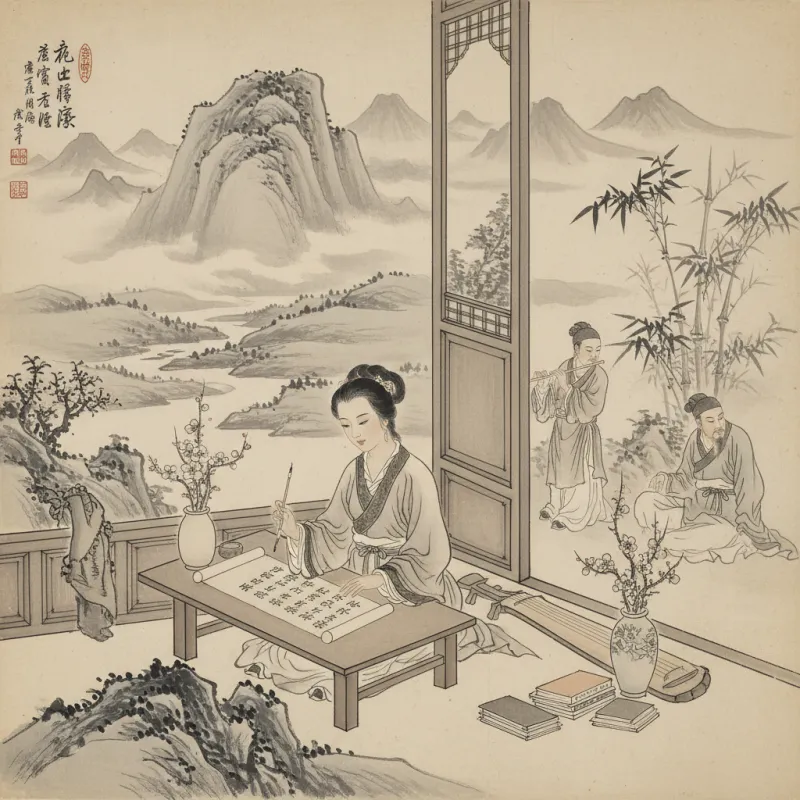
Picture this: A wealthy widow in her twenties sits behind a screen at her father's banquet, listening to a traveling scholar play the qin (琴, qín, a seven-stringed zither). The music is good. The musician is better-looking. By the end of the night, she's decided to throw away her comfortable life, her father's fortune, and every rule of Han Dynasty propriety to run away with him. Her name was Zhuo Wenjun (卓文君, Zhuō Wénjūn, c. 175–121 BCE), and she's about to become the most famous elopement in Chinese literary history.
This isn't a fairy tale. It's a documented scandal that shocked the Western Han court and gave us one of the earliest examples of a Chinese woman using poetry not to express delicate feelings, but to win a very public marital dispute.
The Elopement That Scandalized Sichuan
Zhuo Wenjun was the daughter of Zhuo Wangsun, one of the wealthiest iron merchants in Linqiong (臨邛, Línqióng, in modern Sichuan). She'd been married young, widowed young, and sent back to her father's house — a position that gave her slightly more freedom than the average Han Dynasty woman, but only because her social value had already been spent. She was expected to live quietly, manage her dowry, and fade into respectable obscurity.
Then Sima Xiangru (司馬相如, Sīmǎ Xiāngrú) showed up. He was a minor official with major literary ambitions, temporarily staying with a local magistrate. The magistrate, knowing Zhuo Wangsun's weakness for cultured company, arranged a banquet. Sima Xiangru played the qin. Zhuo Wenjun listened from behind the screen where unmarried women and widows were sequestered during mixed gatherings.
What happened next depends on which historical source you trust. The Shiji (史記, Shǐjì, Records of the Grand Historian) by Sima Qian suggests Sima Xiangru deliberately played a piece called "Phoenix Seeks His Mate" to signal his interest. Other accounts claim Zhuo Wenjun sent a servant with a message first. Either way, they eloped that same night.
Her father was furious. He cut her off completely, refusing to provide the dowry that was legally hers. This is where the story gets interesting — because instead of crawling back or starving quietly, Zhuo Wenjun opened a wine shop.
The Wine Shop: When Poetry Meets Economics
Let's be clear about what this meant. A woman from one of the richest families in Sichuan was serving wine to customers in public. She wasn't managing the business from a back room — she was working the counter, visible to anyone who walked in. Sima Xiangru, the educated scholar, was washing dishes.
This was performance art as much as survival. Zhuo Wenjun knew exactly how humiliating this would be for her father. A man of his status having his daughter seen in such a position? The gossip must have been spectacular. Within months, Zhuo Wangsun caved and provided a dowry of 100 servants and a million cash coins. They closed the wine shop and moved to Chengdu.
The story could have ended there — rebellious daughter wins, gets her money, lives happily ever after. But this is where Zhuo Wenjun's real genius shows up, because the marriage itself was about to become the problem.
"Baitou Yin": The Poem That Saved a Marriage
Sima Xiangru became famous. His fu (賦, fù, rhapsody-prose) caught the attention of Emperor Wu, and he was appointed to the imperial court. Success, as it turns out, made him reconsider his marriage to a woman who'd once served wine in public. According to multiple sources, he sent a letter home suggesting he might take a concubine — or in some versions, a second wife.
Zhuo Wenjun's response was "Baitou Yin" (白頭吟, Báitóu Yín, "Song of White Hair"), a poem so cutting that it's been studied for over two thousand years:
皚如山上雪,皎若雲間月。 闻君有两意,故来相决绝。
"Pure as snow on the mountain, bright as the moon among clouds. / I hear you have two hearts now, so I've come to make a clean break."
The poem continues for several more lines, but these opening couplets do the heavy lifting. She's not begging. She's not crying. She's presenting divorce as her decision, framed in language so elegant that refusing would make Sima Xiangru look like a fool. The "snow on the mountain" and "moon among clouds" aren't just pretty images — they're assertions of her own worth and purity, a direct counter to any suggestion that her past made her unsuitable.
Some versions of the story include a second poem, "Yuanjun Ci" (怨郎詩, Yuàn Láng Shī, "Poem of Resentment"), which is even more direct:
一别之后,二地相悬。 都说是三四月,谁又知五六年。
"After one parting, two places suspended in longing. / They say it's been three or four months, but who knows it's been five or six years."
The poem uses number progression as a structural device, counting up the years of separation and the depth of her grievance. It's mathematically precise emotional accounting.
Sima Xiangru backed down. He stayed married to Zhuo Wenjun for the rest of his life.
What the Historians Actually Said
Here's where we need to talk about sources, because Zhuo Wenjun's story has been romanticized, moralized, and probably embellished over two millennia. The earliest account is in Sima Qian's Shiji, written within a century of the events. Sima Qian treats the elopement as a biographical detail about Sima Xiangru, not as a love story. He mentions the wine shop. He doesn't mention "Baitou Yin."
The poem first appears in later anthologies, and some scholars argue it might not be Zhuo Wenjun's work at all. The attribution could be a later addition, a way of giving narrative closure to a story that people wanted to end with female triumph. "Yuanjun Ci" is even more dubious — it doesn't appear in any source before the Tang Dynasty.
But here's the thing: even if the poems are apocryphal, the fact that they were attributed to Zhuo Wenjun tells us something important. Chinese literary culture needed to believe that a woman in her position could have written them. The story required that ending. And the poems themselves, whoever wrote them, became models for how women could use literary skill as leverage in a system that gave them almost none.
The Legacy: Poetry as Power
Zhuo Wenjun's story influenced centuries of Chinese literature about women who chose their own paths. She appears in Tang Dynasty poetry, Ming Dynasty plays, and Qing Dynasty novels. Ban Zhao, writing a century later, would take a very different approach to female education and propriety, but even she couldn't ignore the fact that women like Zhuo Wenjun existed.
The wine shop detail is particularly important. It wasn't just about survival — it was about visibility. Zhuo Wenjun made herself impossible to ignore, and in doing so, she forced her father to acknowledge her agency. This strategy of using public shame as leverage shows up again and again in stories about Chinese women navigating patriarchal systems.
Later writers sometimes tried to domesticate her story, emphasizing the romance and downplaying the rebellion. But the core remains: she chose her husband, she defended her marriage, and she used poetry to do it. In a literary tradition where women's poetry was often confined to expressions of longing or descriptions of nature, Zhuo Wenjun's work (or the work attributed to her) was tactical.
Why This Story Still Matters
Zhuo Wenjun lived over two thousand years ago, but her story keeps getting retold because it offers something rare in classical Chinese literature: a woman who wins on her own terms. She didn't die tragically. She didn't sacrifice herself for virtue. She didn't wait to be rescued. She opened a wine shop, embarrassed her father into compliance, and wrote a poem that made her husband reconsider his life choices.
The historical accuracy is debatable. The literary influence is not. "Baitou Yin" became a model for the "abandoned woman" genre in Chinese poetry, but with a crucial difference — Zhuo Wenjun wasn't abandoned. She was threatened with abandonment and responded with such skill that the threat evaporated.
Compare her story to the countless tales of faithful women who waited, suffered, and died beautifully. Li Qingzhao would later write heartbreaking poetry about loss and longing, but she wrote from within the system. Zhuo Wenjun's story suggests that the system itself could be challenged, at least by a woman with enough wealth, education, and nerve.
The wine shop is the detail I keep coming back to. It was temporary — she only ran it for a few months. But it was public, visible, and deliberately shocking. It was a performance of downward mobility that forced her father to restore her status. And it worked. That's the part that makes this story more than just a romance. It's a case study in how someone with no formal power can create leverage through reputation management and public spectacle.
The Poems We Have
Whether or not Zhuo Wenjun actually wrote "Baitou Yin," the poem attributed to her is worth reading in full. The complete version runs about eighteen lines, and it moves from the opening assertion of purity through a catalog of broken promises to a final declaration of separation. The tone never wavers into pleading. It's angry, yes, but it's controlled anger, the kind that comes from someone who knows exactly what she's worth.
The language is relatively simple compared to the ornate fu that Sima Xiangru was famous for. There's an argument to be made that this simplicity is strategic — she's not trying to out-scholar him. She's speaking in a register that makes her point unavoidable. You can't hide behind literary allusions when someone is telling you plainly that they're done with you.
"Yuanjun Ci," if it is hers, uses a different technique. The number progression (one parting, two places, three or four months, five or six years) creates a rhythm that mimics obsessive counting, the way someone might mark time during a long separation. It's less confrontational than "Baitou Yin" but more emotionally raw. Together, the two poems give us a complete picture: the public ultimatum and the private grief.
The fact that these poems survived, regardless of authorship, tells us that Chinese literary culture valued the idea of a woman who could write her way out of a bad situation. That's not nothing. In a tradition where women's voices were often mediated through male editors and anthologists, having poems attributed to a specific historical woman — poems about her own life, her own choices — was radical.
Related Reading
- Rediscovering Women Poets of the Tang, Song, and Yuan Dynasties
- Women Poets of China: The Voices That History Almost Silenced
- Ban Zhao: Scholar, Historian, Poet — The Woman Who Finished China's Greatest History
- Women Poets of China: The Voices That Were Almost Lost
- The Banana Garden Poetry Club: When Women Took Over Chinese Poetry
- Li Qingzhao: The Greatest Female Poet in Chinese History
- The Four Great Classical Novels of Chinese Literature
- Unveiling the Essence of Chinese Classical Poetry: Insights from Tang, Song, and Yuan Poets
Explore Chinese Culture
- Explore the Tang dynasty's golden age
- Explore Daoist themes in classical poetry
- Explore Chinese literary traditions