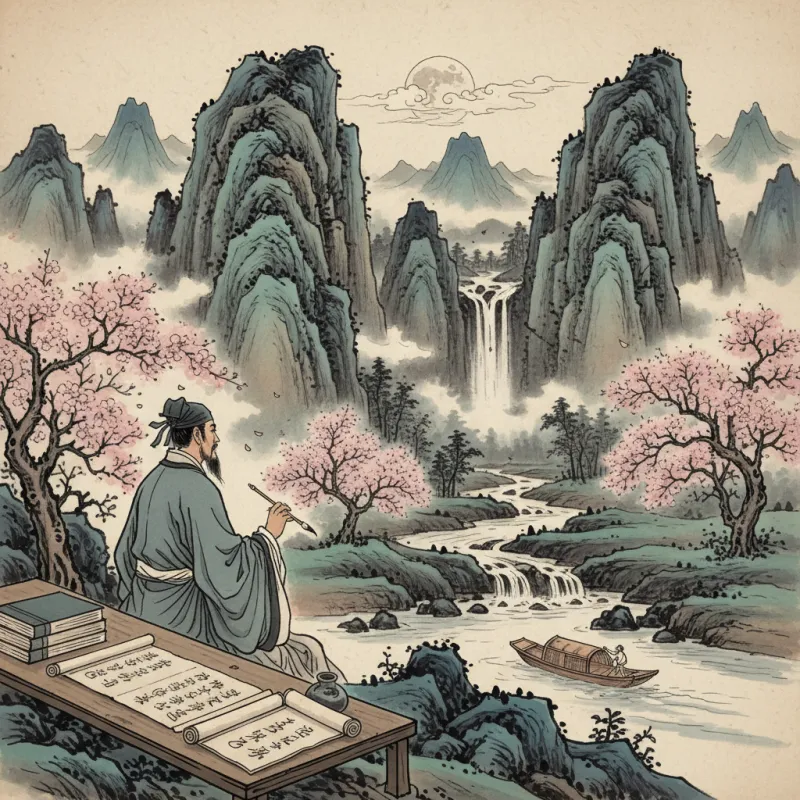
You open a Tang dynasty poem in translation and read: "The moon shines on the river." Beautiful, yes. But you've just missed the percussion of four tones rising and falling like a drumbeat, the visual symmetry of characters stacked in perfect balance, and a literary reference that every educated reader in 750 CE would have caught instantly. You're reading sheet music without hearing the orchestra.
This isn't about learning Chinese. It's about learning what to listen for when the music has been translated into prose.
The Tonal Architecture You Cannot Hear
Chinese is a tonal language, which means the pitch contour of each syllable carries meaning. Say "ma" with a flat tone and you get "mother." Say it with a rising tone and you get "hemp." Classical Chinese poetry weaponizes this feature.
In regulated verse (律詩, lǜshī), the dominant form of Tang poetry, tones must follow strict patterns. Level tones (平聲, píngshēng) and oblique tones (仄聲, zèshēng) alternate in prescribed sequences across each line and between couplets. The result is a sonic architecture that exists completely apart from semantic meaning.
When Du Fu writes a regulated verse, he's composing in two dimensions simultaneously: meaning and music. English translation can only capture one. You're reading the libretto without the score.
What to do? When you encounter a translated Tang poem, imagine that beneath the English words runs a percussion track you cannot hear. The poem's pacing, its pauses, its sense of completion or suspension — these often derive from tonal patterns that have vanished in translation. If a line feels abrupt or a couplet seems oddly balanced, you may be sensing the ghost of a tonal structure.
Parallelism: The Couplet as Mirror
The central unit of Chinese poetry is not the line but the couplet. And Chinese couplets do something English couplets rarely attempt: they create perfect structural parallelism.
In a parallel couplet (對句, duìjù), each word in the first line must match its counterpart in the second line by grammatical category and often by semantic field. Noun matches noun, verb matches verb, color matches color. The effect is like holding up a mirror that reflects not the image but the structure.
Li Bai writes:
床前明月光 (chuáng qián míng yuè guāng) 疑是地上霜 (yí shì dì shàng shuāng)
Word by word: "bed / before / bright / moon / light" parallels "doubt / is / ground / upon / frost." The structure is identical. The second line is the first line's grammatical twin.
English translation gives you: "Moonlight before my bed / I thought it was frost on the ground." The meaning survives. The architecture collapses.
This matters because parallelism is not decoration. It's a thinking tool. The parallel structure forces the poet to find unexpected connections, to see how "moonlight" and "frost" occupy the same grammatical and conceptual space. The form generates insight.
When reading translations, look for couplets that seem to echo each other's structure. Even when the parallelism is broken in English, you can often sense its presence in the way images are paired or contrasted. The translator is showing you where the mirror was, even if the reflection has blurred.
The Compression Problem
Classical Chinese is radically compressed. A five-character line contains five words, no articles, no tenses, no plurals, minimal grammar. The reader must supply the connective tissue.
Take Wang Wei's famous line: 空山不見人 (kōng shān bù jiàn rén). Character by character: "empty / mountain / not / see / person."
Is it "In the empty mountains I see no one" or "The empty mountains see no person" or "Empty mountains: no one is seen"? All are possible. The ambiguity is not a bug but a feature. The line shimmers between interpretations.
English translation must choose. It must add articles, specify tenses, clarify subjects. The translator writes "In the empty mountains I see no one" and the shimmer stops. One interpretation solidifies.
This is why reading multiple translations of the same poem is not redundant — it's essential. Each translation is a different path through the ambiguity. Compare three versions of a Du Fu poem and you're not seeing three opinions about what he meant. You're seeing three of the ten things he actually said simultaneously.
For a deeper dive into how classical Chinese works differently from English, see Understanding Classical Chinese Poetry Forms.
Allusion as Compression
Chinese poetry is allusive to a degree that makes T.S. Eliot look straightforward. A single character can invoke an entire story, a historical event, a philosophical concept, or another poem.
When Du Fu writes 江山 (jiāng shān, "rivers and mountains"), he's not just describing landscape. He's invoking the entire tradition of landscape poetry, the concept of natural beauty as moral instruction, and possibly the political instability of his time (since "rivers and mountains" is also a term for the state itself).
When Li Shangyin writes about the 錦瑟 (jǐn sè, "brocade zither"), he's referencing a specific instrument, yes, but also a constellation of associations: the legendary musician who played it, the philosophical debates about music and emotion, and at least three earlier poems that used the same image.
These allusions are not footnotes. They're load-bearing structures. Remove them and the poem doesn't just lose depth — it loses coherence.
Good translations include notes. Read them. Then read the poem again. Then read the notes again. The poem is designed to be read with its allusive network activated. Without it, you're seeing the nodes but not the web.
Visual Meaning: The Character as Image
Chinese characters are not phonetic symbols. They're compressed images with etymological histories. Many retain visual elements of what they represent.
The character 山 (shān, "mountain") looks like three peaks. The character 水 (shuǐ, "water") shows flowing streams. When these appear in a poem, they carry both semantic meaning and visual presence.
This matters most in calligraphy, where the physical act of writing becomes part of the poem's meaning. A character for "mountain" written with bold, angular strokes creates a different mountain than one written with soft, flowing strokes. The poem exists not just as sound and meaning but as visual art.
You cannot access this dimension in translation. But you can know it's there. When you read a translated Chinese poem, imagine that each word also has a visual presence, a physical shape that contributes to meaning. The poem is not just heard and understood — it's seen.
What Translation Can Preserve
This is not an argument against translation. It's an argument for reading translations with awareness of what they cannot do.
The best translators are honest about their losses. They choose which dimension to prioritize — tonal music, parallelism, compression, allusion, or visual presence — and sacrifice the others. Reading multiple translations shows you which dimensions each translator chose to save.
Some things do survive translation: imagery, emotional arc, the progression of thought, the relationship between human and natural worlds. These are not small things. They're why we read poetry at all.
When Wang Wei writes about mountains and rivers, the specific tonal pattern may be lost, but the sense of vast emptiness, of human consciousness dissolving into landscape, comes through. When Li Bai writes about drinking alone with the moon, the parallelism may collapse, but the loneliness and defiance survive.
The question is not whether to read Chinese poetry in translation. The question is how to read it with full awareness of what you're getting and what you're missing.
Reading With Informed Imagination
Here's a practical approach: Read the translation first for pleasure. Then read it again, slowly, imagining the tonal music beneath the words, the parallel structures in the couplets, the multiple meanings compressed into each line, the allusions radiating outward, the visual presence of characters you cannot see.
You won't reconstruct the original. But you'll read the translation as a translation — as one possible path through a multidimensional original. You'll develop what might be called informed imagination: the ability to sense the presence of what's absent.
Read the translator's notes. Read multiple translations. Read about the poet's life and historical context. Read about the major forms of Tang poetry and the philosophical traditions that shaped them. Each piece of context adds a dimension to your reading.
The goal is not to become a scholar. The goal is to read with your eyes open, to know that when you encounter a translated Chinese poem, you're seeing a shadow of a multidimensional object. The shadow is real and beautiful. But it's not the whole thing.
And sometimes, knowing what you cannot see makes what you can see more vivid.
Related Reading
- Lost in Translation: Famous Challenges in Translating Chinese Poetry
- How to Actually Read Classical Chinese Poetry: A Practical Guide
- Tonal Patterns Explained: The Music Inside Chinese Poetry
- How to Read Chinese Poetry: A Guide for English Speakers
- Discovering the Rich Legacy of Tang, Song, and Yuan Poetry
- Zen Poetry: Enlightenment in Seventeen Syllables
- The Banana Garden Poetry Club: When Women Took Over Chinese Poetry
Explore Chinese Culture
- Explore the Tang dynasty's golden age
- Explore Daoist themes in classical poetry
- Explore Chinese literary traditions