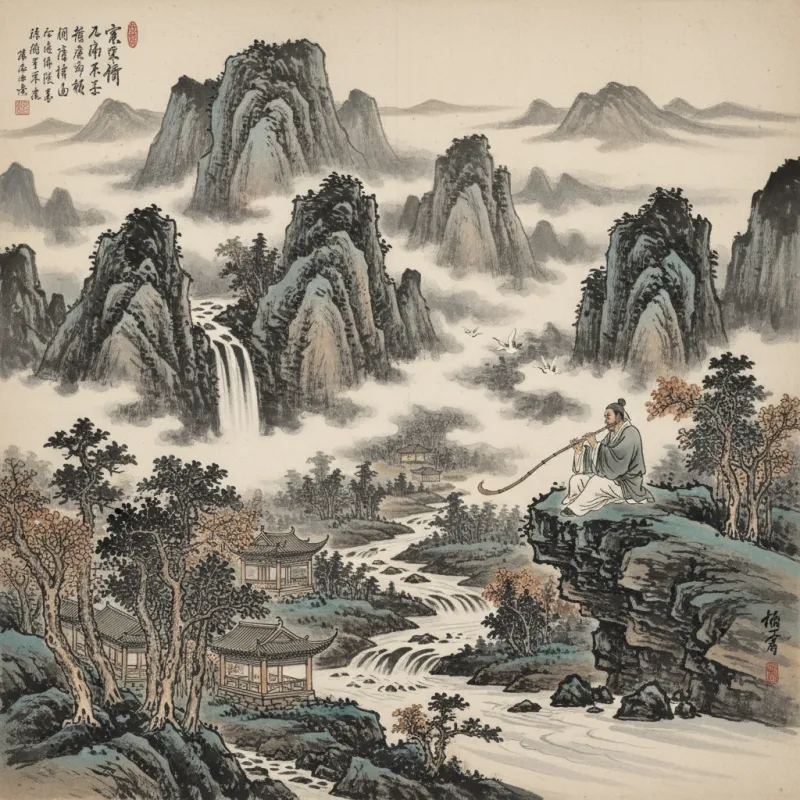
Picture a Han dynasty court poet standing before the emperor, about to recite a composition so elaborate it would take an hour to perform—a verbal tapestry weaving together mythology, natural philosophy, imperial grandeur, and moral instruction, all while displaying every rhetorical flourish in the Chinese literary arsenal. This was the fu (賦, fù), and calling it merely a "poem" would be like calling the Forbidden City merely a "house."
What Makes Fu Different from Everything Else
The fu occupies a peculiar space in Chinese literature—it's not quite poetry, not quite prose, but something magnificently in between. Unlike the compressed intensity of regulated verse or the lyrical intimacy of ci poetry, the fu revels in expansiveness. It's the literary equivalent of a grand imperial procession: elaborate, ceremonial, and designed to overwhelm through sheer accumulation of detail.
The form typically opens with a prose introduction setting the scene, then launches into extended passages of rhymed, rhythmic description. These descriptive sections pile image upon image, metaphor upon metaphor, creating what scholars call "enumerative" or "cataloging" poetry. A fu about a palace might list every type of wood in its beams, every precious stone in its floors, every exotic bird in its gardens—not because the reader needs this information, but because the abundance itself becomes the point.
What distinguishes fu from the more familiar shi (詩, shī) poetry is its relationship to music and performance. While shi poems were often sung, fu pieces were chanted or recited in a semi-musical manner called song (誦, sòng). The rhythm comes not from strict tonal patterns but from parallel constructions, balanced phrases, and strategic placement of rhymes—usually at the end of every other line or every few lines, depending on the period and author.
The Han Dynasty Golden Age
The fu reached its apex during the Western Han dynasty (206 BCE–9 CE), when it became the preferred literary form of the imperial court. The greatest practitioner was Sima Xiangru (司馬相如, Sīmǎ Xiāngrú, 179–117 BCE), whose compositions were so admired that Emperor Wu personally summoned him to court after reading his "Rhapsody on Master Vacuous" (Zixu Fu 子虛賦).
Sima Xiangru's masterpiece, "Rhapsody on the Imperial Park" (Shanglin Fu 上林賦), exemplifies everything audacious about the form. Spanning over a thousand characters, it describes the emperor's hunting preserve in such exhaustive detail that modern readers might find it tedious—but that's missing the point. The poem catalogs hundreds of plants, animals, geographical features, and architectural wonders, each named with precise terminology. The effect is less like reading a nature poem and more like experiencing a verbal theme park, where the guide insists on pointing out every single attraction.
But here's what makes Sima Xiangru brilliant: buried within all this descriptive excess is a subtle moral argument. The fu concludes by suggesting that such imperial extravagance, while impressive, should be tempered with concern for the people's welfare. This became a defining characteristic of Han fu—the ability to praise and critique simultaneously, to dazzle with description while smuggling in Confucian remonstrance.
Other Han masters included Yang Xiong (揚雄, Yáng Xióng, 53 BCE–18 CE), who grew disillusioned with the form's ornamental excess and advocated for more philosophical substance, and Ban Gu (班固, Bān Gù, 32–92 CE), whose "Rhapsody on the Two Capitals" (Liang Du Fu 兩都賦) compared the former Han capital Chang'an with the new capital Luoyang in a tour de force of historical and geographical learning.
The Structural Architecture
A typical Han fu follows a recognizable pattern, though individual works vary considerably. The standard structure includes:
The prose preface (xu 序) establishes the occasion and introduces the speakers—often fictional characters representing different viewpoints. Many fu are structured as dialogues or debates, with one character praising something extravagantly and another offering a more measured perspective.
The main body consists of extended descriptive passages in rhymed, rhythmic language. These sections employ pianwen (駢文, piánwén) or "parallel prose" techniques, where phrases are balanced against each other in elaborate syntactic patterns. You might see constructions like "In the east, jade mountains rise; in the west, golden rivers flow"—the grammatical structure mirrored perfectly across the caesura.
The conclusion typically shifts back to prose or adopts a more reflective tone, often introducing a moral or philosophical lesson. This is where the poet, having spent thousands of characters describing imperial splendor or natural beauty, suddenly reminds everyone about frugality, virtue, or cosmic harmony.
Beyond the Han: Evolution and Transformation
After the Han dynasty collapsed, the fu evolved in fascinating directions. During the Six Dynasties period (220–589 CE), poets began writing shorter, more lyrical fu pieces focused on personal emotion rather than cosmic grandeur. These "small fu" (xiao fu 小賦) or "lyrical fu" (shuqing fu 抒情賦) abandoned the encyclopedic ambitions of their Han predecessors in favor of intimate subjects: a woman's sorrow, autumn melancholy, the beauty of a particular flower.
Tao Yuanming (陶淵明, Táo Yuānmíng, 365–427), better known for his reclusive poetry, wrote "Rhapsody on Returning Home" (Gui Qu Lai Xi Ci 歸去來兮辭), which describes his decision to abandon official life for rural retirement. It's personal, direct, and emotionally transparent in ways that would have seemed bizarre to Han court poets.
The Tang dynasty (618–907) saw fu composition become a required skill for the civil service examinations, which paradoxically both preserved and ossified the form. Candidates had to demonstrate mastery of fu techniques, but the examination format encouraged formulaic compositions rather than genuine creativity. Still, major Tang poets like Wang Bo (王勃, Wáng Bó, 650–676) and Yang Jiong (楊炯, Yáng Jiǒng, 650–692) produced memorable fu works, often on assigned topics.
Why Fu Matters (and Why It Faded)
The fu represents something essential about traditional Chinese aesthetics: the belief that abundance, elaboration, and comprehensive enumeration could themselves be forms of beauty. Where Western classical rhetoric often prizes concision—Horace's advice to get to the point quickly—Chinese fu poets believed that dwelling on details, multiplying examples, and exhausting a subject demonstrated both learning and artistic control.
This aesthetic connects to broader Chinese philosophical concepts. The impulse to catalog everything in the emperor's park reflects a Confucian desire for complete knowledge and proper categorization. The parallel structures mirror cosmological beliefs about balance and correspondence. Even the moral conclusions align with the Confucian scholar's duty to remonstrate with power while serving it.
Yet the form's very strengths became its weaknesses. By the Song dynasty (960–1279), when ci lyrics and more personal forms of expression dominated literary culture, the fu seemed antiquated—too formal, too impersonal, too concerned with displaying erudition rather than expressing genuine feeling. The great Song poet Su Shi (蘇軾, Sū Shì, 1037–1101) wrote brilliant fu pieces like "Rhapsody on the Red Cliff" (Chibi Fu 赤壁賦), but even he was transforming the form, infusing it with personal reflection and philosophical depth that earlier practitioners would have found strange.
Reading Fu Today
Modern readers approaching fu for the first time often struggle with the form's conventions. The endless catalogs can feel tedious, the parallel constructions repetitive, the moral conclusions tacked-on. But try shifting your expectations. Don't read a fu the way you'd read a Tang shi poem—looking for compressed imagery and emotional punch. Instead, let yourself be carried along by the accumulation, the rhythm of the lists, the pleasure of linguistic display.
Think of it like experiencing baroque architecture or listening to a Mahler symphony—the point isn't minimalist elegance but maximal elaboration, where excess itself becomes a kind of meaning. The Han poets who perfected the fu weren't trying to move you to tears or capture a fleeting moment. They were constructing verbal palaces, demonstrating that language could encompass entire worlds, that a skilled writer could name everything under heaven and arrange it all into patterns of sound and sense.
The fu may no longer be a living form—no contemporary Chinese poet writes traditional fu pieces with any expectation of reaching a general audience—but its influence persists. The descriptive techniques, the parallel structures, the interweaving of prose and verse: these elements filtered into later Chinese literature, shaping everything from classical fiction to modern prose poetry. Understanding the fu means understanding something fundamental about how Chinese literary culture conceived of language's possibilities—not as a tool for confession or compression, but as a medium for comprehensive, elaborate, magnificent display.
Related Reading
- Poetic Forms: The Rules That Made Chinese Poetry Great
- Ci Poetry: When Poems Were Songs
- Jueju: The Art of the Four-Line Poem
- Poetic Forms in Chinese Literature: The Rules That Set Poetry Free
- Modern Chinese Poetry: From Classical Forms to Free Verse
- Friendship and Farewell: Poems of Parting
- Rediscovering Women Poets of the Tang, Song, and Yuan Dynasties
- Unveiling the Essence of Chinese Classical Poetry: Insights from Tang, Song, and Yuan Poets
Explore Chinese Culture
- Explore the Tang dynasty's golden age
- Explore Daoist themes in classical poetry
- Explore Chinese literary traditions