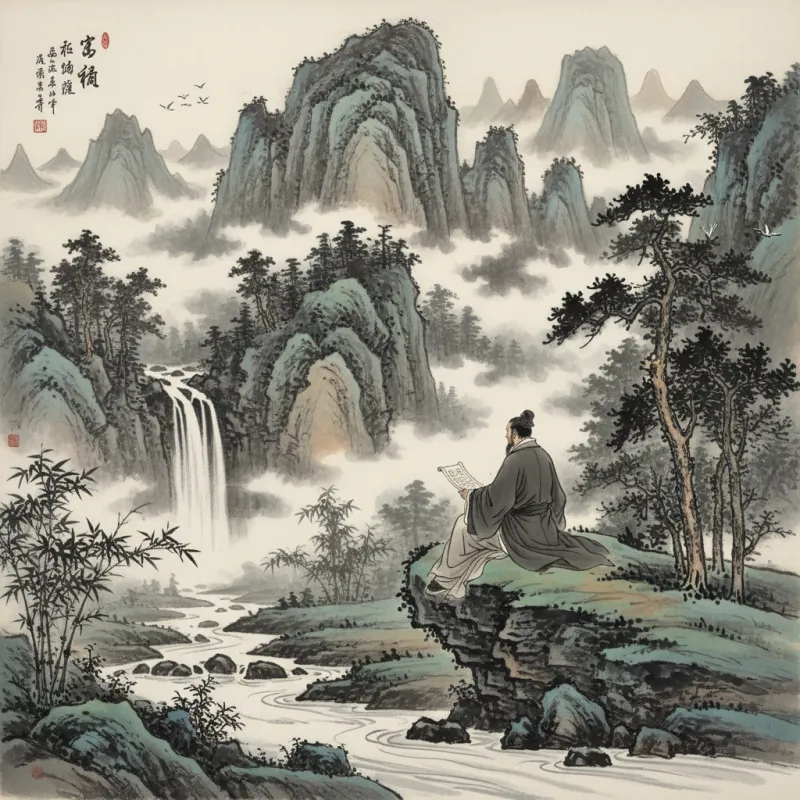
When Ezra Pound translated Li Bai's poems in 1915, he worked from Ernest Fenollosa's notes—and Fenollosa didn't read Chinese. The resulting collection, Cathay, is considered one of the masterpieces of English poetry. This paradox sits at the heart of Chinese poetry translation: sometimes the "best" translations come from those who take the greatest liberties, while the most accurate versions can feel lifeless on the page.
The Bed That Launched a Thousand Debates
Every Chinese schoolchild can recite Li Bai's "Quiet Night Thought" (静夜思, Jìng Yè Sī):
床前明月光
疑是地上霜
举头望明月
低头思故乡
The standard translation reads: "Before my bed, the bright moonlight / I think it's frost upon the ground / I raise my head to gaze at the bright moon / I lower my head and think of home."
But here's where it gets interesting: what exactly is 床 (chuáng)? Modern Chinese dictionaries define it as "bed," but Tang Dynasty usage suggests it could mean a well curb, a sitting platform, or even a portable stool. If Li Bai is lying in bed staring at moonlight on his floor, we have a poem about insomnia and melancholy. If he's sitting outside on a bench under the actual moon, we have a meditation on distance and longing. The entire emotional architecture shifts.
Scholar Kang-i Sun Chang argues for the outdoor reading, noting that Tang poets rarely wrote about indoor scenes—they were obsessed with nature. But translator David Hinton keeps "bed" because English readers need that intimate, vulnerable image. Who's right? Both. Neither. This is the translator's impossible position.
When One Character Contains Multitudes
Chinese poetry's compression creates translation nightmares. Take Du Fu's line: 感时花溅泪 (gǎn shí huā jiàn lèi). Word by word: "feel/time/flower/splash/tears." But which way does the emotion flow?
- "Moved by the times, flowers make me weep"
- "Feeling the moment, I splash tears on flowers"
- "Sensitive to the season, even flowers seem to weep"
All three readings exist simultaneously in the original. The Chinese language's lack of grammatical markers—no articles, no verb tenses, ambiguous subjects—means the poem shimmers with possibility. English demands we choose. We must murder the ambiguity to make the translation live.
This connects to the broader challenge of understanding classical Chinese poetic forms, where structural constraints create layers of meaning that resist direct translation.
The Tonal Dimension We Can Never Hear
Here's what gets lost immediately: sound. Chinese is a tonal language, and classical poetry exploits this ruthlessly. When Wang Wei writes 空山不见人 (kōng shān bù jiàn rén), the tones create a musical pattern—level, level, falling, falling-rising, level—that reinforces the emptiness he's describing. The sound is part of the meaning.
English translators can try to capture rhythm and rhyme, but we're working in a completely different sonic universe. Arthur Waley chose to abandon rhyme entirely, arguing that forced rhymes in English create a singsong effect that trivializes the original. But traditional Chinese poetry without rhyme? That's like translating a sonnet into free verse—technically possible, but something essential evaporates.
The Cultural Context Problem
When Li Shangyin writes about the 锦瑟 (jǐn sè, "brocade zither"), he's invoking a whole constellation of associations: the instrument's fifty strings, the legend of the goddess who played it, the sound of longing and lost love. English readers see "zither" and think of Julie Andrews in The Sound of Music. The cultural resonance simply doesn't transfer.
Translators face a choice: add explanatory notes (which kill the poem's flow) or let the reference pass unexplained (which kills the meaning). Some, like Red Pine, include extensive annotations. Others, like Kenneth Rexroth, rewrite the cultural references entirely, substituting Western equivalents. Rexroth once turned a Chinese moon-viewing party into something resembling a California wine tasting. Purists were horrified. Readers loved it.
The Grammar of Absence
Classical Chinese poetry thrives on what's not said. The language allows—even encourages—dropping subjects, objects, and connective words. A line like 月落乌啼霜满天 (yuè luò wū tí shuāng mǎn tiān) literally reads: "moon/fall/crow/cry/frost/fill/sky." No verbs in the English sense, no clear relationships between images.
Zhang Ji's "Night Mooring at Maple Bridge" uses this technique brilliantly. English translations must add words—"the moon sets," "crows are crying," "frost fills"—but each addition is an interpretation. We're not translating; we're reconstructing, like archaeologists building a complete vase from three shards.
Burton Watson, one of the great translators of Chinese poetry, admitted he sometimes spent weeks on a single four-line poem. Not because he couldn't understand the Chinese, but because he was trying to preserve what he called "the poem's breathing space"—that quality of suggestiveness that makes classical Chinese poetry feel so alive.
When Mistranslation Creates Masterpieces
Pound's Cathay is full of "errors." He didn't know that 長安 (Cháng'ān) was the capital city, so he translated it as "long peace." He misread characters, missed allusions, and invented meanings. Yet his "The River-Merchant's Wife: A Letter" (based on Li Bai's 長干行, Cháng Gān Xíng) is so emotionally true that Chinese scholars reading it back-translated into Chinese have wept.
This raises an uncomfortable question: what is translation for? If the goal is scholarly accuracy, Pound fails. If the goal is creating English poems that capture the spirit and emotional power of the originals, he succeeds brilliantly. As translator Eliot Weinberger puts it, "A translation is not a pony; it's a poem."
The Impossible Made Possible
The truth is that Chinese poetry in translation is always a ghost of itself—but sometimes ghosts can be more powerful than the living. When we read Tang Dynasty poets like Li Bai and Du Fu, we're not reading their poems; we're reading new poems inspired by theirs, filtered through centuries and languages and the particular genius of translators who devoted their lives to this impossible art.
The best translations don't try to be invisible. They acknowledge the gap, the loss, the necessary betrayal—and then they leap across the chasm anyway, creating something that honors the original by being unafraid to be different. As translator David Hawkes once said, "The translator must be prepared to be unfaithful in order to be true."
Every translation of Chinese poetry is an act of creative interpretation, a bridge built from one linguistic universe to another. The bridge is never perfect. But without it, we'd never cross at all.
Related Reading
- How to Read a Chinese Poem: A Practical Guide for English Speakers
- How to Read Chinese Poetry: A Guide for English Speakers
- How to Actually Read Classical Chinese Poetry: A Practical Guide
- Tonal Patterns Explained: The Music Inside Chinese Poetry
- Poetry as Philosophy: How Chinese Poets Think
- Delving into the Techniques of Chinese Classical Poetry: Insights from Tang, Song, and Yuan Poets
- Du Fu: The Conscience of Chinese Poetry
Explore Chinese Culture
- Explore the Tang dynasty's golden age
- Explore Daoist themes in classical poetry
- Explore Chinese literary traditions