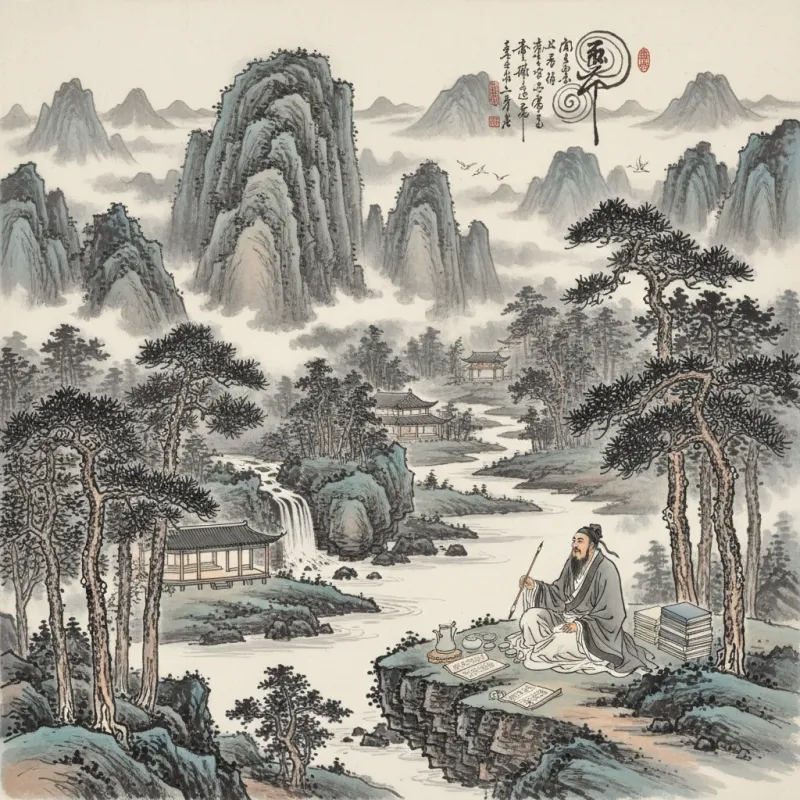
When Du Fu (杜甫) wrote "A single thread of green water divides the white sand / One thatched hut faces the yellow leaves," he wasn't being decorative. He was making an argument about the structure of reality itself — that meaning emerges not from abstract principles but from the precise relationship between things. The green against white, the singular dwelling against multiplicity, the human shelter facing (not turning away from) decay. This is philosophy, but it thinks differently than Aristotle or Kant. It thinks in images that refuse to be translated into propositions.
The Poem as Argument
Western philosophy since Plato has been suspicious of poetry's ambiguity, its emotional appeals, its resistance to logical verification. Chinese intellectual culture made the opposite bet: that certain truths about existence can only be approached through the compressed, multi-layered language of poetry. When Wang Wei (王維) writes "Empty mountains, no one in sight / Yet human voices echo / Returning light enters deep forest / Again shining on green moss," he's not describing a scene. He's demonstrating the Buddhist concept of emptiness (空 kōng) — how absence and presence interpenetrate, how consciousness persists even when the body is gone, how light (awareness) penetrates darkness (ignorance) and illuminates what was already there.
The poem does philosophical work that a treatise cannot. It forces you to hold contradictions simultaneously: the mountains are empty yet full of voices, the forest is dark yet illuminated, the moss is passive yet actively receiving light. Try to resolve these contradictions logically and you miss the point. Sit with them, let them work on your consciousness, and you begin to understand emptiness not as a concept but as a lived experience.
This is why Chinese literati spent decades memorizing poems rather than philosophical texts. The poems weren't examples of ideas — they were technologies for transforming consciousness. Reading Li Bai's (李白) "Drinking Alone Under the Moon" wasn't like reading Descartes on the self. It was more like doing a meditation practice that gradually revealed something about the nature of solitude, companionship, and the boundaries of the self.
Thinking in Correspondences
Chinese poetry operates through a system of correspondences that Western philosophy would call "mere association" but which Chinese thought recognizes as a fundamental structure of reality. When Du Mu (杜牧) writes "The merchant's wife knows not the sorrow of a fallen kingdom / Across the river she still sings 'Flowers of the Rear Court,'" he's not making a simple political point. He's demonstrating how ignorance, pleasure, historical catastrophe, and aesthetic beauty exist in a web of mutual implication.
The poem thinks through juxtaposition rather than logical progression. The merchant's wife and the fallen kingdom, the river as both separation and connection, the song that was once court entertainment now sung in a commercial context — these elements don't add up to a thesis. They create a field of meaning where the reader must actively construct understanding. This is closer to how Daoism (道家 Dàojiā) understands reality: not as a chain of causes and effects but as a pattern of resonances and correspondences.
Consider how different this is from Western philosophical method. Kant builds arguments step by step, each premise supporting the next, until he arrives at a conclusion. Wang Wei places images next to each other and lets them speak. Both are rigorous, but they're rigorous in different ways. The poem's rigor lies in its precision of observation and its refusal of false clarity. It won't pretend that the relationship between human consciousness and the natural world can be captured in a syllogism.
The Landscape as Mind
When Chinese poets write about mountains and rivers (山水 shānshuǐ), they're not writing nature poetry in the Western sense. They're exploring the topology of consciousness itself. The mountain is not a symbol of permanence — it IS permanence, and simultaneously it's the mind contemplating permanence, and simultaneously it's the dissolution of the boundary between observer and observed.
Xie Lingyun (謝靈運), the great landscape poet of the fifth century, would spend days hiking to reach a particular vista, then write a poem that seems to simply describe what he saw. But read carefully: "Cliffs rise sheer, no path through / Streams wind deep into valleys / Clouds and mist gather and disperse / Monkeys cry, birds call back." The landscape is doing something — rising, winding, gathering, dispersing, calling. It has agency. And the poet's consciousness is not separate from this activity. The poem enacts the interpenetration of mind and world that Buddhism calls "non-duality" (不二 bù'èr).
This is why Chinese poetry resists the Western distinction between subjective and objective. When Li Shangyin (李商隱) writes "The evening rain on the river makes autumn / The cold lamp in the study illuminates solitude," is he describing external weather or internal mood? Both, neither, something that exists in the space between. The poem is thinking about how consciousness and world co-arise, how there is no "pure" observation untouched by feeling, no "pure" emotion unconnected to circumstance. This is phenomenology centuries before Husserl, but arrived at through poetic practice rather than philosophical method.
Time, Memory, and the Instant
Chinese poetry's treatment of time offers another example of how poems think philosophically. Western philosophy tends to analyze time as a sequence — past, present, future as distinct modes of being. Chinese poetry collapses these distinctions. When Li Qingzhao (李清照) writes "Last night the rain was sparse, the wind sudden / Deep sleep did not dispel the lingering wine / I ask the one rolling up the curtain / But she says the crabapple is just the same / Don't you know, don't you know / It should be green fat, red thin," she's not narrating events in sequence. She's creating a temporal knot where past (last night), present (the question), and future (the changed blossoms) exist simultaneously in consciousness.
The poem thinks about how memory works — not as retrieval of stored information but as a present experience colored by absence and change. The crabapple blossoms are "just the same" to the servant but transformed to the speaker who knows what they were and anticipates what they will become. "Green fat, red thin" (綠肥紅瘦 lǜféi hóngshòu) is one of the most celebrated phrases in Chinese poetry precisely because it compresses an entire philosophy of time into four characters: the green leaves fattening as the red blossoms thin, growth and decay as simultaneous processes, beauty existing in transition rather than stasis.
This connects to the broader Chinese philosophical concept of process over substance, becoming over being. Where Western metaphysics asks "what is a thing?", Chinese thought asks "how does a thing transform?" The poem is the perfect medium for this kind of thinking because it can show transformation happening, can make you feel the movement from red to green, from wine-drunkenness to morning clarity, from ignorance to recognition.
The Social Self in Poetic Form
Chinese poetry also does ethical and political philosophy, but again, not through argument. When Du Fu writes his famous lines about the An Lushan Rebellion — "The nation shattered, mountains and rivers remain / City in spring, grass and trees grow deep" — he's making a claim about what endures and what doesn't, about the relationship between human institutions and natural processes, about where to locate value in a time of catastrophe. The poem doesn't argue for a position. It places you inside an experience where certain truths become self-evident.
The regulated verse forms (律詩 lǜshī) that dominated Tang and Song poetry are themselves philosophical technologies. The strict tonal patterns, the required parallelism, the limitation to eight lines — these constraints force a particular kind of thinking. You can't be verbose or vague. Every character must carry maximum weight. The parallelism in the middle couplets creates a structure of comparison and contrast that mirrors how Chinese philosophy thinks about complementary opposites (陰陽 yīnyáng). The form itself is an argument about how meaning is made: through balance, through resonance, through the productive tension between constraint and expression.
This is why the relationship between form and freedom in Chinese poetry is itself a philosophical question. The poet submits to rigid formal requirements but finds liberation within them. This enacts the Confucian ideal of finding freedom through ritual (禮 lǐ), or the Daoist paradox that yielding is a form of strength. The poem doesn't describe these ideas — it performs them, makes you experience them in the act of reading.
Why This Matters Now
In an age of academic philosophy that often prizes technical precision over wisdom, Chinese poetry offers an alternative model of what philosophical thinking can be. It suggests that some truths about existence are better approached through image than argument, through juxtaposition than logic, through the transformation of consciousness than the construction of theories.
This doesn't mean Chinese poetry is "mystical" or "intuitive" in contrast to "rational" Western philosophy. That's a false dichotomy that does justice to neither tradition. Chinese poetry is rigorous, precise, and intellectually demanding. It just demands different things: attention to nuance, tolerance for ambiguity, willingness to let meaning emerge rather than forcing it into predetermined categories.
When you read Wang Wei's "Deer Park" — "Empty mountain, no one seen / Only hearing human voices echo / Returning light enters deep forest / Again shining on green moss" — you're not reading a description of a scene. You're being invited into a way of thinking about presence and absence, sound and silence, light and darkness that can't be reduced to propositions but which is no less philosophical for that. The poem is thinking, and if you read it properly, it teaches you to think differently too.
This is the gift of Chinese poetry to world philosophy: the demonstration that thinking can happen in forms other than the treatise, that wisdom can be transmitted through beauty, that the most profound insights about existence might come not from arguments but from the precise placement of images in relation to each other. In a world that increasingly values only what can be measured and proven, this is a reminder that some truths require poetry to be understood at all.
Related Reading
- Daoist Poetry: Finding the Way Through Nature
- Confucian Values in Classical Chinese Poetry: Duty, Loyalty, and the Weight of the World
- The Timeless Elegance of Chinese Classical Poetry: Tang, Song, and Yuan Eras
- Zen Poetry: Enlightenment in Seventeen Syllables
- Daoist Poetry: The Art of Doing Nothing
- Rediscovering Women Poets of the Tang, Song, and Yuan Dynasties
- Why Some Chinese Poems Are Untranslatable: The Beauty That Gets Lost
- Exploring Chinese Classical Poetry: Tang, Song, and Yuan Poets’ Literary Legacy
Explore Chinese Culture
- Explore the Tang dynasty's golden age
- Explore Daoist themes in classical poetry
- Explore Chinese literary traditions