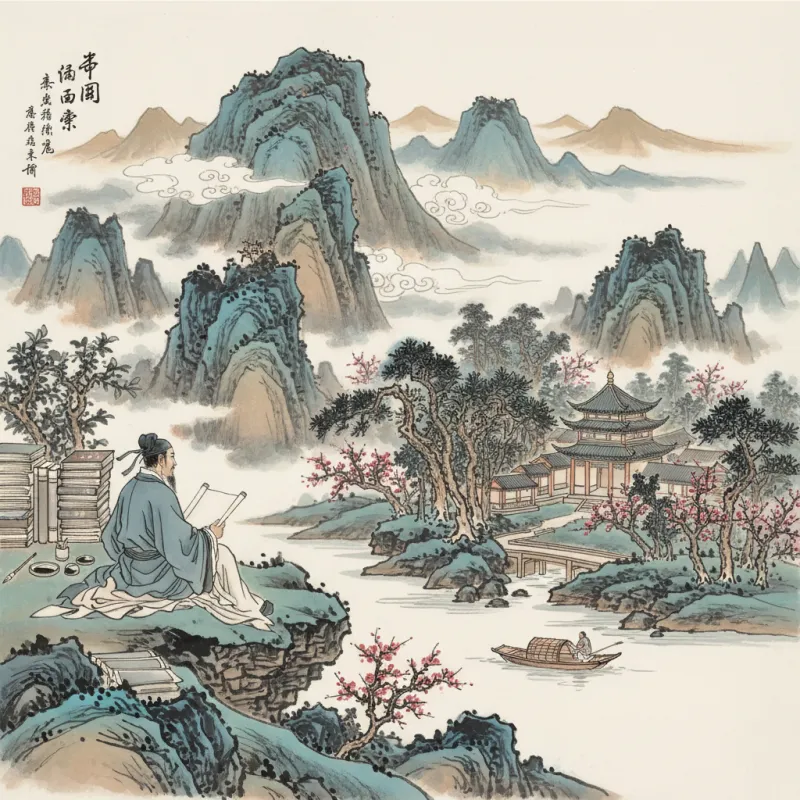
You're staring at a Tang dynasty poem. Eight lines. Forty characters total. You recognize maybe three of them. Your eyes glaze over. You close the book.
This is where most people give up on classical Chinese poetry — even native speakers. The language feels like a locked door. But here's what nobody tells you: you don't need to translate every character to understand the poem. You need to see the architecture first, then fill in the details.
Start With Structure, Not Vocabulary
Classical Chinese poetry works like a building. Before you worry about the paint color, you need to see the frame. There are two main forms, and they're more rigid than anything in Western poetry:
Regulated verse (律诗, lǜshī) has eight lines. Each line has either five or seven characters — no variation, no exceptions. The middle four lines (lines 3-4 and 5-6) must form two parallel couplets. This isn't loose parallelism like "I wandered lonely as a cloud / That floats on high o'er vales and hills." This is grammatical mirroring down to the part of speech. If line 3 starts with a noun, line 4 starts with a noun in the same position. If line 5 has a verb in position three, line 6 has a verb in position three.
Quatrain (绝句, juéjù) is exactly half that: four lines, same character count per line. Think of it as a regulated verse with the middle cut out. Many quatrains are actually the first or last four lines of a longer poem that the poet decided worked better alone.
Why does this matter? Because once you know the form, you know where to look. The first couplet introduces the scene. The middle couplets develop it through parallel images. The final couplet pivots — often to emotion, philosophy, or a wider perspective. This pattern is so consistent that you can guess the emotional arc before you understand a single character.
Read the Parallelism First
Here's the secret that unlocks most Tang and Song poetry: the parallel couplets are doing half the translation work for you. When Du Fu (杜甫) writes two lines that mirror each other grammatically, he's essentially defining his terms through juxtaposition.
Take this couplet from Wang Wei's (王维) "Deer Park" (鹿柴, Lùzhài):
空山不见人 (kōng shān bù jiàn rén)
但闻人语响 (dàn wén rén yǔ xiǎng)
Even if you only know 山 (mountain) and 人 (person), the parallel structure tells you something. Both lines have the same rhythm. Both mention people. The first line has 不见 (not see), the second has 但闻 (only hear). The parallelism creates a contrast: empty mountain, no people visible, but voices echo. You've understood the core image without translating every character.
This is why understanding tonal patterns matters less than you think at first. Yes, regulated verse has strict tonal rules — alternating level and oblique tones in specific positions. But those rules exist to create musicality, not meaning. Focus on the parallel grammar first. The tones are the advanced class.
Look for the Pivot
Every classical Chinese poem has a turn — a moment where the perspective shifts. In regulated verse, it's almost always in the final couplet. In quatrains, it's usually the last line.
Li Bai (李白) is the master of the dramatic pivot. His poems often spend three-quarters of their length building a scene, then hit you with a final image that recontextualizes everything. In "Quiet Night Thought" (静夜思, Jìng Yè Sī), he describes moonlight on the floor, looking up at the moon, looking down again — then the last line reveals he's thinking of home. The entire poem was about homesickness, but he never said it until the end.
This structure comes from regulated verse conventions that poets internalized so deeply they used it even in freer forms. Once you expect the pivot, you start reading differently. You're not just processing images — you're waiting for the emotional punch.
Stop Trying to Translate Everything
Here's what trips up most readers: they think they need to know every character to understand the poem. But classical Chinese poetry is compressed to the point of ambiguity on purpose. A single character can be a noun, verb, or adjective depending on context. Subjects and objects are often omitted. Tense doesn't exist.
This isn't a bug. It's the aesthetic. The ambiguity creates space for multiple readings. When Du Fu writes 星垂平野阔 (xīng chuí píng yě kuò) — literally something like "stars hang plain wild broad" — you're not supposed to parse it into perfect English. You're supposed to see stars hanging low over a vast plain. The grammar is deliberately loose to let the image breathe.
Focus on the concrete nouns first: mountain, river, moon, wine, horse, tower. Then the verbs: see, hear, return, leave, sit, stand. Classical Chinese poetry is built from a surprisingly small vocabulary of natural images and basic actions. Once you recognize these building blocks, the poems start to make sense even when you can't translate every particle.
Use Commentaries, But Skeptically
Every major classical Chinese poem has centuries of commentary attached to it. Scholars have argued about what Du Fu meant in line six, whether Wang Wei was a Buddhist or a Daoist, whether Li Bai was drunk when he wrote this or that poem.
Read the commentaries. They'll tell you about historical context, literary allusions, biographical details. But don't let them replace your own reading. Classical Chinese poetry is short enough that you can hold the entire poem in your head at once. You can see patterns that commentators, focused on individual characters, might miss.
The best approach: read the poem first without help. Notice what images repeat. Notice where the parallel couplets align and where they diverge. Notice the pivot. Then read the commentary to catch allusions you missed — references to earlier poems, historical events, philosophical concepts. Then read the poem again with that context. It's a different poem now, but your first reading wasn't wrong. It was just incomplete.
Practice With Quatrains
If you're new to classical Chinese poetry, start with quatrains, not regulated verse. Four lines is manageable. You can memorize a quatrain in five minutes. You can write it out, look up every character, map the grammar, and still finish in an afternoon.
Wang Wei's quatrains are perfect for beginners. His language is simple, his images are clear, and his poems are short enough that the structure is obvious. "Deer Park" is twenty characters total. "Bird-Cry Brook" (鸟鸣涧, Niǎo Míng Jiàn) is twenty characters. You can read five Wang Wei quatrains in the time it takes to read one Du Fu regulated verse, and you'll learn more about how the form works.
Once quatrains feel comfortable, move to regulated verse. The extra length gives poets room to develop ideas, but the core structure is the same. You're just seeing it stretched out over eight lines instead of four.
The Real Difficulty Isn't Language
The hardest part of reading classical Chinese poetry isn't the archaic grammar or the compressed syntax. It's the cultural distance. These poems assume you know the major poets and their styles, the historical periods, the philosophical schools, the earlier poems being referenced. They assume you've read the Book of Songs (诗经, Shījīng) and the Songs of Chu (楚辞, Chǔcí). They assume you know what a willow branch means, why autumn is sad, what it means to fail the imperial examinations.
You can learn all this, but it takes time. The good news: you don't need it to start. You can appreciate the structure, the imagery, the emotional arc without knowing every allusion. Read the poems first. Let them be strange. Then slowly, as you read more, the cultural context fills in. You start to recognize recurring images. You notice when a poet is responding to an earlier poem. You see the conversation happening across centuries.
That's when classical Chinese poetry stops being intimidating and starts being addictive. You're not just reading poems anymore. You're reading a tradition.
Related Reading
- Lost in Translation: Famous Challenges in Translating Chinese Poetry
- How to Read Chinese Poetry: A Guide for English Speakers
- How to Read a Chinese Poem: A Practical Guide for English Speakers
- Poems of Separation: The Chinese Art of Saying Goodbye
- Ban Zhao: Scholar, Historian, Poet — The Woman Who Finished China's Greatest History
- Sun Tzu's Art of War: The Complete Guide for Modern Readers
Explore Chinese Culture
- Explore the Tang dynasty's golden age
- Explore Daoist themes in classical poetry
- Explore Chinese literary traditions