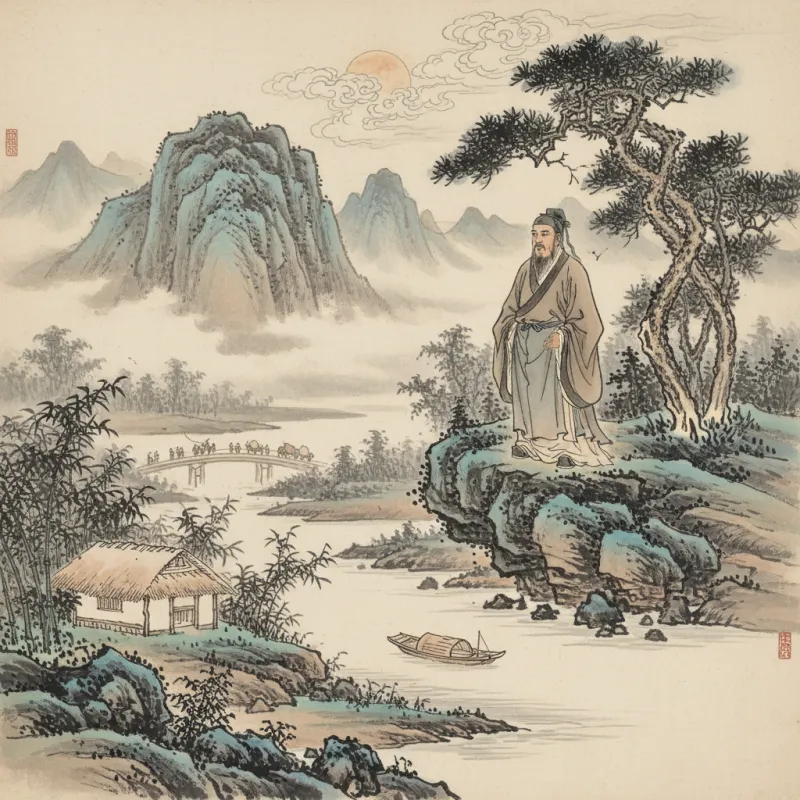
A fifty-eight-year-old man sits in a leaking boat on the Yangtze River, coughing blood into his sleeve. He's hungry, sick, and so poor he can't afford wine. His poems — hundreds of them, meticulously crafted — are scattered across China, copied by a few friends but largely ignored. Within months, he'll be dead. A thousand years later, he'll be called the greatest poet in Chinese history.
Du Fu (杜甫 Dù Fǔ, 712–770) is the poet nobody wanted to be. While his contemporary Li Bai drank with emperors and wrote poems that made you feel like you could fly, Du Fu wrote about watching his children starve. While other Tang poets celebrated the glory of empire, Du Fu documented its collapse. He failed the imperial examinations. He begged for minor government posts. He spent his final decade as a refugee, fleeing war and famine, writing poems that nobody read.
And yet. By the Song Dynasty (宋朝 Sòngcháo, 960–1279), the verdict was in: Du Fu was the "Sage of Poetry" (诗圣 shīshèng), the supreme master of Chinese verse. Not Li Bai with his cosmic charisma. Not Wang Wei with his Buddhist serenity. Du Fu — the poet of suffering, precision, and unflinching moral witness.
The Education of a Failure
Du Fu was born into a respectable family with literary credentials. His grandfather Du Shenyan had been a noted poet. Young Du Fu received a classical education, studied the Confucian texts, and fully expected to pass the imperial examinations and serve the Tang Dynasty (唐朝 Tángcháo, 618–907) with distinction.
He failed. Spectacularly. In 735, he took the jinshi (进士 jìnshì) examination — the gateway to government service — and didn't pass. He tried again. Failed again. He spent years in the capital, networking, writing poems to influential people, hoping for patronage. He got nowhere. By his thirties, he was married with children and had no income.
This failure shaped everything. Unlike the aristocratic poets who wrote from positions of comfort and power, Du Fu wrote from the bottom. He knew what it meant to be hungry, to watch your children go without food, to feel the empire's machinery grind you down. When he finally received a minor post in 755 — at age forty-three — it was too little, too late. The An Lushan Rebellion (安史之乱 Ān Shǐ zhī Luàn) erupted that same year, and the Tang Dynasty nearly collapsed.
War, Exile, and the Birth of Witness Poetry
The An Lushan Rebellion (755–763) was catastrophic. Estimates suggest that thirty-six million people died — roughly two-thirds of the empire's population, though these numbers are disputed. The capital Chang'an fell. The emperor fled. The entire social order disintegrated.
Du Fu was caught in the chaos. He was separated from his family, captured by rebels, imprisoned in the occupied capital. When he finally escaped and reunited with his wife and children, he found them starving. His youngest son had died of hunger. This is when Du Fu became Du Fu — not the ambitious young poet seeking fame, but the witness who would document what war actually does to ordinary people.
His poem "Spring View" (春望 Chūn Wàng), written while imprisoned in Chang'an, contains one of the most famous couplets in Chinese literature: "The nation is broken; mountains and rivers remain. / Spring comes to the city; grass and trees grow deep." The empire has collapsed, but nature continues. It's a devastating observation — not dramatic, not rhetorical, just true.
This is Du Fu's genius: radical precision. While other poets wrote about war in grand, abstract terms — honor, glory, sacrifice — Du Fu wrote about a specific old man being conscripted at night, about a wife's grief, about the exact texture of suffering. His "Three Officials" (三吏 Sān Lì) and "Three Partings" (三别 Sān Bié) poems are unbearable to read. They're also impossible to forget.
The Architecture of Regulated Verse
Du Fu didn't invent regulated verse (律诗 lǜshī), but he perfected it. These poems — typically eight lines, with strict tonal patterns, parallelism, and rhyme schemes — are the Mount Everest of Chinese poetry. They require absolute technical mastery while appearing effortless.
Consider the constraints: each line must have the same number of characters (usually five or seven). The tones must follow prescribed patterns. The middle two couplets must be perfectly parallel — matching grammatical structures, balancing images. And somehow, within these rigid rules, you must say something true and new.
Du Fu made it look easy. His regulated verse has a density that rewards endless rereading. Every character is precisely chosen. The parallelism isn't just decorative — it creates meaning through juxtaposition. In "Climbing the Heights" (登高 Dēng Gāo), written in his final years, he describes autumn wind, apes crying, birds circling, endless falling leaves. The images accumulate into an overwhelming sense of transience and exile. The technical perfection is invisible; you just feel the weight of a life ending far from home.
Later poets studied Du Fu's regulated verse the way painters study the old masters. The Song Dynasty poet Huang Tingjian said he read Du Fu's poems so many times he could taste them. That's not metaphor — Du Fu's language has a physical presence, a texture you can feel in your mouth when you read the poems aloud.
The Conscience That Nobody Wanted
Here's what makes Du Fu uncomfortable: he won't let you look away. When the empire is collapsing, he doesn't write about abstract principles. He writes about the old woman whose three sons were all conscripted and killed, who now offers herself to the army because there's nobody else left. He writes about his own shame at having a government salary while people starve. He writes about the emperor's palace, where "wine and meat go to waste behind vermilion gates, / while on the roads lie bones frozen to death."
This is why he's called the conscience of Chinese poetry. Not because he's moralistic or preachy — Du Fu rarely tells you what to think. He just shows you what he sees, with such precision and compassion that you can't ignore it. His empathy is radical. He writes about soldiers, farmers, his own family, refugees, even the horses and birds caught in human disasters.
Compare this to Li Bai, who wrote magnificent poems about freedom, transcendence, and wine-soaked immortality. Li Bai makes you want to be a poet. Du Fu makes you want to be a better person. Li Bai is the poet you read when you're young and everything seems possible. Du Fu is the poet you return to when life has broken you and you need someone who understands.
The Wandering Years
After the rebellion, Du Fu never found stability. He held a few minor posts, but his outspokenness and refusal to flatter the powerful kept him from advancement. In 759, he resigned from government service and moved his family to Chengdu (成都 Chéngdū) in Sichuan province, where a friend helped him build a small cottage.
The Chengdu years (759–765) were his most peaceful, and he wrote some of his most beautiful poems there. But even this refuge was temporary. Political instability forced him to leave. He spent his final years wandering the Yangtze River valley, moving from place to place, increasingly sick and poor.
He died in 770, probably from a combination of illness and malnutrition. The circumstances are unclear — some accounts say he died after eating too much meat and wine after a long period of starvation, his body unable to handle the sudden abundance. It's a cruelly appropriate end for a poet who spent his life writing about hunger and deprivation.
Why Du Fu Won
Du Fu's posthumous victory is one of the strangest reversals in literary history. During his lifetime, he was a minor figure. His poems were too serious, too technical, too focused on suffering. People preferred Li Bai's cosmic flights or Wang Wei's serene landscapes.
But tastes changed. The Song Dynasty literati, looking back at the Tang, recognized something in Du Fu that their own age valued: moral seriousness, technical mastery, and the courage to document reality without flinching. They elevated him to "Sage of Poetry" (诗圣 shīshèng), a title that placed him alongside Confucius himself.
Every subsequent dynasty confirmed this judgment. Du Fu became the model for serious poets — not because he was easy to imitate (he wasn't), but because he showed what poetry could do. It could bear witness. It could preserve the experiences of ordinary people. It could be both technically perfect and emotionally devastating.
Modern readers sometimes find Du Fu difficult. His poems require historical context. His regulated verse doesn't translate well — the tonal patterns and parallelism that make the Chinese so powerful become invisible in English. And his subject matter is often grim.
But once you enter Du Fu's world, you don't leave unchanged. He teaches you to see differently — to notice the specific weight of suffering, to understand that technical mastery and moral vision aren't opposed but necessary to each other. He shows you that poetry isn't escape from reality but a way of facing it more completely.
The Poet Nobody Wanted to Be
There's a reason poetry students study Du Fu but dream of being Li Bai. Du Fu's path was too hard. He failed, suffered, watched his children starve, died in poverty. His poems are monuments to pain, precisely observed and perfectly crafted. Who wants that life?
But here's what the centuries have decided: Du Fu's suffering wasn't wasted. Every humiliation, every failure, every moment of grief — he transformed it into art that has outlasted empires. His poems about the An Lushan Rebellion are now the primary way we understand what that catastrophe meant to ordinary people. His technical innovations in regulated verse set standards that poets still struggle to meet. His moral vision — the insistence that poetry must witness and remember — has become foundational to Chinese literary culture.
Du Fu proved that you don't need power, fame, or comfort to create something permanent. You just need absolute honesty, technical mastery, and the courage to document what you see. A thousand years later, we're still reading his poems about hunger, war, and exile. We're still learning from his example.
The man in the leaking boat, coughing blood, writing poems nobody read — he won. Not in his lifetime, but in every lifetime since.
Related Reading
- Li Bai vs Du Fu: The Rivalry That Defined Chinese Poetry
- Li Shangyin: Master of Romantic Ambiguity
- Tao Yuanming: The Recluse Who Found Paradise
- Women Poets of China: Voices Across Three Millennia
- Xin Qiji: The Warrior Poet
- Unveiling the Rich Tapestry of Chinese Classical Poetry: Insights from Tang, Song, and Yuan Dynasties
- Unveiling the Essence of Chinese Classical Poetry: Insights from Tang, Song, and Yuan Poets
Explore Chinese Culture
- Explore the Tang dynasty's golden age
- Explore Daoist themes in classical poetry
- Explore Chinese literary traditions