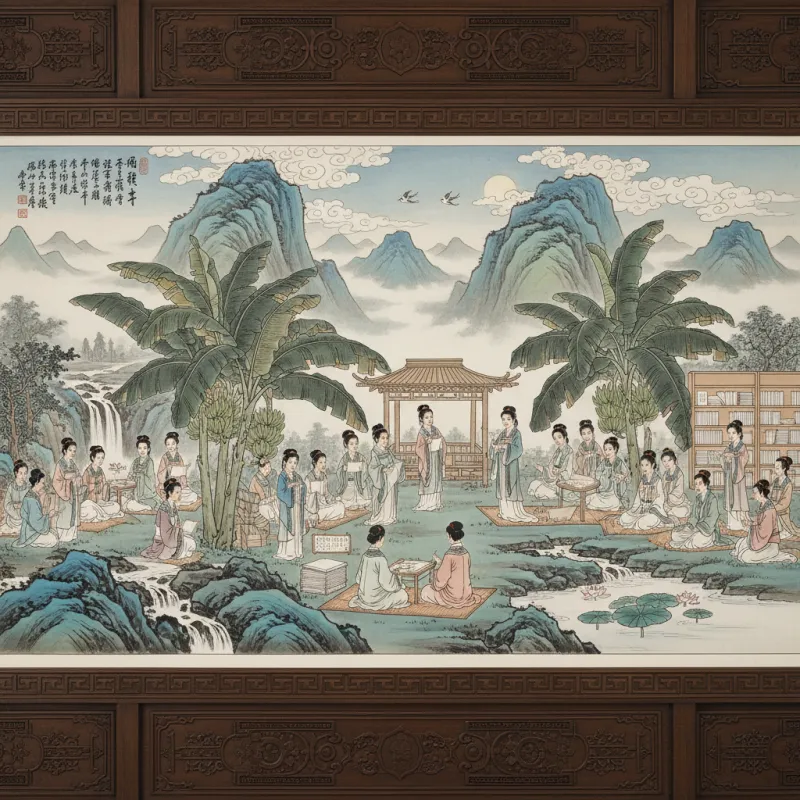
Picture this: Hangzhou, 1664. The Ming dynasty has just fallen. The Manchu conquest has turned the world upside down. Chinese men are being forced to shave their foreheads and wear queues as a sign of submission. Scholars are retreating into private life, nursing their grief and their pride. And in the middle of all this chaos, a woman named Gu Zhiqiong (顾之琼, Gù Zhīqióng) — writing under the pen name Lin Yining (林以宁, Lín Yǐníng) — does something audacious: she invites a group of women to her home, plants banana trees in her garden, and declares it the headquarters of a poetry club. Not a sewing circle. Not a religious gathering. A poetry club. For women. Who would write, critique, publish, and compete exactly like men.
The male literati were not amused.
The Banana Garden Wasn't the First, But It Was the Loudest
Women had been writing poetry in China for centuries. The legendary voices of earlier dynasties — from the Han dynasty's Ban Zhao to the Tang's Xue Tao — proved that women could master the form. Small groups of women poets had gathered before, usually within family compounds or Buddhist convents. But these were private affairs, discreet, easily ignored by the male establishment.
The Banana Garden Poetry Club (蕉园诗社, Jiāoyuán Shīshè) was different. It was organized, ambitious, and unapologetically public. Gu Zhiqiong didn't just want to write poetry with her friends. She wanted to create an institution that would rival the male poetry societies that had dominated Chinese literary culture since the Song dynasty. She wanted anthologies. She wanted recognition. She wanted to prove that women could do everything men could do in the realm of classical Chinese poetry — and maybe do it better.
The club's name itself was a statement. Banana plants (芭蕉, bājiāo) were associated with melancholy and unfulfilled longing in Chinese poetry — the broad leaves made a lonely rustling sound in the rain, a sound that poets had been writing about for centuries. But banana plants were also symbols of resilience. They grew quickly, even in poor soil. They bent in storms but rarely broke. For a group of women poets navigating the aftermath of dynastic collapse, it was the perfect emblem.
The Core Members: Not Your Typical Qing Dynasty Ladies
The Banana Garden's core membership fluctuated, but five women formed its heart: Gu Zhiqiong herself, Zhu Rouze (朱柔则, Zhū Róuzé), Lin Yun (林韵, Lín Yùn), Qian Fenglun (钱凤纶, Qián Fènglún), and Chai Jingyi (柴静仪, Chái Jìngyí). Later, the group expanded to include Gu's younger sister Gu Qiyuan (顾启元, Gù Qǐyuán) and the poet Mao Anqian (毛安倩, Máo Ānqiàn).
These weren't sheltered daughters of minor officials dabbling in poetry to pass the time. Most came from educated merchant or lower gentry families — families wealthy enough to educate their daughters but not prestigious enough to enforce the strictest Confucian restrictions on women's behavior. Several were widows or had experienced failed marriages, which gave them a degree of social freedom that married women lacked. Zhu Rouze, for instance, had been widowed young and returned to her natal family, where she threw herself into poetry with an intensity that shocked her contemporaries.
What united them wasn't just their gender or their talent. It was their timing. They came of age during the Ming-Qing transition, a period of such profound political and social upheaval that old rules seemed suddenly negotiable. If the entire cosmic order could be overturned by Manchu horsemen, why couldn't women write poetry in public?
What They Actually Did: More Than Just Writing Pretty Verses
The Banana Garden poets met regularly at Gu Zhiqiong's home in Hangzhou, which became a kind of literary salon. They set topics for each gathering — often responding to classical themes or current events — and composed poems in various forms: regulated verse (律诗, lǜshī), quatrains (绝句, juéjù), and the more flexible ancient-style poetry (古体诗, gǔtǐshī). They critiqued each other's work with the same rigor that male poets applied in their societies. They kept records of their meetings and their poems.
But here's what made them revolutionary: they published. In 1667, just three years after the club's founding, they produced the "Banana Garden Collection" (蕉园诗集, Jiāoyuán Shījí), an anthology of their work. This wasn't a private manuscript circulated among friends. It was a printed book, available for purchase, with a preface that boldly claimed women's poetry deserved the same respect as men's.
The anthology was a sensation. It sold well. It was reviewed. It was imitated. Within a few years, women's poetry clubs were springing up across the Jiangnan region — the wealthy, cultured area around the Yangtze River delta. The Banana Garden had created a template, and other women were following it.
They also did something that male poetry clubs had been doing for centuries but that women had rarely attempted: they wrote occasional poetry (应制诗, yìngzhìshī) responding to public events. When the Kangxi Emperor made a tour of the south in 1684, several Banana Garden poets composed verses celebrating the occasion. This was a direct claim to participate in public discourse, not just private emotional expression.
The Backlash: When Men Felt Threatened
Not everyone was thrilled. Male literati had mixed reactions to the Banana Garden phenomenon. Some were supportive — the poet and critic Wang Duanshu (汪端淑, Wāng Duānshū), herself a woman, praised the club's work and helped promote it. A few male scholars wrote admiring prefaces for women's poetry collections, positioning themselves as enlightened patrons.
But many men were deeply uncomfortable. The problem wasn't that women were writing poetry — educated men had long accepted that their wives and daughters might compose a few verses. The problem was that these women were organizing, publishing, and claiming authority. They were acting like scholars. They were creating institutions. They were competing.
Critics deployed several strategies to contain the threat. Some praised the Banana Garden poets but insisted their work was valuable precisely because it was "feminine" — delicate, emotional, focused on domestic themes. This was a way of ghettoizing women's poetry, keeping it in a separate, lesser category. Others acknowledged the poets' technical skill but suggested that such public activity was unseemly for respectable women. A few simply ignored the phenomenon, refusing to mention women poets in their literary histories and anthologies.
The most revealing criticism came from those who accused the Banana Garden poets of imitating men. This was meant as an insult — the suggestion being that women who wrote like scholars were abandoning their proper feminine nature. But it was also an admission: these women were writing at a level that couldn't be dismissed as amateur dabbling. They had mastered the forms, the allusions, the techniques that defined classical Chinese poetry. The only way to diminish their achievement was to claim they were being unfeminine.
The Legacy: How the Banana Garden Changed Chinese Literature
The Banana Garden Poetry Club lasted only about a decade in its original form. Members married, moved away, or died. Gu Zhiqiong herself seems to have withdrawn from active leadership by the mid-1670s. But the club's influence extended far beyond its brief existence.
First, it created a model. Women's poetry clubs proliferated in the late 17th and 18th centuries, especially in the Jiangnan region. Some were short-lived; others lasted for generations. The tradition of women organizing their own literary spaces became an established part of Qing dynasty culture, even if it remained controversial.
Second, it changed publishing. Before the Banana Garden, women's poetry was usually published posthumously by male relatives, often with apologetic prefaces explaining that the woman had written only in her spare time and never sought recognition. After the Banana Garden, women poets increasingly published during their lifetimes, sometimes with their own prefaces asserting their right to literary recognition.
Third, it shifted the terms of debate. The question was no longer whether women could write good poetry — the Banana Garden poets had proved they could. The question became whether women should write poetry publicly, whether they should organize, whether they should claim authority. This was a more advanced conversation, and it opened space for more radical arguments about women's capabilities and rights.
The Qing dynasty would eventually produce thousands of women poets, far more than any previous dynasty. Many of them traced their inspiration back to the Banana Garden. When the 18th-century poet Yuan Mei (袁枚, Yuán Méi) took on female students and championed women's poetry, he was building on a foundation that Gu Zhiqiong and her friends had laid.
Why the Banana Garden Still Matters
Here's what strikes me about the Banana Garden poets: they didn't ask for permission. They didn't wait for enlightened men to invite them into literary culture. They didn't apologize or hedge or present themselves as exceptions. They just did it — gathered, wrote, critiqued, published, and claimed their place in the tradition.
This was radical in 1664, and it's still instructive now. The Banana Garden poets understood something that many later feminists would rediscover: you don't change a system by politely requesting inclusion. You change it by building your own institutions, creating your own networks, and producing work so good that it can't be ignored.
Were they perfect? No. They came from privileged backgrounds. Their poetry, while technically accomplished, often stayed within conventional themes and forms. They didn't challenge the fundamental structures of Confucian patriarchy. But they did something crucial: they proved that women could organize, compete, and excel in a domain that men had claimed as exclusively theirs.
The banana plants in Gu Zhiqiong's garden are long gone. But the idea they represented — that women could create their own literary spaces, set their own standards, and demand recognition on their own terms — that idea took root. It grew. It spread. And it changed Chinese literature forever.
Related Reading
- Zhuo Wenjun: The Woman Who Wrote Her Own Love Story
- Women Poets of China: The Voices That History Almost Silenced
- Ban Zhao: Scholar, Historian, Poet — The Woman Who Finished China's Greatest History
- Rediscovering Women Poets of the Tang, Song, and Yuan Dynasties
- Xin Qiji: The Warrior Poet
- The Art of Nature in Tang, Song, and Yuan Dynasty Poetry: A Literary Exploration
- War Poetry of the Tang Dynasty: Beauty in the Midst of Slaughter
Explore Chinese Culture
- Explore the Tang dynasty's golden age
- Explore Daoist themes in classical poetry
- Explore Chinese literary traditions